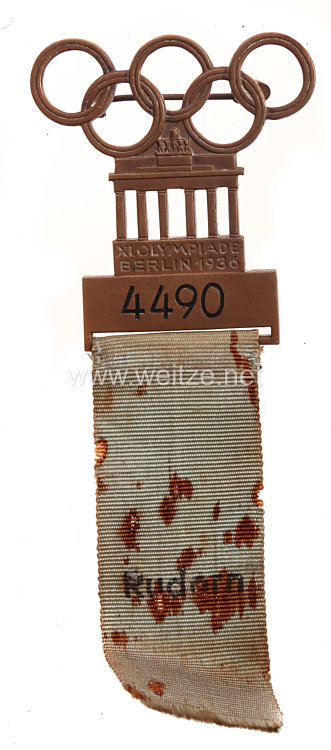
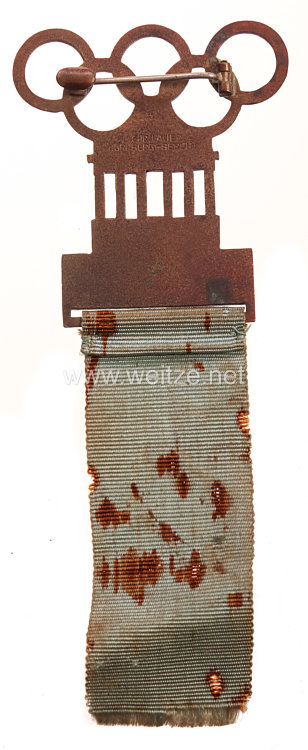
XI. Olympic Games 1936 Berlin - Official Participant Badge for an Athlete in the Rowing Discipline
The official participant badge of the XI Olympic Games 1936 in Berlin represents a significant testament to Olympic history and documents a complex chapter of sports history in the context of Nazi Germany. These badges were issued to all active athletes who participated in the Summer Olympic Games held from August 1-16, 1936.
The XI Olympic Games took place during a period when the National Socialist regime under Adolf Hitler attempted to use the international stage for self-representation. The International Olympic Committee had already chosen Berlin as the host city in 1931, two years before the Nazi seizure of power. Despite international boycott calls, particularly from the United States, the Games proceeded as planned and became the largest and most elaborately organized Olympic Games to date.
This badge was manufactured by the renowned producer L. Chr. Lauer of Nuremberg-Berlin, one of the leading medal and badge manufacturers of that era. The Lauer company had been known since the 19th century for its high-quality metalwork and received numerous official commissions. The badge is made of tombac, a copper-zinc alloy characterized by its gold-like color and good workability.
Each participant badge bore an individual registration number, in this case number 4490, which enabled precise assignment to a specific athlete. This numbering served organizational and control purposes, as the badges functioned as official identification for athletes and granted them access to Olympic facilities.
The light blue ribbon with the inscription “Rudern” (Rowing) identifies the wearer's specific sport discipline. The rowing competitions of the 1936 Olympic Games took place on the specially prepared Grünau Regatta Course in Berlin. The facility was modernized for the Games and provided ideal conditions for the competitions. A total of seven rowing events for men were held, including singles, pairs, fours, and eights in various boat classes.
The rowing competitions were particularly prestigious, as they had a long Olympic tradition and several nations sent strong teams. Particularly noteworthy was the victory of the American eight from the University of Washington, which won gold under difficult conditions. Germany itself achieved several medals in rowing, underscoring the national importance of this sport.
The design of the participant badges followed a uniform concept that combined Olympic symbolism with contemporary design. The organizing committee placed great emphasis on representative execution, as these badges not only fulfilled practical functions but also served as mementos and symbols of Olympic participation.
From a historical perspective, these badges must be viewed ambivalently today. On one hand, they document the athletic achievements of athletes from 49 nations who competed in fair competition. On the other hand, they exist in the context of Nazi propaganda, which instrumentalized the Games for its purposes. The international community controversially discussed participation, but ultimately most nations decided to send their athletes.
The 1936 Olympic Games were also significant because they were comprehensively documented through film and media for the first time. Leni Riefenstahl's film “Olympia” set new standards in sports film production. The technical and organizational execution of the Games was at the highest level, which found international recognition.
For collectors and historians, these participant badges are important primary sources today. They enable the reconstruction of participant lists and offer insights into the organization and execution of the Games. The registration numbers can partially be cross-referenced with historical documents and participant lists, allowing individual athlete biographies to be traced.
The condition of this badge with its original ribbon is remarkable, as many of these pieces were lost or damaged over the decades. The slight stains on the ribbon testify to the authentic use and age of the object, but do not diminish its historical significance.
In summary, this participant badge represents a significant chapter of Olympic and German history that is of great relevance both in sports history and contemporary history, requiring careful, context-related consideration.