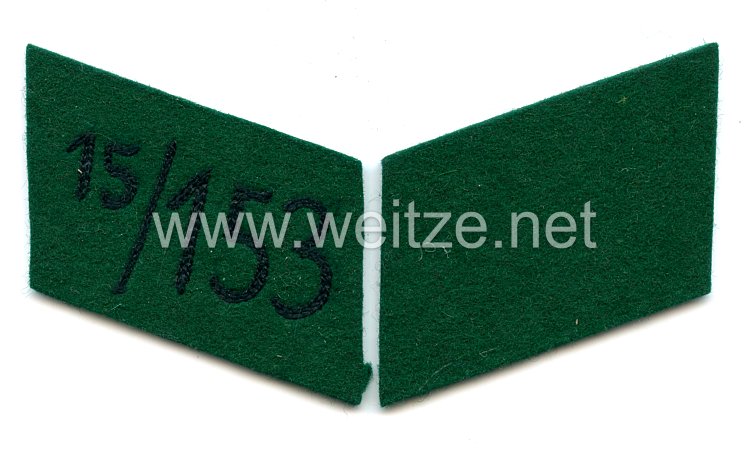
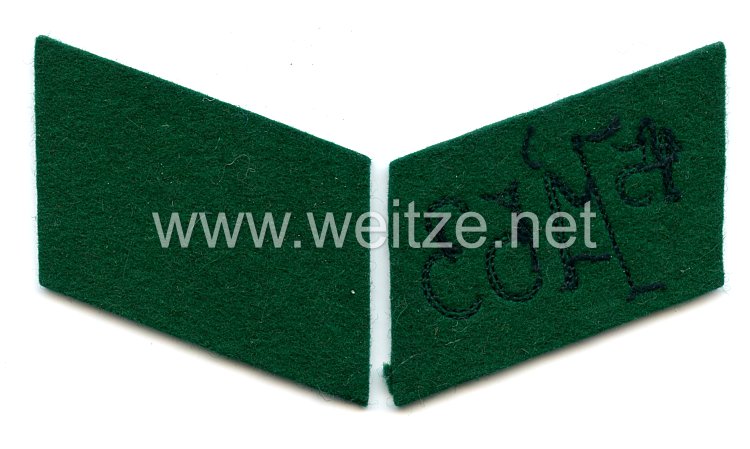
SA Pair of Collar Tabs for Enlisted Men SA-Gruppe Kurpfalz Sturm 15 of Standarte 153

Freudenstadt - Mannheim, circa 1933, steel green, from an old tailor’s stock, unworn, condition 2
364323
90,00

SA Pair of Collar Tabs for Enlisted Men SA-Gruppe Kurpfalz Sturm 15 of Standarte 153

These SA collar patches for enlisted men represent an authentic example of the uniform insignia of the Sturmabteilung (SA) from the early phase of the Nazi regime. These collar patches belonged to SA-Gruppe Kurpfalz, specifically Sturm 15 of Standarte 153, and date from around 1933, the year of the Nazi seizure of power.

The SA was originally founded in 1920/21 as the paramilitary combat organization of the NSDAP. Under the leadership of Ernst Röhm, it developed into a mass organization with millions of members. The characteristic brown uniform of the SA, supplemented by various rank insignia and unit badges, became one of the most visible symbols of the Nazi movement.

The SA-Gruppe Kurpfalz was one of the regional subdivisions of the SA and encompassed the geographical area of the historical Palatinate, with Mannheim as an important center. The organization of the SA followed a military model: the smallest unit was the Trupp (squad), several squads formed a Sturm (storm troop), several storm troops formed a Standarte (regiment), and several regiments were combined into a Gruppe (group).

The collar patches described here in steel green are particularly noteworthy, as this color was used for certain units or purposes within the SA. Regular SA units typically wore various collar patch colors that indicated their affiliation with specific regiments or functions. The coloring and design of the collar patches followed strict regulations laid down in SA uniform regulations.

The fact that these collar patches originate from an old tailor's stock and are unworn gives them special documentary value. They testify to the extensive uniform production of that time and the infrastructure necessary to equip the rapidly growing SA membership. After the seizure of power in 1933, the SA expanded considerably, leading to an enormous demand for uniform parts.

Standarte 153 was part of the complex organizational structure of the SA. Each Standarte comprised several hundred to a thousand men and was divided into various storm troops. Sturm 15 was one of these subunits, typically consisting of about 70 to 120 men. Assignment to specific storm troops often followed geographical considerations within the location.

The year 1933 marks a decisive turning point in the history of the SA. After Hitler's appointment as Reich Chancellor on January 30, 1933, the SA experienced a massive influx of members. It played a central role in intimidating political opponents and enforcing Nazi rule. SA men were instrumental in the persecution of communists, social democrats, and other opponents of the regime.

The Freudenstadt-Mannheim region, from which these collar patches originate, was an important area for SA activities. Mannheim, as an industrial city, had a strong labor movement, making the city a focal point of political conflicts. The SA was particularly active here in suppressing the opposition.

The uniform and its components, including the collar patches, served not only for identification but also for creating esprit de corps and demonstrating power and unity. The uniform clothing was intended to level social differences and create a sense of camaraderie, while simultaneously demonstrating strength and determination to the outside world.

After the Röhm Purge in June 1934, during which the SA leadership was largely murdered, the organization lost considerable significance. The SS increasingly took over its functions, and the SA was degraded to a largely insignificant organization. Nevertheless, it formally remained in existence until the end of World War II.

Today, such SA uniform parts are important historical documents that provide insight into the organization, structure, and visual culture of the Nazi movement. They serve historical research and education and help understand the mechanisms of totalitarian rule. The unworn condition of these collar patches makes them particularly valuable study objects, as they have preserved their original manufacturing state.

r