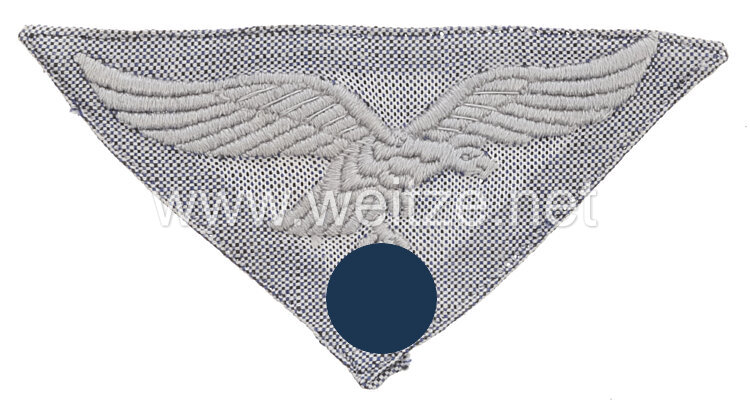
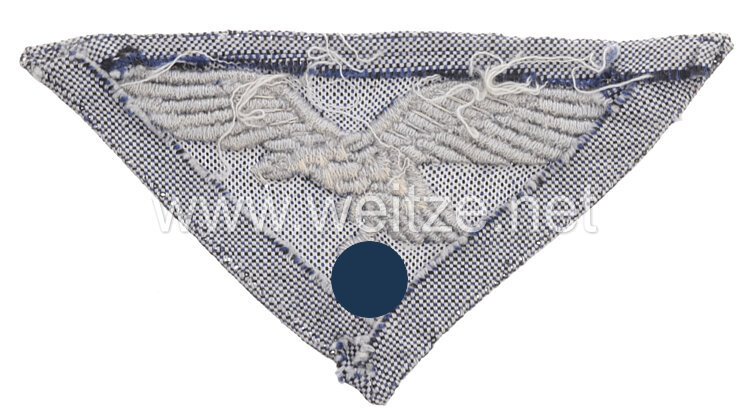
Luftwaffe Breast Eagle for Enlisted Men for the Blue Tropical Service Shirt

Machine-embroidered version on blue heather fabric, worn condition, Condition 2.
463823
450,00

Luftwaffe Breast Eagle for Enlisted Men for the Blue Tropical Service Shirt

The Luftwaffe breast eagle for enlisted personnel represents a characteristic insignia of the German Air Force during World War II. This particular example was manufactured for the blue tropical service shirt and displays the machine-embroidered version on blue mottled fabric, typical of uniforms used in North African and Mediterranean theaters of operation.

Tropical uniforms of the Luftwaffe were introduced from 1940 onwards, as German forces were increasingly deployed in climatically challenging regions. Following initial experiences in the Mediterranean and preparations for the German Afrika Korps, Wehrmacht leadership recognized the necessity for specialized clothing suited to hot climates. The Luftwaffe accordingly developed its own tropical service shirts in a characteristic blue shade, distinctly different from the Army's olive-green tropical shirt.

The blue service shirt was manufactured from lightweight, breathable material and was intended for service in North Africa as well as southern European regions such as Italy, Greece, and the Balkans. The blue coloring corresponded to the traditional service color of the Luftwaffe and was meant to maintain identification with the air force even in tropical regions.

The breast eagle itself followed the design guidelines of the Luftwaffe as established in uniform regulations. The national emblem displayed a stylized eagle with outstretched wings, clutching a swastika in its talons. For enlisted men and non-commissioned officers without sword knot, the design was simpler than that for officers. The machine-embroidered variant was the standard version for enlisted ranks and was produced in large quantities.

The machine embroidery was typically executed with light blue or white thread on the blue mottled base fabric. This mottling served to optically adapt the wearer to the color tones of the operational environment. Production was carried out by civilian suppliers in the clothing industry who worked according to precise specifications from the Luftwaffe administration.

The wearing of the breast eagle on the service shirt was precisely regulated. It was attached to the right breast side, with the exact position specified by Army clothing regulations (HBV) and corresponding Luftwaffe directives. The insignia had to be firmly sewn on and could not be loose or improperly attached, as this was considered a violation of uniform regulations.

The operational context of these tropical shirts extended across various theaters of war. Luftwaffe personnel in North Africa, whether at airfield units, anti-aircraft formations, or ground personnel of fighter and bomber wings, wore this uniform in daily service. The blue tropical shirt was also used on the Greek islands, in Sicily and southern Italy, and later in the Balkans.

Material shortages toward the end of the war led to quality deterioration in production. While early examples were manufactured from high-quality fabrics, substitute materials had to be increasingly used from 1943/44 onwards. Embroidery quality also varied depending on the time of manufacture and the producing company.

From a collector's historical perspective, worn examples like the one described are of particular interest, as they exhibit authentic traces of use and thus document actual employment. The indicated condition 2 suggests a well-preserved piece with normal signs of aging and wear, but without serious damage.

The historical significance of such uniform pieces lies in their function as period documents. They illustrate not only the organizational structure and hierarchy of the Luftwaffe, but also the logistical challenges of uniform supply in different climate zones. Simultaneously, as relics of a criminal regime, they serve as reminders for critical engagement with German military history of the 20th century.

Today, such items are studied by military historians and collectors as material evidence of wartime equipment and supply systems. They provide tangible connections to the experiences of individuals who served in these far-flung theaters of operation, while requiring careful contextualization within the broader historical framework of World War II and Nazi Germany's aggressive warfare.