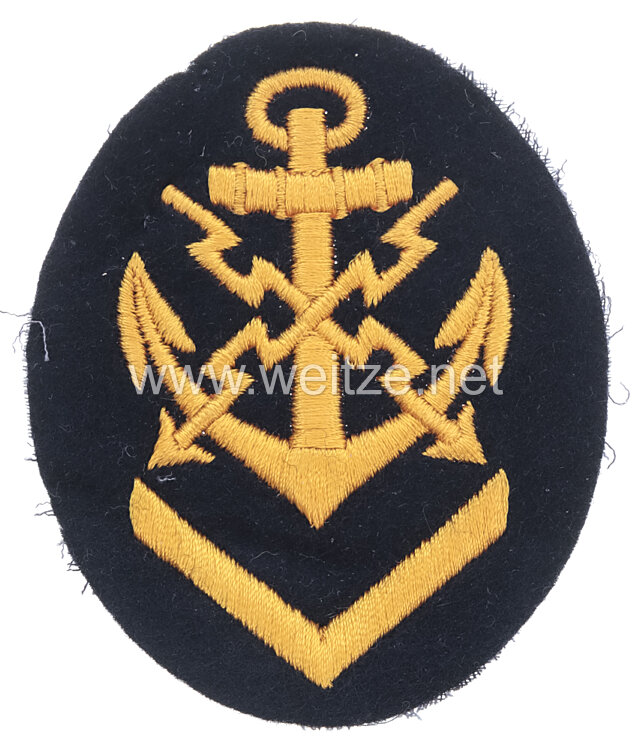
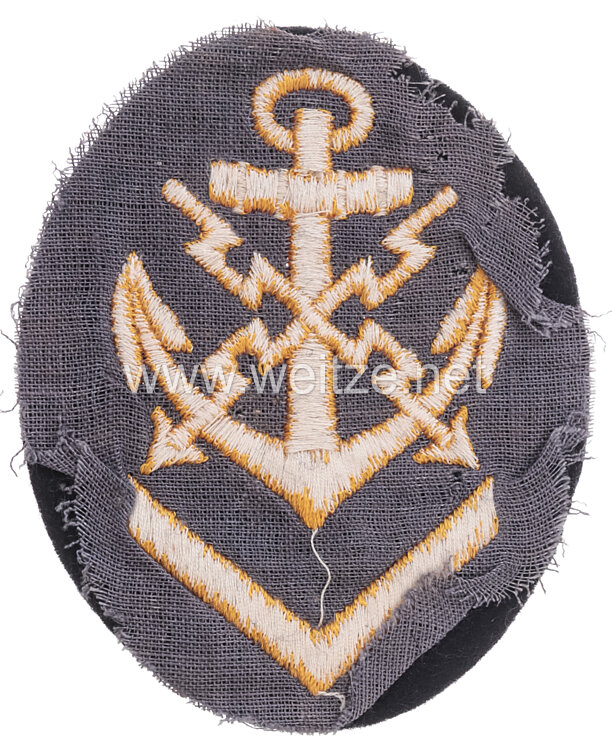
Kriegsmarine Sleeve Insignia Career Path Oberfunkmaat

For the blue blouse, condition 2.
466223
15,00

Kriegsmarine Sleeve Insignia Career Path Oberfunkmaat

The Kriegsmarine sleeve insignia for Oberfunkmaat (Senior Radio Petty Officer) represents an important element of the rank identification system of the German Navy during World War II. These special badges served the visual identification of rank and career path within the complex hierarchy of German naval forces between 1935 and 1945.

The Kriegsmarine was officially established on June 1, 1935, as the successor to the Reichsmarine, representing a deliberate break from the restrictions of the Treaty of Versailles. With the expansion of the navy under Grand Admiral Erich Raeder and later Karl Dönitz, a comprehensive system of rank insignia and career path identifiers was developed that integrated both traditional naval elements and National Socialist symbolism.

The Oberfunkmaat belonged to the career group of radio operators, a technical specialization that was crucial for naval warfare. The rank of Oberfunkmaat corresponded to the middle non-commissioned officer level and was hierarchically positioned between Funkmaat (Radio Petty Officer) and Oberfunkmeister (Senior Radio Warrant Officer). This position required comprehensive technical knowledge in radio transmission, Morse code communication, and the operation of complex radio equipment.

The career sleeve insignia were worn on the blue blouse, which was part of the Kriegsmarine's service uniform. These badges were typically attached to the left upper arm and indicated the respective career path through their specific design. For radio personnel, these were characteristic symbols that made the wearer's technical specialization immediately recognizable.

The insignia was worn according to the uniform regulations for the Kriegsmarine, which were detailed in various service regulations. The M.Dv. Nr. 53 (Marine Service Regulation) precisely regulated the manner of wearing, position, and combination of various rank insignia and career identifiers. The blue blouse on which this insignia was worn was part of the shipboard uniform and was worn during daily service aboard warships.

The production of such insignia was carried out by various authorized manufacturers who had to maintain strict quality standards. The insignia were typically manufactured as embroidered or woven versions, with quality and workmanship varying depending on the production period and manufacturer. During the war years, simplifications in production increasingly occurred due to material shortages.

The radio operator career path itself held special significance in the Kriegsmarine. Radio personnel were responsible for all communication between ships, submarines, and shore stations. Particularly in submarine warfare, radio operators played a decisive role, as the coordination of wolf pack tactics depended entirely on reliable radio communication. Training to become a Funkmaat took place in specialized naval schools and included both theoretical and practical components.

After the end of World War II and Germany's unconditional surrender on May 8, 1945, the Kriegsmarine was dissolved. Allied control authorities prohibited the wearing of all military insignia of the Third Reich. Many of these items were destroyed in the post-war period, making surviving examples historical documents today.

From today's perspective, such sleeve insignia are important sources for military historical research. They document the organizational structure of the Kriegsmarine, technical specializations, and the complex rank system. Collectors and museums preserve these objects as part of historical heritage, always emphasizing the context of their origin and use within the framework of the National Socialist war machine.

The scholarly examination of such military equipment serves to understand the structure and functioning of German armed forces in World War II and contributes to the historical reappraisal of this era.