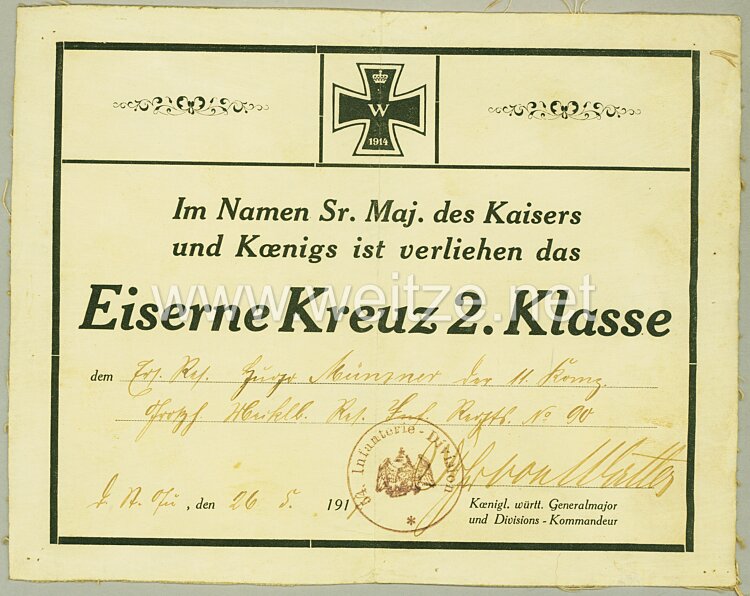
World War I - Original Signature of Pour le Mérite with Oak Leaves Recipient Lieutenant General Freiherr Oskar von Watter

on an award certificate for the Iron Cross 2nd Class, issued to a replacement reservist of the 11th Company, Grand Ducal Mecklenburg Reserve Infantry Regiment No. 90, dated May 26, 1917, with a very fine ink signature “Frhr von Watter” as Royal Württemberg Major General and Division Commander of the 54th Infantry Division; folded and backed with cloth.

http://de.wikipedia.org/wiki/Oskar_von_Watter
252423
150,00

World War I - Original Signature of Pour le Mérite with Oak Leaves Recipient Lieutenant General Freiherr Oskar von Watter

Generalleutnant Freiherr Oskar von Watter and the Award Certificate for the Iron Cross 2nd Class from World War I

This award certificate for the Iron Cross 2nd Class from 1917 bears the signature of one of the most distinguished German military commanders of World War I: Generalmajor Freiherr Oskar von Watter, who at that time commanded the 54th Infantry Division in the Royal Württemberg service.

Oskar von Watter was born on September 24, 1861, in Trier and came from a family with a long military tradition. His military career began in the Prussian Army, where he rapidly advanced through professional competence and tactical skill. During World War I, von Watter proved himself as one of the most capable division commanders in the German Army. His outstanding achievements were recognized on October 11, 1917, with the award of the Pour le Mérite, Prussia's highest military decoration. On June 6, 1918, he additionally received the Oak Leaves to the Pour le Mérite, an honor bestowed upon only 122 officers during the entire war and testifying to extraordinary leadership qualities.

The 54th Infantry Division, which von Watter commanded in 1917, was a Württemberg formation deployed to several important front sectors. The division fought on both the Western Front and temporarily on the Eastern Front, participating in significant operations. As division commander, von Watter was responsible for thousands of soldiers and held the authority to award decorations and honors.

The Iron Cross 2nd Class was the most frequently awarded decoration for bravery in the German Empire during World War I. It was instituted by King Frederick William III of Prussia in 1813 during the Wars of Liberation and renewed in 1870 and 1914. The award was given for proven bravery before the enemy or outstanding military merit. An estimated 5 million Iron Crosses 2nd Class were awarded during World War I, illustrating the intensity and scope of the conflict.

The recipient named in this certificate belonged to the 11th Company of the Grand Ducal Mecklenburg Reserve Infantry Regiment No. 90. This regiment was part of the Mecklenburg contingents within the Prussian Army. Reserve regiments were formed from reservists at the outbreak of war and played a crucial role in the massive expansion of German armed forces from 1914 to 1918. An “Ersatz-Reservist” (replacement reservist) was a soldier sent to the front as a replacement for fallen, wounded, or otherwise incapacitated soldiers.

The issuance of the certificate on May 26, 1917, falls during a phase of the war characterized by intense fighting on the Western Front. In spring 1917, the Allies conducted several major offensives, including the costly Nivelle Offensive and the Battle of Arras. The German Army had withdrawn to the fortified Siegfried Position (called the Hindenburg Line by the Allies) and defended this position against sustained attacks.

The formal design of such award certificates followed strict military regulations. They typically contained the recipient's name and unit, the date of the award, the justification (often in general terms), and the signature of the awarding commander. Von Watter's signature as “Royal Württemberg Major General and Division Commander” confirms his position within the Württemberg military hierarchy, although he originally came from Prussia.

The physical condition of the certificate – folded and backed with fabric – is typical of documents kept by soldiers at the front. Soldiers often carried their most important papers in special pockets, and the textile reinforcement provided protection against moisture and damage under the harsh conditions of trench warfare.

After the war, von Watter played a controversial role during the revolutionary unrest of 1919-1920. He was appointed commander of Military District V and was involved in the military suppression of the Munich Soviet Republic. His military career ended with his retirement in 1920. He died on September 4, 1934, in Bad Reichenhall.

Such signed award certificates possess considerable historical and collectible value today, especially when signed by highly decorated officers like von Watter. They document not only individual bravery but also the complex military organization of the Empire and the hierarchies through which recognition and honor were bestowed. The combination of the common soldier's personal history and the signature of a later Pour le Mérite recipient makes such documents significant historical testimonies of World War I.