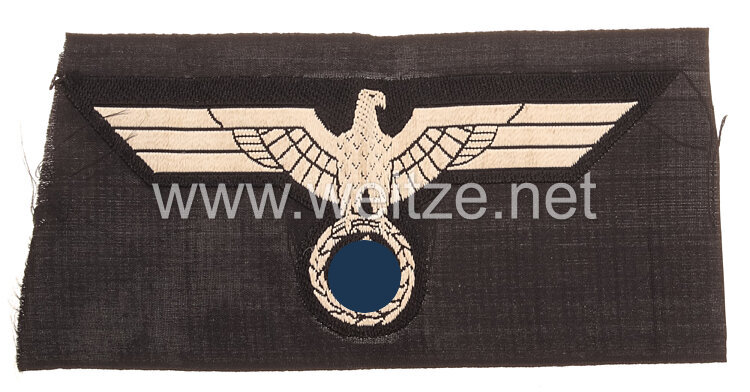
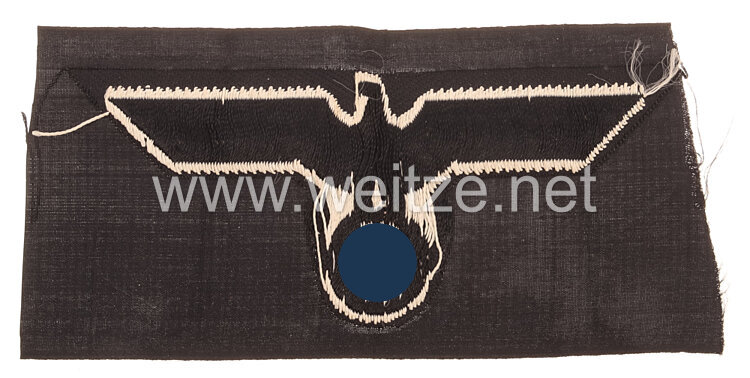
Wehrmacht Heer Breast Eagle for Enlisted Men Panzer Troops
The Wehrmacht Heer breast eagle for enlisted men of the Panzer troops represents a characteristic insignia of the German armored forces during World War II. This particular example displays the Bevo-woven execution featuring a white eagle on black background, typical for the Wehrmacht's Panzer troops.
The Army Clothing Regulations (Heeresbekleidungsvorschrift - HBV) established precise specifications for all uniform insignia from 1935 onwards. The breast eagle, also referred to as the national emblem (Hoheitsadler), was worn above the right breast pocket of the field tunic and symbolized the soldier's national allegiance. Different color combinations existed for the various branches of the Wehrmacht, with the Panzer troops characterized by their distinctive black branch color.
The Bevo weaving technique, named after the Barmen Vereinigte Orts-Krankenkasse Bandweberei (Barmen United Local Health Insurance Ribbon Weaving), revolutionized the production of textile insignia. This machine-weaving technique enabled mass production of detailed insignia with high quality and durability. Unlike embroidered versions, Bevo-woven insignia were more cost-effective to produce and displayed more uniform quality. The weaving threads formed the motif directly during the weaving process, resulting in a flat, precise appearance.
The German Panzer force developed after World War I under strictest secrecy, as the Treaty of Versailles prohibited Germany from developing tanks. Only after 1933 did open construction of the armored force begin. Colonel General Heinz Guderian, often called the “Father of the Panzer Troops,” developed the tactical concepts of armored warfare that focused on rapid, concentrated attacks with mechanized units.
The black uniform of the Panzer troops, introduced from 1934, differed significantly from the field-gray standard uniform of the army. This special uniform considered the particular requirements of tank service: the black color was intended to make oil stains and dirt less visible. The characteristic Panzer jacket was cut shorter than the normal field tunic to avoid hindrance during confined work inside the tank.
Specific clothing regulations applied to enlisted ranks, which included soldiers from Panzer gunner to senior private (Obergefreiter). The white eagle on black background was worn on both dress and field uniforms. Positioning followed precise regulations: centered above the right breast pocket with specified distance to the pocket flap and shoulder seam.
The production of uniform effects was subject to strict controls during the war. Various manufacturers produced according to uniform specifications, though quality varied as the war progressed. Towards the end of the war, material shortages and overloaded production capacities led to simplified versions and lower processing quality.
The collecting and preservation of such historical militaria today serves historical documentation and research. Unworn examples in good condition, such as the described piece in condition 2, are of particular documentary value as they authentically convey the original manufacturing quality and materiality. They enable insights into textile manufacturing techniques, material usage, and quality standards of the period.
Academic engagement with such objects always requires critical contextualization. They are testimonies of a criminal dictatorship and a war of aggression that cost millions of lives. Their preservation in collections and museums serves exclusively historical education and research, not glorification.