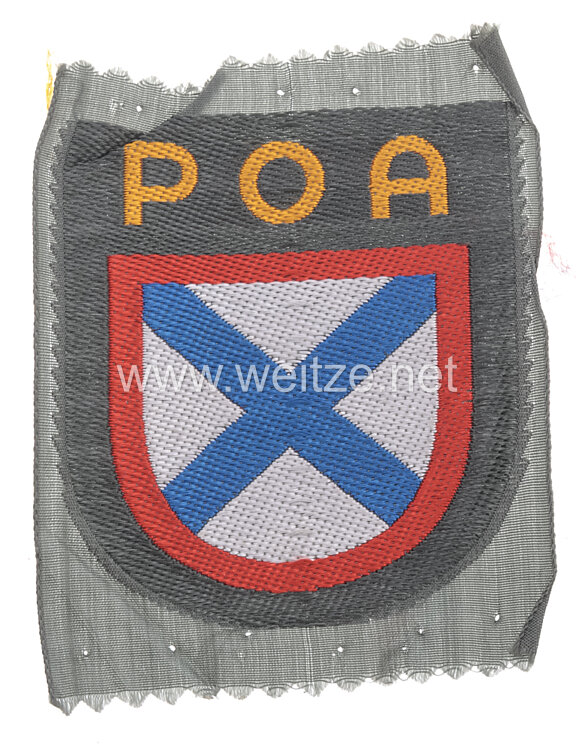
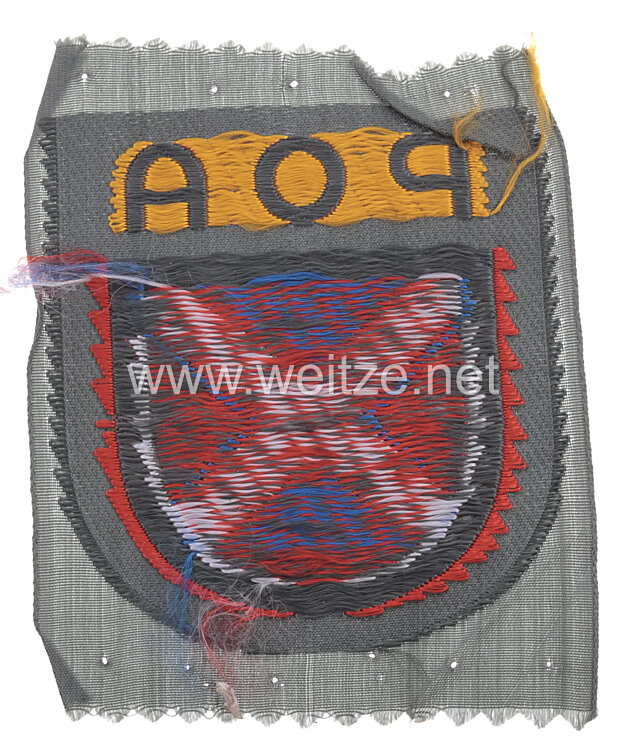
Wehrmacht Heer Sleeve Shield of the Russian Liberation Army POA

BeVo woven construction. Unissued condition, grade 2+

The Russian Liberation Army (Русская освободительная армия – РОА, Russkaja oswoboditel'naja armija – ROA), also known as the Vlasov Army after its first commander, was a Russian volunteer formation that fought on the German side in World War II. Its formation was authorized by Adolf Hitler in late 1944, while volunteers from non-Russian peoples of the Soviet Union had already been organized in the Eastern Legions three years earlier.

The ROA was organized by former Red Army Lieutenant General Andrei Vlasov, who sought to unite all Russians in the fight against the Soviet Union. Among the volunteers were prisoners of war, forced laborers, and Russian émigrés. The ROA received the status of an allied state's army and was subordinated to the Wehrmacht in operational matters.
463622
150,00

Wehrmacht Heer Sleeve Shield of the Russian Liberation Army POA

The sleeve shield of the Russian Liberation Army (ROA) represents a significant artifact from one of the most controversial military formations of World War II. This insignia, manufactured using the Bevo weaving technique, was worn by members of Russian volunteer units who fought on the German side against the Soviet Union.

The Russian Liberation Army (Russian: Русская освободительная армия – РОА) was officially established only in late 1944 by order of Adolf Hitler, although Russian volunteer formations had been serving in various capacities since 1941. The delay in official recognition resulted from National Socialist ideology, which regarded Slavs as “subhumans” and long rejected equal cooperation.

Command of the ROA was assumed by Lieutenant General Andrei Andreyevich Vlasov, a former high-ranking officer of the Red Army. Vlasov had distinguished himself during the Battle of Moscow in 1941 and was considered one of the most capable Soviet commanders. After his capture in July 1942 during the Volkhov Battle, he decided to collaborate with Germany. His motives were complex: personal bitterness toward Stalin, ideological opposition to Communism, and the belief that only through cooperation with Germany could a free Russia be created.

The sleeve shield typically displayed the colors of the Russian tricolor – white, blue, and red – and frequently bore the letters “РОА” or other Russian national symbols. This symbolism was intended to emphasize the claim of fighting for a liberated Russia rather than for Nazi Germany. The Bevo weaving technique, named after the Barmen Ribbon Weaving Mill Ewald Vorsteher, was the standard method for high-quality Wehrmacht insignia and was characterized by fine detail accuracy and durability.

The composition of the ROA was heterogeneous. It included Soviet prisoners of war seeking to escape the catastrophic conditions of German camps, Ostarbeiter (forced laborers from the Soviet Union), Russian emigrants from the post-1917 period, and ideologically motivated opponents of the Stalin regime. The exact number of members is disputed, but estimates range from approximately 50,000 to 130,000 men serving in various formations.

Legally, the ROA received the status of an army of an allied state, but was subordinated to the Wehrmacht in operational matters. On November 14, 1944, the Prague Manifesto was published, defining the political goals of the movement: the elimination of the Stalin regime, peace with Germany, and the creation of a new, non-communist Russia. However, this declaration came too late to have any military or political significance.

The most important military operations of the ROA took place only in the final months of the war. The 1st Division of the ROA under General Sergei Bunyachenko was stationed on the Oder in April 1945. The most famous action, however, was participation in the Prague Uprising in May 1945, when parts of the ROA turned against their German allies and attempted to gain pardon from the Western Allies by supporting the Czech insurgents.

After the war's end, most ROA members were handed over to the Soviet Union in accordance with the Yalta Agreements. General Vlasov was captured by the Red Army in May 1945, sentenced to death, and executed on August 1, 1946. Thousands of his soldiers were executed or deported to Gulag camps. The repatriations, particularly those carried out by British and American troops, later became known as “Operation Keelhaul” and remain a controversial chapter of postwar history.

The ROA sleeve shield is today a rare collector's item documenting the tragic history of Russian collaborators. These men found themselves caught between two totalitarian systems and had to make impossible choices. While they were universally branded as traitors in the Soviet Union, their story is in reality far more complex and reveals the human dimensions of an ideological world war. The historical assessment of the ROA remains controversial: Were they freedom fighters against Stalin or collaborators with National Socialism? This question continues to occupy historians today.