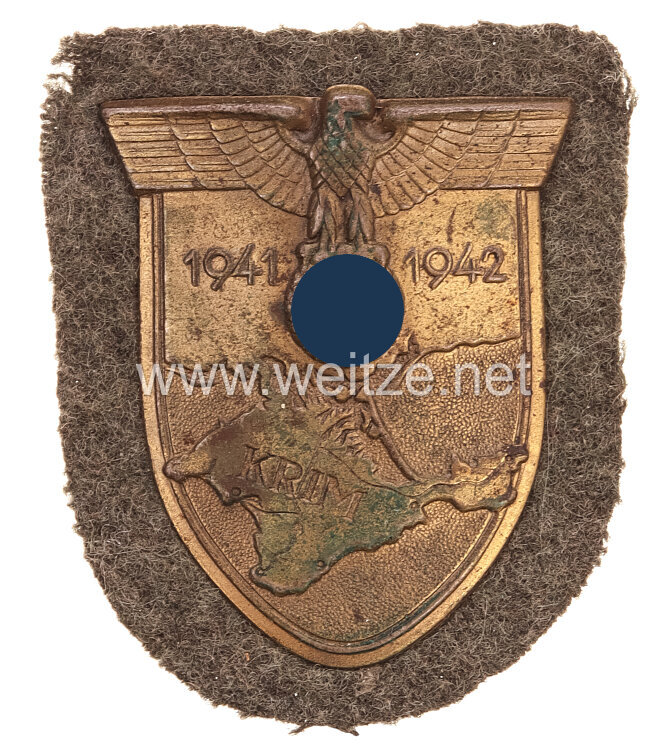
Crimea Shield 1941 - 1942
The Crimea Shield (Krimschild) ranks among the most significant campaign awards of the German Wehrmacht during World War II. It was instituted on July 25, 1942 by Adolf Hitler to recognize participation in the successful conquest of the Crimean Peninsula between September 1941 and July 1942. This military operation, which culminated in the capture of the heavily fortified city of Sevastopol, was considered one of the Wehrmacht's most important strategic successes on the Eastern Front.
The award criteria were clearly defined: All members of the Wehrmacht and Waffen-SS who had fought in Crimea for at least three months from September 21, 1941 to July 4, 1942, or who had been evacuated due to wounds, were eligible for the Crimea Shield. Soldiers who participated in the battles for Sevastopol from September 24, 1941 to June 2, 1942 were also decorated, regardless of the duration of their deployment.
The present specimen displays the typical construction of the Crimea Shield: A bronzed iron shield featuring the characteristic depiction of a map of Crimea, superimposed by an eagle with outstretched wings holding a swastika in its talons. Above the map is the inscription “KRIM”, below it the years “1941-1942”. The bronzed iron version was the most common variant, although the shield was also manufactured in other materials.
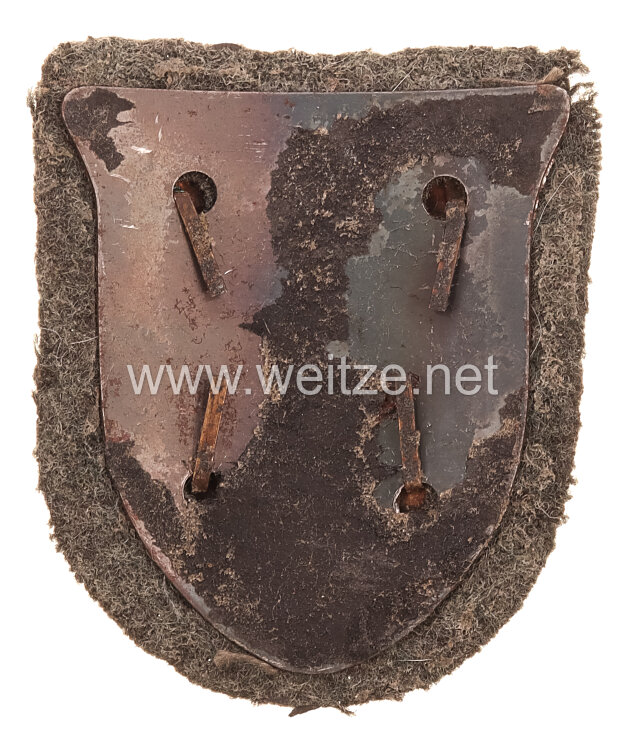
The field-gray cloth backing and the back plate are typical features of worn examples of this award. The shield was worn on the upper left sleeve of the uniform, with the cloth backing serving to protect the uniform fabric while providing more stable attachment. The absence of paper covering indicates an actually awarded and worn piece, as the paper wrapping was typically only present during issue and later removed.
The manufacture was carried out by various producers, leading to variations in execution quality and details. Most manufacturers used a metal or cardboard back plate to which the pin for attachment was affixed. The bronzed surface was created through chemical treatment or lacquering, with quality varying depending on the time of manufacture and material shortages.
The historical context of the Crimean campaign is of great military-historical significance. The operation began in September 1941 as part of the German advance into southern Russia. The 11th Army under Field Marshal Erich von Manstein led the offensive against Soviet defenders. The fighting was extraordinarily fierce and costly, particularly the siege of Sevastopol, which lasted for months and ended only on July 4, 1942 with the conquest of the fortress.
Approximately 250,000 Crimea Shields were awarded in total, reflecting the scale of German and allied forces deployed. The award was made upon presentation of appropriate documentation by the responsible command authorities. Each recipient received an award certificate documenting their entitlement to wear the shield.
The Crimea Shield belongs to a series of sleeve insignia instituted for specific campaigns. Comparable awards included the Afrika Korps cuff band, the “Crete” cuff band, and the Narvik Shield. This tradition of campaign-specific awards had predecessors in German military history, such as during World War I.
From a collector-historical perspective, worn examples with original backing are particularly interesting as they document the authentic state of use. The indicated condition 2- (good to very good) corresponds to a piece with normal wear but without significant damage. Such specimens bear witness to the actual wearers and their fate during one of history's bloodiest conflicts.
The scholarly examination of such military-historical objects serves historical documentation and research. It enables insights into award practices, manufacturing techniques, and the material culture of World War II. At the same time, these objects serve as reminders of the devastating consequences of war and the suffering of all involved.