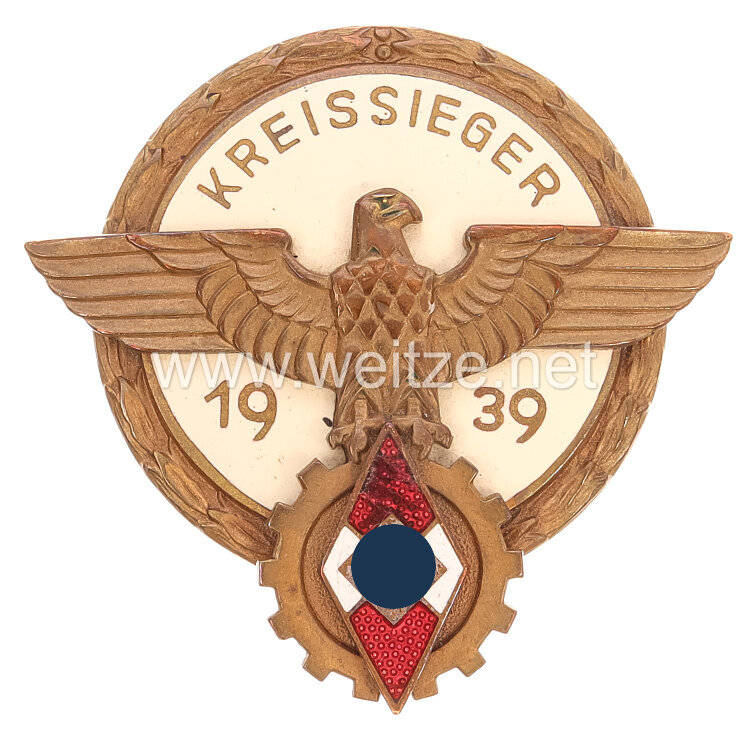
District Winner in the Reich Vocational Competition 1939
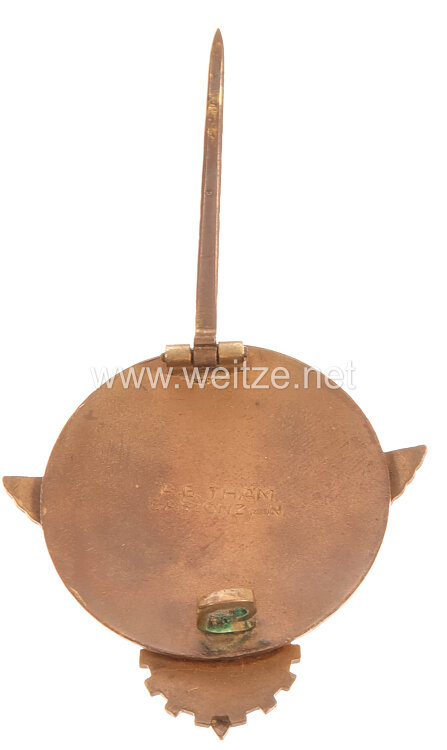
The present award badge bears the inscription “Kreissieger im Reichsberufswettkampf 1939” (District Winner in the Reich Vocational Competition 1939) and represents a fascinating testimony to National Socialist youth and labor policy in the final months of peace before the outbreak of World War II. Manufactured from non-ferrous metal with partial enameling, this badge was produced by the company A.G. Tham in Gablonz, an important center of the jewelry and costume jewelry industry in the former Sudetenland.
The Reichsberufswettkampf (Reich Vocational Competition) was established in 1934 by the German Labor Front (Deutsche Arbeitsfront, DAF) and formed a central component of National Socialist performance ideology. These annual competitions aimed to promote the professional competence of German youth while simultaneously serving as an instrument of political indoctrination. The Reich Vocational Competition was primarily directed at young workers, apprentices, and employees between the ages of 14 and 21, encompassing both theoretical and practical examinations in various professional fields.
The organization of the competition followed a hierarchical structure on several levels: First, factory competitions took place, followed by local competitions, then district competitions, regional competitions, and finally the Reich competition at the national level. The present badge honors a district winner (Kreissieger), meaning a participant who had achieved the best performance in his respective professional category at the district level. This was a considerable achievement that identified the wearer as particularly qualified within his region.
The year 1939 holds particular historical significance. In March 1939, the German Reich had occupied the “remainder of Czechoslovakia” and established the Protectorate of Bohemia and Moravia. During the summer of 1939, the international crisis over Poland escalated dramatically. The Reich Vocational Competition of 1939 took place during a period when Germany was already heading toward war, which began on September 1, 1939, with the invasion of Poland. The awards were presumably conferred during the summer months of 1939, possibly before the outbreak of war or during the first weeks of conflict.
The manufacturing company A.G. Tham was based in Gablonz an der Neiße (today Jablonec nad Nisou in the Czech Republic), a traditional center of the glass jewelry and costume jewelry industry. After the annexation of the Sudetenland to the German Reich in October 1938 following the Munich Agreement, the factories there were integrated into the production of orders, decorations, and badges for the Reich. The Tham company was among the numerous manufacturers that worked for state agencies and produced awards in large quantities.
The craftsmanship of such badges varied depending on the hierarchical level of the award. District winner badges were typically made from non-ferrous metal (a copper alloy) and partially enameled to display the colors of the movement or the respective organization. The enameling was usually done using the hot enamel process, giving the badges particular color brilliance and durability. The manufacturer's mark on the reverse side was customary for official awards and served for quality control as well as billing with state agencies.
The Reich Vocational Competition was closely connected with the Hitler Youth and the League of German Girls, although it was formally organized by the German Labor Front. Participation was officially voluntary, but social pressure to participate was considerable. Successful participants received not only awards but also material prizes and, above all, improved career opportunities in their respective professions. The system was designed to reward performance while simultaneously shaping youth according to National Socialist ideology.
After the outbreak of war, these competitions gradually lost importance but continued in reduced form until 1944. Awards from the early years such as 1939 are today historical documents that provide insight into the penetration of all areas of life by the Nazi regime. They demonstrate how professional qualification and political education were interlinked and how the regime attempted to mobilize youth for its goals from an early age.
Today, such objects are important sources for researching the Nazi era and its everyday culture. They document the mechanisms of reward and recognition in the totalitarian state and convey an impression of the reach of National Socialist organizations. The partial damage to the present specimen attests to its authenticity and its nearly 85-year history.