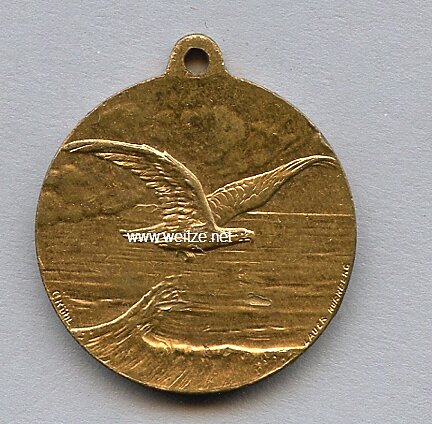
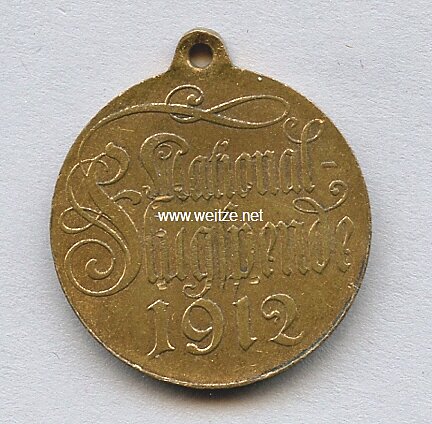
Wearable Donation Medal "National-Flugspende 1912"
The portable donation medal “National-Flugspende 1912” (National Aviation Donation 1912) represents a fascinating testament to early German aviation enthusiasm and documents a significant phase in the development of the German Empire's military air forces. This bronze medal was issued as part of a nationwide fundraising campaign aimed at collecting funds for the construction and modernization of the German air fleet.
In the early 20th century, aviation was still in its infancy, but European military leadership already recognized the immense strategic potential of aircraft. Following the Wright brothers' first successful flights in 1903, a veritable international race for air superiority developed. The German Empire found itself in direct competition with France, which had already invested considerable resources in its Aéronautique Militaire.
The National Aviation Donation of 1912 was a campaign initiated by the Deutscher Luftflottenverein (German Air Fleet Association) and other patriotic organizations that found broad support among the population. Similar to the better-known fleet collection for the Imperial Navy, private donations were to be collected to provide additional funds for the procurement of aircraft and the training of pilots. The imperial government recognized that state funds alone were insufficient to keep pace with neighboring countries.
This donation medal was presented to supporters as a token of gratitude and as a visible sign of their patriotic sentiment. Unlike military decorations, such aviation donation badges were not official state orders but commemorative pieces marking participation in a national movement. The bronze version was the most common variant, issued to smaller donors, while versions in silver or with special distinctions existed for larger contributions.
The year 1912 marks a decisive turning point in German military aviation. The Kaiserliche Fliegertruppe (Imperial Flying Corps), officially founded in 1910, was expanding rapidly. Numerous flight schools were established, and industry began the serial production of military aircraft. Manufacturers such as Albatros, Rumpler, and Fokker developed into significant armaments companies. The funds collected through the donation campaign helped accelerate this development.
The medal itself was typically provided with a ribbon that allowed the owner to wear it at patriotic events or holidays. The bronze toning was characteristic of this type of commemorative piece and gave them a solemn, military character. The design of such medals typically included symbols of aviation such as airplanes, propellers, or the German eagle, along with corresponding inscriptions referring to the donation campaign.
The 1912 donation campaign must be understood in the context of general rearmament and growing nationalism in Europe before World War I. Public enthusiasm for technical innovations, particularly in aviation, was enormous. Air shows attracted thousands of spectators, and pilots like August Euler or Hans Grade became folk heroes. The government skillfully exploited this mood to involve the population in military preparation.
Only two years after the donation campaign, World War I broke out, and the air force would play a central role in this conflict. What was still considered an exotic military branch in 1912 developed into a decisive factor in warfare. The aircraft financed through donations and the trained pilots formed an important part of the German air forces deployed in the war.
Today, such donation medals are sought-after collectibles that recall a time when technological progress and national enthusiasm converged. The condition rating of “2-” indicates a well-preserved specimen with minor signs of wear, which is quite remarkable for objects over 110 years old. The absence of the ribbon is not unusual for these medals, as textile ribbons often did not withstand the test of time or were stored separately. The medal represents not only a piece of military history but also testimony to social mobilization and collective engagement in the German Empire before the Great War.