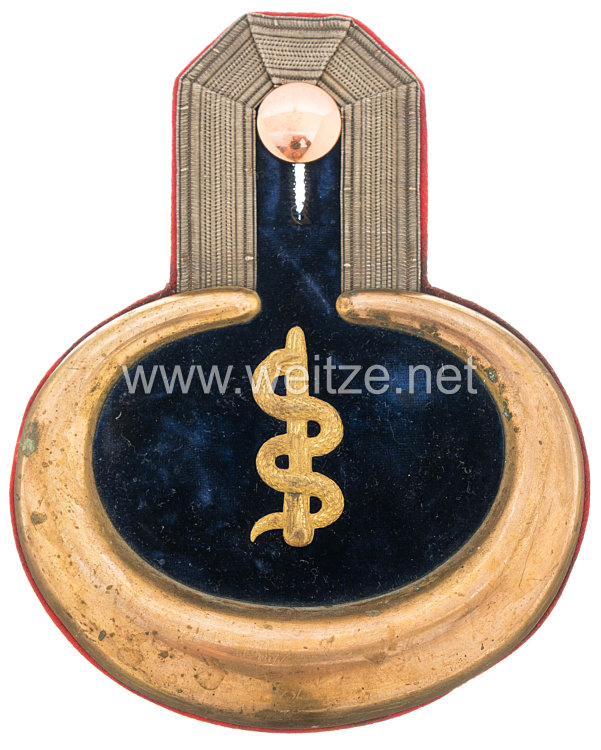
Prussia Single Epaulette for an Assistant Surgeon

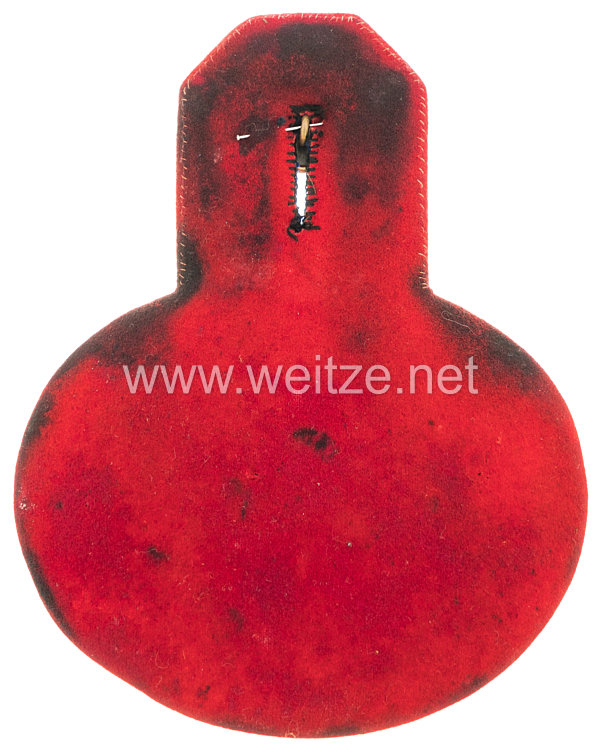
Circa 1900. The cloth base is stained. Condition 2-.
415621
170,00

Prussia Single Epaulette for an Assistant Surgeon

The Prussian single epaulette for an Assistant Medical Officer from around 1900 represents a fascinating chapter in the history of German military medical services. These rank insignia were not merely functional markers of military hierarchy, but also expressions of the increasing professionalization of medical services within the Prussian and later Imperial German Army.

The Medical Corps of the Prussian Army had undergone significant enhancement since the mid-19th century. The experiences of the Wars of Unification in 1864, 1866, and particularly the Franco-Prussian War of 1870-71 had impressively demonstrated the crucial importance of well-organized medical care. The high casualty rates and the necessity for efficient treatment of wounded soldiers led to fundamental reforms in military medical services.

The Assistenzarzt (Assistant Medical Officer) represented the entry-level rank for licensed physicians entering military service. After completing medical studies and state examinations, young doctors could enter the army as assistant medical officers. They were subordinate to the Oberarzt (Senior Medical Officer) and higher ranks of the medical service, performing their duties in military hospitals, garrisons, or with troop units.

The epaulette as a rank insignia had a long tradition in the Prussian Army, dating back to the 18th century. Originally, epaulettes served as shoulder protection against saber strikes, but quickly evolved into purely decorative rank markers. Regulations for medical personnel's epaulettes were precisely defined in various uniform regulations.

Assistant medical officers characteristically wore only a single epaulette on the right shoulder, while the left shoulder bore a simpler shoulder strap or shoulder piece. This asymmetrical wearing style was a clear rank marker and distinguished assistant medical officers from higher officer ranks who wore paired epaulettes. The assistant medical officer's epaulette typically consisted of an oval or crescent-shaped cloth backing decorated with metal threads, usually silver-colored bullion or fringe.

The coloring of the cloth backing followed the branch colors of the Medical Corps. For the Prussian medical service, the color dark blue was characteristic, clearly distinguishing it from the colors of other service branches. The metallic trimmings were typically silver-colored, corresponding to medical personnel and contrasting with the gold trimmings of other branches.

Around 1900, the creation period of this object, the German Empire was in the Wilhelmine Era. Kaiser Wilhelm II took great interest in military affairs and uniform matters. By this time, the Medical Corps was already highly professionalized, and significant medical advances, particularly in surgery and bacteriology, had been incorporated into military medicine.

The Adjustierungsvorschrift (Uniform Regulation) of 1899 regulated in detail the uniform and insignia regulations of the Prussian Army. This included precise specifications for epaulettes, including dimensions, materials, and wearing instructions. These regulations were extraordinarily precise and left little room for individual variations.

Assistant medical officers wore their epaulettes with various uniform types: with the parade uniform, with the gala uniform at ceremonial occasions, and sometimes with the walking-out uniform. In field service, however, simpler shoulder straps were preferred, being more practical and less conspicuous. The elaborate epaulettes remained reserved for special occasions and garrison duty.

The manufacture of such epaulettes was handcrafted and required considerable artisanal skill. Specialized military outfitters and uniform tailors produced or distributed these pieces. Officers generally had to procure their uniform items themselves, which involved considerable expense. A complete officer's outfit could cost several months' salary.

The condition with stained cloth backing is not unusual for objects of this type and age. Textiles are particularly susceptible to aging processes, light exposure, and moisture. The metallic trimmings often survive better than the cloth backing, which can be observed in many preserved examples.

This epaulette is an authentic witness to an era when military hierarchies were made visible through elaborate uniform systems. It documents the history of the medical service and the position of military physicians in Imperial German society. Today, such objects are important sources for military historical research and the study of military uniforms.

The single epaulette system for assistant medical officers reflected the careful gradation of ranks within the medical service. It also demonstrated the integration of academically trained professionals into a traditionally aristocratic officer corps, where medical expertise was increasingly valued alongside military prowess. These insignia thus represent not only military tradition but also the modernization of warfare and the growing recognition of scientific medicine in military contexts.