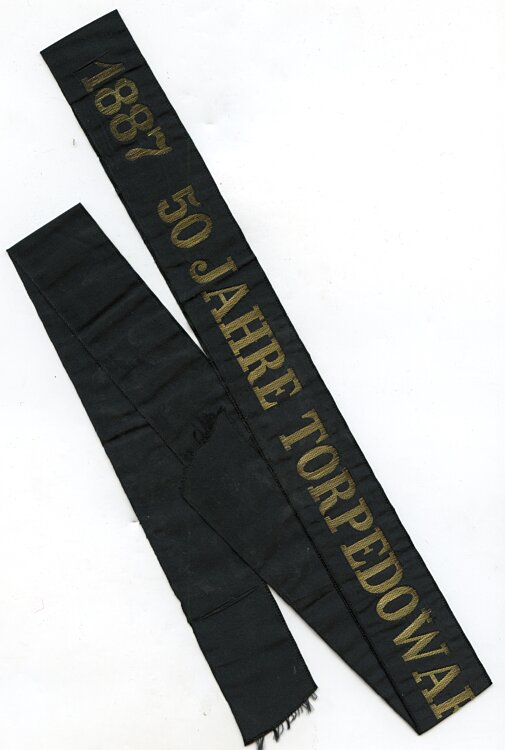
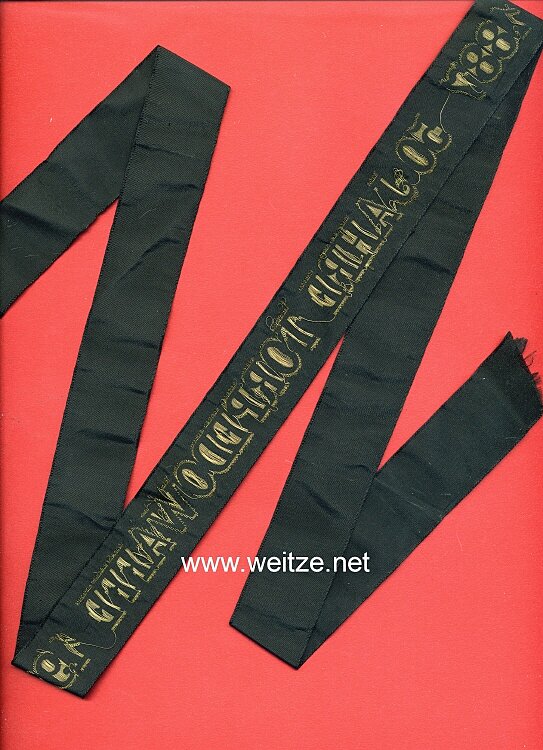
Kriegsmarine Tradition Cap Tally "1887 50 Jahre Torpedowaffe 1937"
The Kriegsmarine Traditions Cap Tally “1887 50 Jahre Torpedowaffe 1937” represents a significant commemorative piece from German naval history. This special cap tally was issued to celebrate the 50th anniversary of the torpedo weapon in the German Navy and documents an important milestone in the development of maritime warfare.
The torpedo weapon was officially introduced into the Imperial German Navy in 1887, following successful experiments with self-propelled underwater projectiles. The torpedo fundamentally revolutionized naval warfare, as it gave smaller vessels the ability to effectively combat larger units. Torpedo boats and later submarines became feared weapons in both World Wars.
The present cap tally is rendered in the old Latin script (Fraktur script), which was used in the German Navy until 1941. The metal thread execution identifies this tally as a high-quality variant, in which silver or gold-colored metal threads were woven into the black base fabric. This type of execution was typical for official commemorative tallies and differed from the simpler everyday tallies of regular ship crews.
Cap tallies of the Kriegsmarine were an essential part of the uniform and served to identify ship affiliation or, as in this case, to mark special units or anniversaries. The standard length of such tallies was typically between 110 and 120 centimeters, with the 112 centimeters noted here corresponding to regular measurements.
The year 1937 marks not only the anniversary but also falls into a phase of intensive rearmament of the Kriegsmarine under Grand Admiral Erich Raeder. The Z-Plan, an ambitious fleet construction program, was in planning, and the torpedo weapon played a central role in the Navy's strategic orientation. Submarines were considered the decisive weapon for a possible future conflict.
Torpedo development in Germany had a long tradition. The Torpedo Testing Institute in Friedrichsort near Kiel was the center of technical development. German engineers like Robert Whitehead and later German designers continuously perfected the weapon. By 1937, several generations of torpedoes had been developed, from the early Schwarzkopf torpedoes to modern electric and steam torpedos.
Such anniversary tallies were produced in limited editions and typically distributed to personnel connected with the torpedo weapon – this included crews of torpedo boats, destroyers, submarines, and personnel of torpedo schools. The tally was worn on the side cap or peaked cap and was a visible sign of affiliation with this branch of weaponry.
The fact that this tally was worn gives it additional historical value. The signs of wear testify to its authentic use by a member of the Kriegsmarine during this significant time. Such worn pieces are often more valuable than unused examples, as they represent a direct connection to history.
In the context of naval history, this cap tally documents the continuity between the Imperial Navy and the Kriegsmarine. Although the Weimar Republic and the National Socialist years lay between these epochs, the Kriegsmarine deliberately emphasized the traditions of the Imperial fleet. The celebration of the 50th anniversary of the torpedo weapon in 1937 was part of this tradition maintenance.
Today, such cap tallies are sought-after collectibles that represent important testimonies of naval history. They document not only military development but also maritime culture and tradition. The metal thread execution makes this example particularly noteworthy, as such high-quality variants are rarer than ordinary woven tallies.