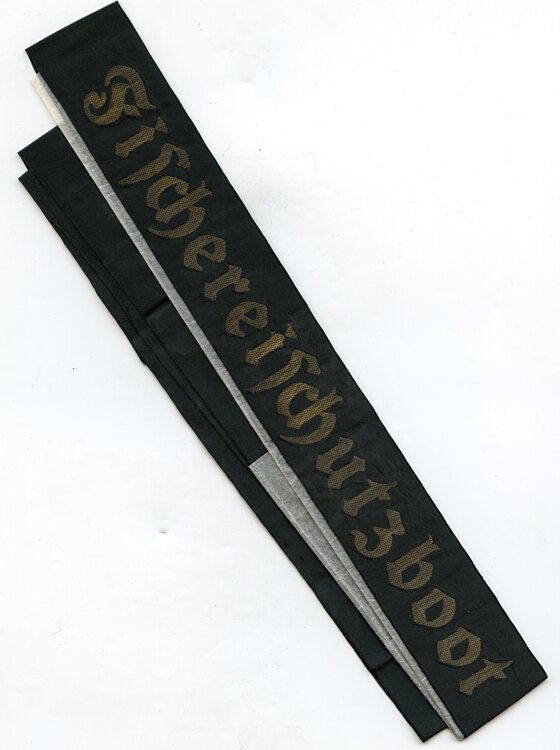
Kriegsmarine Cap Tally "Fischereischutzboot Elbe"
The cap tally (Mützenband) was an essential component of German naval uniforms, serving to identify the specific unit or vessel to which a sailor was assigned. The present example bears the inscription “Fischereischutzboot Elbe” (Fishery Protection Vessel Elbe) and represents a particular type of Kriegsmarine unit during the Second World War era.
The Kriegsmarine, the official designation of the German Navy from 1935 to 1945, adopted numerous traditions from the Imperial German Navy following its establishment through the Law on the Reconstruction of the Wehrmacht. Among these traditions was the wearing of cap tallies on the peaked caps of enlisted men and petty officers. These ribbons were typically black with gold or yellow lettering displaying the name of the ship, unit, or shore establishment.
Fishery protection vessels had a long tradition in the German Navy dating back to the Imperial era. Their primary peacetime mission consisted of protecting and monitoring the German fishing fleet, as well as enforcing fishing boundaries and regulations. These vessels operated mainly in the North Sea and Baltic Sea, responsible for controlling fishing activities, enforcing closed seasons, and preventing illegal fishing operations.
With the outbreak of World War II, many fishery protection vessels were converted for military purposes. They received additional armament and assumed duties such as coastal patrol operations, minesweeping, convoy escort, and anti-submarine warfare. Their knowledge of home waters and robust construction made them particularly valuable for these tasks.
The designation “Elbe” refers to the major German river that flows into the North Sea. It was customary to name fishery protection vessels after German rivers, similar to how other ship classes of the Kriegsmarine followed systematic naming conventions. Battleships received names of federal states or historical regions, cruisers were named after cities, and destroyers often carried personal names.
The production of cap tallies during the Kriegsmarine period was subject to specific regulations and quality standards. They were manufactured by specialized textile manufacturers authorized by the Navy. The lettering had to be executed in golden-yellow color and conform to certain typographic specifications. The ribbons were machine-woven, with the letters directly incorporated into the band during the weaving process.
The condition of the present cap tally is described as “mint” (neuwertig), with portions still in the original paper packaging. This suggests that the ribbon may never have been worn or was stored as a spare item. The slightly faded lettering is typical for these historical textiles, as the dyes used undergo natural aging over the decades, even when stored in protected conditions.
For collectors and military historians, such cap tallies are of significant interest as they represent concrete connections to specific units and vessels of the Kriegsmarine. They enable the reconstruction of crew histories and provide insight into the organizational structure of the German Navy during World War II. The rarity of particular cap tallies depends on various factors, including crew size, duration of the vessel's service, and the survival rate of these objects.
Authenticating Kriegsmarine cap tallies requires expertise, as reproductions and forgeries exist due to their collectible value. Original ribbons exhibit specific weaving patterns, material properties, and aging characteristics that can be verified by experts. The original paper packaging, as partially present with this example, can provide additional evidence of authenticity but must be evaluated in the overall context.
The study of such military equipment items contributes to a more comprehensive understanding of the daily reality of naval personnel and supplements naval historiography, which often focuses on major sea battles and strategic operations, with important details about the material culture and organizational structure of the Kriegsmarine.