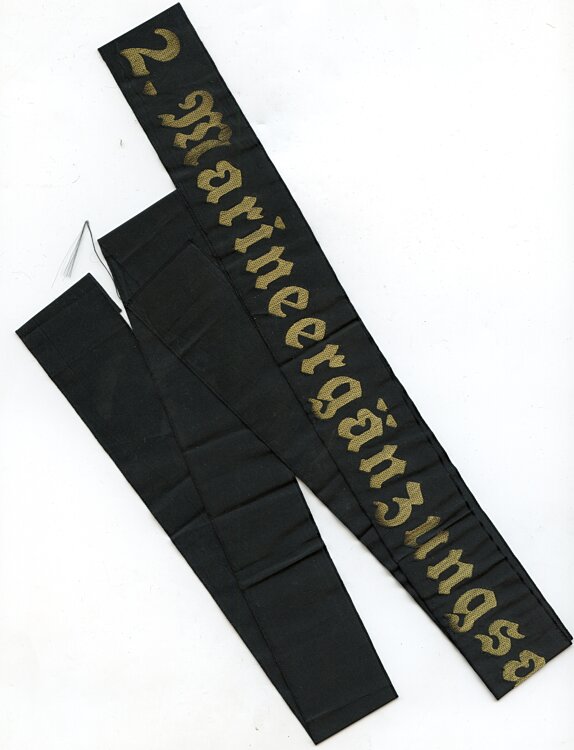
Kriegsmarine Cap Tally "2. Marineergänzungsabteilung 2."
The Kriegsmarine cap tally of the 2. Marineergänzungsabteilung 2 (2nd Naval Replacement/Supplementary Division 2) represents an authentic artifact of the organizational and training structure of the German Kriegsmarine during World War II. These cap tallies were not merely functional components of the naval uniform, but also served as important identification markers documenting a sailor's assignment to a specific unit or ship.
The Marineergänzungsabteilungen (Naval Replacement Divisions) were established during the massive expansion of the Kriegsmarine in the late 1930s and throughout World War II. Following the reintroduction of conscription in 1935 and the initiation of the ambitious Z-Plan under Grand Admiral Erich Raeder, the navy required an efficient organizational structure to train and administer the rapidly growing personnel numbers. The Naval Replacement Divisions functioned as reserve and training units responsible for basic training, personnel assignment, and administration of reservists.
The cap tally system in the Kriegsmarine followed precise regulations stipulated in the Kriegsmarine dress regulations (Anzugsordnungen). The standard design consisted of a black ribbon made of cotton or artificial silk with golden-yellow lettering. The letters and numbers were either machine-embroidered or printed. The length of the ribbon was precisely regulated and had to be measured so that it could be placed around the cap with a characteristic bow at the back of the head.
The designation “2. Marineergänzungsabteilung 2” indicates a specific training unit. The numbering system of the Naval Replacement Divisions was complex and underwent several reorganizations to accommodate changing strategic situations and growing personnel requirements. These divisions were geographically distributed throughout the Reich territory, with concentrations in traditional naval cities on the North and Baltic Sea coasts such as Wilhelmshaven, Kiel, Stralsund, and Flensburg.
Wearers of such cap tallies were typically recruits in basic training or sailors awaiting assignment to an operational unit or ship. After completing training and being transferred to a warship, sailors received a new cap tally bearing the name of their respective ship or new unit. This made the cap tallies of the Replacement Divisions temporary identification markers in a naval soldier's military career.
Production of these cap tallies was carried out by specialized manufacturers who often also produced other uniform parts and military equipment items. As the war progressed and material shortages increased, manufacturing quality frequently deteriorated. Later wartime productions showed simplified weaving patterns and the use of substitute materials.
From a historical perspective, such cap tallies document the enormous training machinery necessary to compensate for the Kriegsmarine's personnel losses. The U-boat arm alone recorded loss rates exceeding 75 percent, requiring a constant supply of trained personnel. The Naval Replacement Divisions played a central, though often overlooked, role in naval warfare.
Today, authentic Kriegsmarine cap tallies are sought-after collector's items that provide important information about the organizational structure of the German Navy. Their preservation and scientific documentation contributes to understanding military everyday culture and personnel administration during World War II. The indicated condition 2 suggests a well-preserved example showing only minimal signs of wear.