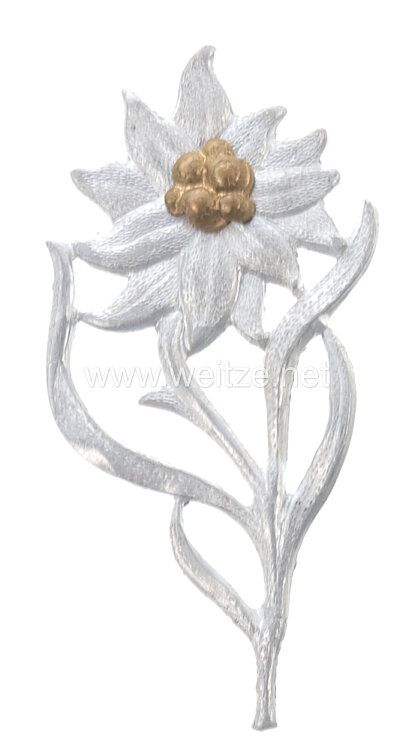
HJ Cap Edelweiss of the HJ-Gruppe Hochland

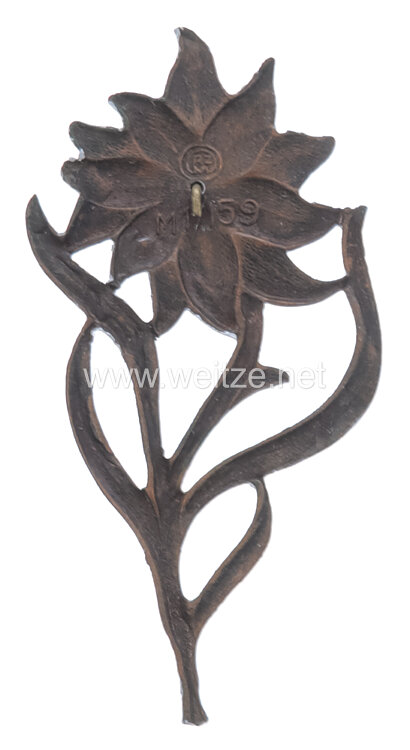
Cupal, reverse with RZM manufacturer M1/59, condition 2.
463921
75,00

HJ Cap Edelweiss of the HJ-Gruppe Hochland

The cap edelweiss badge of the HJ-Gruppe Hochland represents a characteristic insignia of the National Socialist youth organization, specifically worn by members of the Hitler Youth (Hitler-Jugend, HJ) in the Hochland territorial unit. This badge, manufactured from Cupal, bears the marking RZM M1/59 on its reverse, indicating the authorized manufacturer.

The Reichszeugmeisterei (RZM) was established in 1929 as the central procurement office of the NSDAP and was responsible for standardization, quality control, and licensing of manufacturers for all uniform parts, badges, and equipment of the Party and its formations. The manufacturer code M1/59 identifies a specific production facility licensed by the RZM. The material Cupal was a copper-aluminum alloy frequently used in the 1930s and 1940s for badge production, as it was cost-effective, corrosion-resistant, and easily workable.

The Hitler Youth was founded in 1926 and evolved into the state youth organization of the German Reich after the Nazi seizure of power in 1933. With the Law Concerning the Hitler Youth of December 1, 1936, all German youth within the Reich territory were consolidated into the HJ. From 1939 onward, membership became effectively mandatory through the youth service obligation. The organization was structured into various regions (Gebiete), districts (Banne), units (Stämme), and smaller formations, with the HJ-Gebiet Hochland encompassing southern Bavaria with headquarters in Munich and later Berchtesgaden.

The edelweiss as a symbol had a long history in Alpine tradition as a sign of mountaineering, courage, and Alpine identity. Within the HJ, it was particularly used by mountain infantry units and Alpine groups. The HJ-Gebiet Hochland, covering the Bavarian Alpine regions, used the edelweiss as a characteristic identification mark reflecting the geographical and cultural identity of this unit.

According to HJ uniform regulations, cap badges were worn on the peaked cap or mountain cap. The exact placement and manner of wear were detailed in service regulations. For members of Gebiet Hochland, the edelweiss was a sign of belonging to this special regional formation.

The production of such badges was subject to strict RZM guidelines. Manufacturers had to be licensed and mark their products. The reverse marking M1/59 enabled traceability and was intended to prevent the manufacture of unauthorized copies. The RZM assigned manufacturer numbers systematically, with the prefix “M1” indicating a specific category of metal badges.

Throughout the existence of the Nazi regime from 1933 to 1945, millions of such badges were produced and issued. The HJ grew from approximately 100,000 members in 1933 to over 8 million members in 1939. This massive organization required corresponding production of uniform parts and badges.

After the collapse of the Third Reich in 1945, the Hitler Youth and all its subdivisions were officially dissolved and banned by Control Council Law No. 2 of October 10, 1945. The possession, manufacture, and distribution of HJ insignia were criminalized. In the Federal Republic of Germany today, the Criminal Code (§ 86a) regulates the handling of insignia of unconstitutional organizations, with exceptions for historical, scientific, and educational purposes.

From a military-historical perspective, such objects document the organizational structure, symbolism, and material culture of the National Socialist youth organization. They serve as material witnesses to an era that must be critically researched and remembered. Technical details such as manufacturer markings, materials used, and production methods provide insights into the economic structure and standardization efforts of the Nazi regime.

The scholarly examination of such objects in museums, collections, and historical research is essential for understanding this epoch and contributes to historical education and awareness.

r