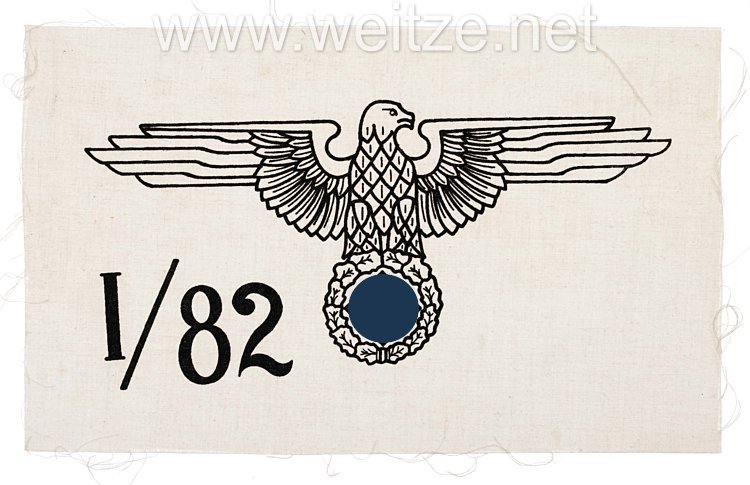
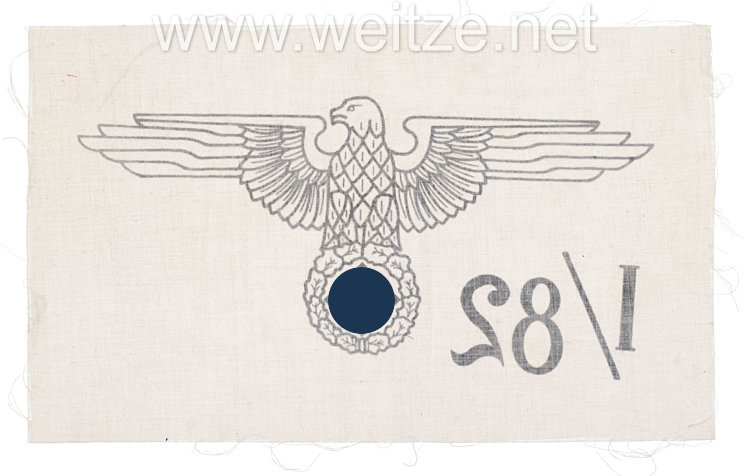
Allgemeine-SS Mirror Blank for the Sturmbann Flag I SS-Standarte 82

Location Bielefeld, circa 1938. Printed version national eagle with number “I/82”, dimensions approximately 29 x 18 cm. Unused, not yet hemmed, condition 2. Very rare.
300921
1.500,00

Allgemeine-SS Mirror Blank for the Sturmbann Flag I SS-Standarte 82

This object is a mirror blank (Spiegelrohling) for the Sturmbann flag of the I. Sturmbann of SS-Standarte 82 of the Allgemeine SS, dated around 1938 from Bielefeld. This unused blank represents a significant aspect of the organizational structure and visual identity of the SS before World War II.

SS-Standarte 82 was founded on October 1, 1933, and was headquartered in Bielefeld, Westphalia. As part of the Allgemeine SS, the political organization as opposed to the armed Waffen-SS, Standarte 82 was responsible for the East Westphalia region. The territorial structure of the SS was based on military district divisions and local political structures of Nazi Germany.

A Spiegelrohling or flag mirror was a central element of SS Sturmbann flags and standards. The term “Spiegel” (mirror) refers to the central emblem that was sewn on both sides of the flag. These mirrors typically displayed the national eagle (Hoheitsadler) of the Third Reich combined with the respective unit number. In this case, the mirror bears the designation “I/82”, identifying the first Sturmbann (I) of Standarte 82.

The Sturmbann organization was a fundamental structural level of the SS. A Standarte normally consisted of three to five Sturmbänne, each comprising several Stürme (companies). The I. Sturmbann was traditionally the first and often highest-ranking unit within a Standarte. The size of a Sturmbann varied but typically encompassed several hundred men.

The printed execution of this mirror is particularly noteworthy. While early SS flags often used hand-embroidered or hand-painted mirrors, the late 1930s saw an increasing shift to printed versions that were more cost-effective and faster to produce. This reflects the increasing standardization and bureaucratization of the SS organization during this period.

The year 1938 marks a significant phase in SS history. Following the Blomberg-Fritsch Crisis at the beginning of the year, the SS gained considerable power and influence. The Allgemeine SS experienced membership growth and organizational consolidation. Simultaneously, the transformation toward the more military Waffen-SS began, although the Allgemeine SS retained its local and political functions.

Flag consecration and bestowal in the SS followed strict ceremonial protocols. New flags were often consecrated at major rallies, particularly during the Reich Party Congresses in Nuremberg, by the highest SS leaders. The Blood Flag from 1923 played a mystical-ritual role in touching new flags, reinforcing the cult around the “martyrs” of the movement.

The fact that this blank survived unused and not sewn is extraordinary. This could have several reasons: the flag may never have been completed, the Sturmbann may have been reorganized before the flag could be used, or the blank was produced as a reserve. With the outbreak of war in 1939, the SS focus increasingly shifted to military tasks, and the ceremonial significance of the Allgemeine SS declined.

The symbolism of such flags was central to SS ideology. The national eagle with swastika represented the connection to the National Socialist movement and the German Reich. The unit numbers reinforced the sense of belonging to an elite, hierarchically organized fighting community. The black base color of SS flags deliberately distinguished them from other Nazi organizations.

The dimensions of approximately 29 x 18 cm correspond to the standardized measurements for flag mirrors of this period. This standardization was part of the comprehensive regulation of uniforms, insignia, and flags in the SS, which was established in various service regulations.

After 1945, most SS flags were destroyed or lost. Surviving examples, particularly unused blanks like this one, are therefore of considerable historical significance for understanding the organization, symbolism, and material culture of the SS. They serve as primary sources for researching the structures of the Nazi regime and its organizations.

Today, such objects are important testimonies of a dark period in German history. Their preservation in museums and archives serves historical education and research, not glorification. They remind us of the systematic organization of a criminal institution that was centrally responsible for the crimes of National Socialism.