Black SS, Armed SS, SS VT

Waffen-SS - Official Stamp "SS - Pz.-Jg.-Abt.LSSAH1"

Embossing seal with border marking, condition 2.
510224
350,00

Waffen-SS - Official Stamp "1. SS - Pz. Armee"

Embossing seal with ground edge marking. Condition 2.
510195
600,00

Waffen-SS - Official Stamp "SS-Division Wiking"

Embossing seal with edge marking. Condition 2.
510194
600,00

Waffen-SS - Official Stamp "17. SS-Pz.Gren. - Div. Götz von Berlichingen"

Embossing seal with ground edge marking. Condition 2.
510193
600,00

Waffen-SS - Official Stamp "SS - F.P.A. 111"

Embossing seal with ground edge marking. Condition 2.
510192
450,00

Waffen-SS - Official Stamp "SS - Tot. Div. 5."

Embossing seal with ground edge marking. Condition 2.
510190
600,00

SS/SD Operation Bernhard: Counterfeit 10 Pound Banknote, Manufactured in Sachsenhausen Concentration Camp

Perfectly printed counterfeit of a “10 Pounds” banknote, dated August 18, 1932. With signs of aging, condition 2. 

During World War II, the Sicherheitsdienst (SD) conducted the largest counterfeiting operation in the world: The objective of “Operation Bernhard” was to put a large quantity of counterfeit British currency into circulation and thereby damage the value of the British Pound. The resulting weakening of the economy would have led, among other things, to a decline in British war production. Shortly after the outbreak of war, a counterfeiting workshop was established in the premises of the Reichssicherheitshauptamt (RSHA). Hitler, who personally approved the operation, recommended focusing first on pound notes of the “Bank of England.” The name of “Operation Bernhard” can be traced back to its director, SS-Sturmbannführer Bernhard Krüger. The operation was top secret; not even rumors about the counterfeit money were permitted to reach Great Britain. The slightest hint of the German plans would have doomed the operation to failure before it even started.  For this reason, the Germans resorted to forced laborers. They specifically searched among Jewish prisoners for skilled workers in printing technology, graphic artists, engravers, and paper specialists and brought them along with equipment to Sachsenhausen concentration camp. There, barracks 18 and 19 served as a counterfeiting workshop from 1942. To ensure that other prisoners in Sachsenhausen would not learn of the operation, the two barracks were separated from the rest of the camp by high fences. The 144 prisoners working there counterfeited banknotes in denominations of 5, 10, 20, and 50 Pounds Sterling. The counterfeits were sometimes of such exceptionally high quality that even employees of the “Bank of England” did not recognize the forgeries. The Jewish counterfeiters received better treatment than their fellow prisoners in the rest of the camp. For example, they could move freely within the cordoned-off area, received more food, could wear normal clothing, or let their hair grow.  In total, money amounting to approximately 132 million Pounds was printed. The quality varied greatly, of course: from Class A notes that were even accepted by the Bank of England, to Class C notes that were intended for dropping over England. Since infiltrating these notes into the economic cycle through official channels was out of the question, it was hoped that the money collected by people would be spent in small amounts.  The original plan to flood England with massive quantities of counterfeit money was ultimately not implemented; only a few notes entered circulation. This was also due to the fact that the forced laborers secretly delayed production and delivery. To cover up the operation at the end of the war, the equipment and many thousands of counterfeit notes were sunk in the Austrian Toplitzsee. “Operation Bernhard” remained largely unknown for many years after the end of the war. In the course of destroying the equipment, the prisoners were also to be murdered. Fortunately for the prisoners, it did not come to that and they were liberated together with the rest of the camp on May 6, 1945, by American troops. The Allies became aware of the operation primarily through the liberated prisoners. As a precautionary measure, the Bank of England therefore recalled all pound notes of five pounds and above in circulation, destroyed them, and finally issued new notes. Only with the partial recovery of the printing plates and counterfeits from the Toplitzsee beginning in 1959 did the operation become known to the public. 
517430
240,00

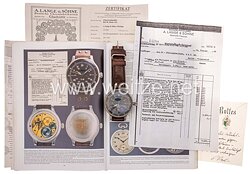
Waffen-SS Observer's Watch M-B, A. Lange & Söhne Glashütte Movement No. 215 803

circa 1944. Waffen-SS observer's watch, movement cal. 48 mm, case diameter 65 mm, the case constructed as pilot's wristwatch, of matte gray brass. The watch with pull-out crown and stop device, with large black special dial as prescribed by the Waffen-SS with designation “W-SS” and “M-B”, instead of numerals III and IX extended division marks at 15 and 45, with luminous numerals and hands, seconds at dial center, 1/5 second jumping, second hand at rear end provided with luminous mark. Complete with brown riveted leather strap with nickel-plated clasp.

In 1940 the Waffen und Geräteamt (Weapons and Equipment Office) of the Waffen-SS commissioned A. Lange & Söhne to develop an “observer's watch for survey battery” (M-B) with larger diameter, based on the Luftwaffe B-Uhr (observation watch). For photographic recordings the second numerals were additionally to be applied in mirror writing. After the prototypes in silver case, 10 watches were to be delivered monthly from March 1941. In 1943, according to the present document, 22 of these watches in nickel-plated brass case with 65 mm diameter were completed by A. Lange & Söhne. One of these watches manufactured in 1943 is illustrated with the page from the shipping ledger dated October 22, 1943 in the reference book by Konrad Knirim “Militäruhren - Military Timepieces” on page 452.

Our example comes from the delivery of February 29, 1944. The watch is lightly worn, on the reverse of the case back with stamped movement no. 215803, the inside of the cover stamped “Lange & Söhne Glashütte” and “C 84”. The movement partially gilt, with designation “A. Lange & Söhne”, twice with movement no. 215803.
Accompanied by a certificate from Reinhard Reichel, the expert of the Glashütte Watch Museum from 2002.
The watch was completely disassembled and cleaned approximately 10 years ago by a German master watchmaker. The angle lever spring and the hand-setting lever were replaced with original parts. The finish of the case middle section was renewed, the balance staff was reproduced in a previous repair. (Letter from the master watchmaker included).
The watch is fully functional and in good condition.
Together with a photocopy of the shipping ledger of A. Lange & Söhne, dated February 29, January 1944. On that day 11 SS observer's watches were delivered to the SS-Führungshauptamt (SS Main Leadership Office), Amt IX, Berlin-Wilmersdorf, by registered package to the SS-Artillerie-Schule Glau (SS Artillery School Glau). The 3rd watch listed is our piece with movement no. 215 803.

Extremely rare, based on the two present shipping ledger pages from 1943 and 1944, probably 33 watches were manufactured. Apart from these two pieces, no other SS observer's watches are known to us.
463936

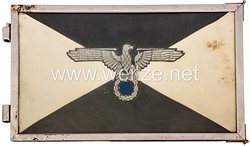
SS Vehicle Pennant for the Chiefs of the 3 SS Main Offices

From 1936. Vehicle pennant, in the center large SS national eagle in Bevo metal-thread woven execution, applied on a black/white diagonal field. Complete with original metal frame, protective cover made of celluloid. Dimensions 38 x 22.5 cm. On the side with 2 metal sleeves for attachment to the vehicle mounting rod. Clear signs of use and age, condition 2-.
Extremely rare.

The chiefs of the 3 SS Main Offices were:
For the SS-Hauptamt SS-Obergruppenführer August Heißmeyer (1935–1939) and SS-Obergruppenführer Gottlob Berger.
For the SS-Führungshauptamt SS-Obergruppenführer Hans Jüttner.
For the Rasse- und Siedlungshauptamt SS-Gruppenführer Walther Darré (until September 1938) SS-Brigadeführer Günther Pancke (September 12, 1938 to July 9, 1940)
425648
15.000,00
60,00

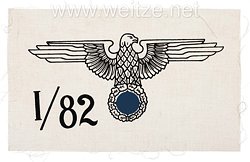
Allgemeine-SS Mirror Blank for the Sturmbann Flag I SS-Standarte 82

Location Bielefeld, circa 1938. Printed version national eagle with number “I/82”, dimensions approximately 29 x 18 cm. Unused, not yet hemmed, condition 2. Very rare.
300921
1.250,00

Allgemeine-SS Vehicle Pennant for Führer

Circa 1936. Version for official vehicles. Double-sided printed execution on metal. In the center the SS runes on black background, the border black/white in the style of an SS cord. Dimensions 22 x 32.5 cm. Significant signs of use and age, mounting bracket missing, paint chipping, condition 2-.
500714
1.200,00

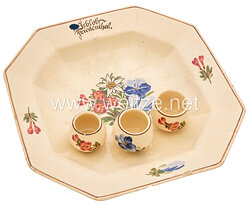
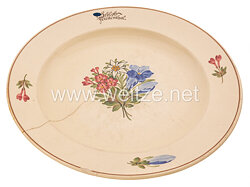
Waffen-SS Mess Plate from the Casino of SS-Schloss Friedenthal

Soup plate made of glazed stoneware with hand-painted flowers, on the rim with the hand-painted inscription "SS Schloss Friedenthal." Reverse side with manufacturer's stamp "Schwarzer Keramik / Handgemalt" (Schwarzer Ceramics / Hand-painted), handwritten "A.3". Diameter 23.5 cm. Typical signs of use, Condition 2. 

SS Schloss Friedenthal was the headquarters of SS Sonderverband z.b.V. Friedenthal under the command of the legendary SS-Obersturmbannführer Otto Skorzeny (who became famous through Operation “Eiche” (Oak), the liberation of Mussolini on September 12, 1943). The castle was the site of planning and training for SS commando operations. The castle was located in Oranienburg near the Sachsenhausen concentration camp and was destroyed on April 10, 1945 by a targeted U.S. bombing raid. One of the very few pieces that survived the war.

452372
850,00

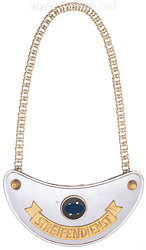
SS-Verfügungstruppe Gorget of the "SS Streifendienst"

Circa 1938. Heavy nickel-plated construction with applied SS runes and gilt bandeau inscribed "Streifendienst". Reverse with dark blue wool backing, suspension clip marked with maker "SS 140 RZM". Complete with the special nickel-plated suspension chain. The gorget shows only light wear, condition 2+.
Extremely rare, one of very few original examples!
444517
9.500,00

Waffen-SS Large Painted Portrait of SS-Untersturmführer Dr. Walter Best, SS War Correspondent, Later SS-Obersturmführer

Large color hand-painted portrait as SS-Untersturmführer, signed on the side by the artist (probably also an SS war correspondent), dated 1.1.43. In original period frame, dimensions 35 x 43 cm. Undamaged, condition 2.

Walter Best (* May 20, 1905 in Liegnitz; † October 3, 1984 in Marburg). After graduating from secondary school, Best studied German philology in Frankfurt am Main from 1924 to 1927. After his studies, he worked successively until 1935 as dramaturg at the Stadttheater Bamberg, then at the Stadttheater in Mainz, and finally at the Preußisches Staatstheater in Kassel. On May 1, 1933, he joined the SS, SS number 107,423, and the NSDAP, membership number 2,018,596. He was also a member of the NS-Kulturgemeinde, the SA (resigned 1935), the NSKK, the NSV, the RLB, and the Reichsschrifttumskammer (RSK), within which he held the position of regional leader of Kurhessen until 1937. From June 5, 1940, Best served under company commander Gunter d'Alquen as a war correspondent of the Waffen-SS. As an SS war correspondent, he accompanied the Leibstandarte-SS Adolf Hitler during the Western Campaign, deployed in the Netherlands, Belgium, France, Yugoslavia, Romania, Hungary, and Denmark. In 1941, he published the book “Mit der Leibstandarte im Westen” as a contribution to the series “Soldaten – Kameraden!” published by the Zentralverlag der NSDAP.
From November 1941 to the end of June 1943, he served as an SS war correspondent with the SS-Division “Totenkopf” and the “SS-Polizei-Division” on the Eastern Front. Final rank in the Allgemeine-SS from 1944: SS-Sturmbannführer; in the Waffen-SS: SS-Obersturmführer.
In his 1970 autobiography, Best writes about the war years merely: “The Second World War broke out and I participated in it as a correspondent for the press.” Until his denazification tribunal proceedings in April 1948, Best was first interned at the Kornwestheim internment camp. Under the Law for Liberation from National Socialism and Militarism of March 5, 1946, the public prosecutor, citing Best's memberships in several NS organizations, demanded that he be classified in Group I of the major offenders. Best himself assured that he had “known nothing of the crimes.” Due to the submission of 14 exculpatory affidavits and “the prosecutor's recommendation that, with the exception of his merely formal membership in the group of major offenders, no transgressions could be attributed to the accused,” Best was ultimately classified in Group IV of the fellow travelers and punished with an atonement payment of RM 2,000.
509470
650,00

Waffen-SS Large Commemorative Plate of the 27th SS Volunteer Grenadier Division “Langemarck” (Flemish No. 1)

Large hand-carved wooden plate with raised rim, diameter 33 cm, in the center the three-armed sun wheel with three surrounding horse heads of the 27th SS Volunteer Grenadier Division “Langemarck” (Flemish No. 1), undamaged, condition 2.
500697
650,00

SS Pair of Cufflinks for the Officer's Formal Dress Uniform for Officers

circa 1938. Silver-plated and toned base metal. Lightly worn, condition 2. Very rare.
471385
1.500,00

SS Pair of Cufflinks for Officer's Full Dress Uniform for Führers

circa 1938. Silver-plated and toned brass alloy. Worn, condition 2. Very rare.
486828
1.500,00

Waffen-SS: Honorary Citizenship Certificate from the City of Deschenitz, Sudetenland, awarded to SS-Hauptsturmführer Fritz Witt on November 9, 1938, later SS-Brigadeführer and recipient of the Knight's Cross with Oak Leaves

Wine-red leather folder, 22 x 32 cm, lined inside with light silk, containing a parchment sheet (left side cut off), handwritten “Honorary Citizenship Certificate - On the occasion of the memorable liberation of our Sudeten German homeland and the associated occupation by the SS-Standarte ‘Deutschland’, the municipality of Deschenitz has, in grateful remembrance, appointed Mr. Fritz Witt, SS-Hauptsturmführer, as honorary citizen - Deschenitz, Böhmerwald, Bavarian Ostmark, November 9, 1938” with signatures of the mayor and the local group leader of the Sudeten German Party. Unfortunately, the left side of the parchment sheet was cut off after 1945, otherwise condition 2.
Includes the personal confirmation by his son Peter Witt from 2012.

The honorary citizenship certificate comes directly from the family estate and was sold by the son several years ago.

Witt, Fritz


* May 27, 1908, Hohenlimburg / Westfalen
+ June 14, 1944, Caen (KIA)


Fritz Witt joined the “SS-Stabswache Berlin” in March 1933 as one of the first 120 volunteers. As SS-Untersturmführer, he became platoon leader in the 2nd Sturm of the Leibstandarte and in 1935 company commander in München. As commander of the 3rd Company of SS-Standarte “Deutschland”, he participated in the Polish Campaign and the Western Campaign. On the evening of May 27, his battalion was attacked from the direction of Eftaires by 20 British tanks. The battalion succeeded in destroying nine tanks without anti-tank weapons; the rest withdrew. For the achievements and successes of his battalion, he was awarded the Knight's Cross on September 4, 1940. In October 1940, he took command of the III. Battalion of the Standarte. He led this successfully during the Balkan Campaign. Heavy fighting occurred at Klidi Pass and Klisura Pass. From June 1941, he was deployed in Russia; on February 8, 1942, he was awarded the German Cross in Gold. In June 1942, he was tasked with establishing SS-Panzergrenadier-Regiment 1, becoming its commander in January 1943. For his exceptional achievements during the battles at Kharkov and between the Donets and Dnieper, he was awarded the Oak Leaves on March 1, 1943. At that time, he held the rank of SS-Standartenführer. In July 1943, he undertook the formation of the 12th SS-Panzer-Division “Hitlerjugend”; on July 1, 1943, he was promoted to SS-Oberführer. Promoted to SS-Brigadeführer and Major General of the Waffen-SS on January 30, 1944, he commanded the division during defensive operations in Normandy in June 1944. On June 14, 1944, he was killed during shelling of his command post.
473850
3.000,00

SS/SD Operation Bernhard: Counterfeit 50 Pound Banknote, Manufactured at Sachsenhausen Concentration Camp

Perfectly printed counterfeit of a “50 Pounds” banknote, dated May 15, 1935. Light signs of age, Condition 2.

During World War II, the Sicherheitsdienst (SD) conducted the largest counterfeiting operation in the world: The objective of “Operation Bernhard” was to circulate large quantities of counterfeit British currency and thereby damage the value of the British Pound. The resulting weakening of the economy would have led to, among other consequences, a decline in British war production. Shortly after the outbreak of war, a counterfeiting workshop was established in the facilities of the Reichssicherheitshauptamt (RSHA). Hitler, who personally approved the operation, recommended focusing first on pound notes from the “Bank of England.” The name “Operation Bernhard” derives from its director, SS-Sturmbannführer Bernhard Krüger. The operation was strictly classified; not even rumors about the counterfeit money were permitted to reach Great Britain. The slightest indication of German plans would have doomed the operation before it even began. For this reason, the Germans utilized forced laborers. They systematically searched among Jewish prisoners for skilled workers in printing technology, graphic artists, engravers, and paper specialists, and brought them along with equipment to Sachsenhausen concentration camp. There, barracks 18 and 19 served as the counterfeiting workshop from 1942 onward. To prevent other prisoners at Sachsenhausen from learning about the operation, the two barracks were separated from the rest of the camp by high fences. The 144 prisoners working there counterfeited banknotes in denominations of 5, 10, 20, and 50 Pounds Sterling. The forgeries were sometimes of such exceptionally high quality that even employees of the “Bank of England” could not detect them. The Jewish counterfeiters received better treatment than their fellow prisoners in the rest of the camp. For example, they could move freely within the cordoned area, received more food, could wear normal clothing, and were allowed to grow their hair. In total, currency valued at approximately 132 million pounds was printed. The quality varied considerably: from Class A notes that were accepted even by the Bank of England, to Class C notes intended for dropping over England. Since infiltrating these notes into the economic system through official channels was inconceivable, the hope was that money collected by people would be spent in small amounts. The original plan to flood England with massive quantities of counterfeit money was ultimately not implemented; only a few notes entered circulation. This was also due to the fact that the forced laborers secretly delayed production and delivery. To conceal the operation at war's end, the equipment and many thousands of counterfeit notes were sunk in Austria's Toplitzsee. “Operation Bernhard” remained largely unknown for many years after the war's end. As part of destroying the equipment, the prisoners were also to be murdered. Fortunately for the prisoners, it did not come to that, and they were liberated along with the rest of the camp on May 6, 1945, by American troops. The Allies became aware of the operation primarily through the liberated prisoners. As a precautionary measure, the Bank of England therefore recalled all pound notes of five pounds and above in circulation, destroyed them, and eventually issued new notes. Only with the partial recovery of printing plates and counterfeits from Toplitzsee beginning in 1959 did the operation become known to the public.
505135
350,00

Waffen-SS - Official Stamp "SS-Schulungsamt VI"

Embossing seal with edge marking, condition 2.
510227
300,00

SS/SD Operation Bernhard: Counterfeit 20 Pound Banknote, Manufactured in Sachsenhausen Concentration Camp

Perfectly printed counterfeit of a “20 Pounds” banknote, dated August 20, 1934. Light signs of aging, condition 2. The banknote was actually in circulation, stamped “Falsification” by the Bank of England.

During World War II, the Sicherheitsdienst (SD) carried out the largest counterfeiting operation in the world: The objective of “Operation Bernhard” was to put a large quantity of counterfeit British currency into circulation and thereby damage the value of the British Pound.

The resulting weakening of the economy would have led, among other things, to a decline in British war production. Shortly after the outbreak of war, a counterfeiting workshop was established in the facilities of the Reichssicherheitshauptamt (RSHA). Hitler, who personally approved the operation, recommended focusing first on pound notes of the “Bank of England.” The name “Operation Bernhard” can be traced back to its director, SS-Sturmbannführer Bernhard Krüger. The operation was strictly secret; not even rumors about the counterfeit money were allowed to reach Great Britain. The slightest hint of German plans would have doomed the operation to failure before it even started. For this reason, the Germans resorted to forced laborers. They specifically searched among Jewish prisoners for skilled workers in printing technology, graphic artists, engravers, and paper specialists, and brought them along with equipment to Sachsenhausen concentration camp. There, barracks 18 and 19 served as a counterfeiting workshop from 1942 onward. To prevent other prisoners in Sachsenhausen from learning about the operation, the two barracks were separated from the rest of the camp by high fences.

The 144 prisoners working there counterfeited banknotes in denominations of 5, 10, 20, and 50 Pounds Sterling. The counterfeit notes were sometimes of such exceptionally high quality that even employees of the “Bank of England” did not recognize the forgeries. The Jewish counterfeiters received better treatment than their fellow prisoners in the rest of the camp. For example, they could move freely within the cordoned-off area, received more food, could wear normal clothing, or let their hair grow. In total, money amounting to approximately 132 million Pounds was printed. The quality varied considerably: from Class A notes that were even accepted by the Bank of England, to Class C notes that were intended for dropping over England. Since infiltrating these notes into the economic system through official channels was inconceivable, they hoped that the money collected by people would be spent in small amounts. The original plan to flood England with massive quantities of counterfeit money was ultimately not implemented; only a few notes entered circulation. This was also because the forced laborers secretly delayed production and delivery.

To cover up the operation at the end of the war, the equipment and many thousands of counterfeit notes were sunk in Austria's Toplitzsee. “Operation Bernhard” remained largely unknown for many years after the end of the war. As part of the destruction of the equipment, the prisoners were also to be murdered.

Fortunately for the prisoners, it did not come to that and they were liberated along with the rest of the camp on May 6, 1945, by American troops. The Allies became aware of the operation primarily through the liberated prisoners. As a precautionary measure, the Bank of England therefore recalled all pound notes of five pounds and above in circulation, destroyed them, and finally issued new notes. Only with the partial recovery of the printing plates and counterfeit notes from Toplitzsee beginning in 1959 did the operation become known to the public. 
517432
300,00

Allgemeine SS Pair of Cufflinks for SS Members

circa 1938. The cufflinks made of silver-plated non-ferrous metal, the enameled plate 15x12 mm. Complete in the original jeweler's box from Dresden. Lightly worn, condition 2
471388
1.650,00

Waffen-SS Commemorative Mug of the SS-Polizei-Division for the Siege of Leningrad 1941 - 1942

Glazed stoneware in color, height approx. 10 cm. Decorative pattern and inscription running around the top. Local manufacture. Condition 2.
516770
550,00

Waffen-SS: Large Depot or Barracks Flag

circa 1938/39. Black flag fabric with SS runes sewn on both sides, dimensions approximately 100 x 150 cm. Side with sewn-in hoist rope. Minor signs of age, condition 2.
498963
2.800,00
r