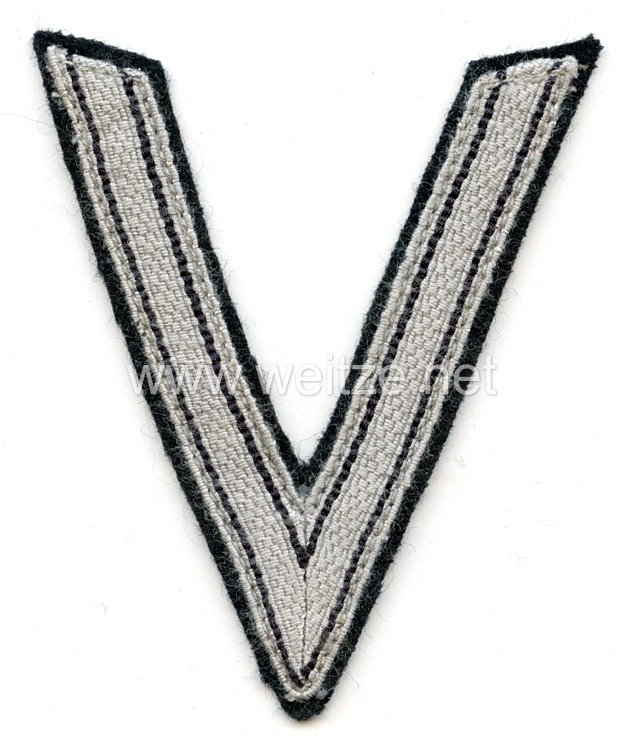
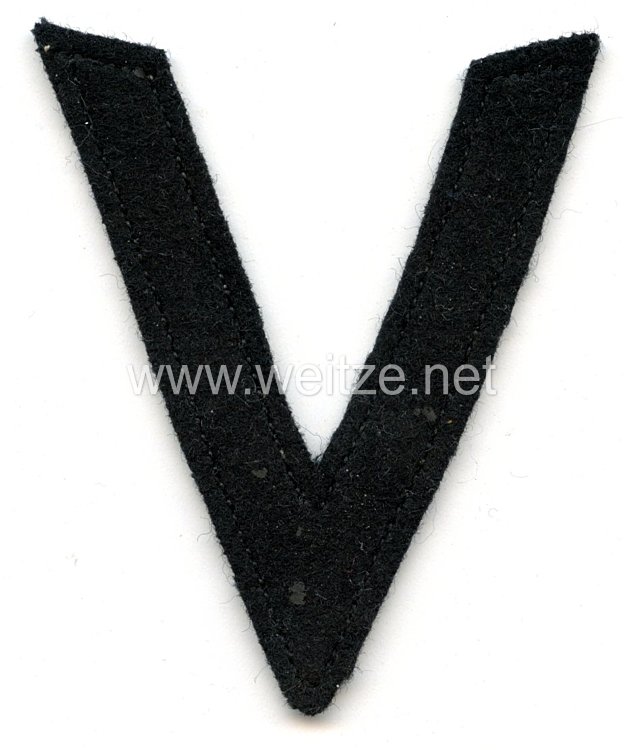
Allgemeine SS Sleeve Chevron for “Alte Kämpfer”

Woven, Condition 2.
440621
350,00

Allgemeine SS Sleeve Chevron for “Alte Kämpfer”

The sleeve chevron for Alte Kämpfer (Old Fighters) of the Allgemeine SS represents a significant distinction element within the uniform-technical hierarchy of the National Socialist organization. These special insignia were worn to identify early membership and long-standing commitment to the NSDAP and its formations before the seizure of power in 1933.

The designation “Alte Kämpfer” referred to those party members who had joined the NSDAP before January 30, 1933, the day of Adolf Hitler's appointment as Reich Chancellor. This status was considered a special honor and was made visible through various badges and decorations. Within the SS, this distinction was regarded as particularly prestigious, as it symbolized ideological loyalty and early commitment to the movement.

The sleeve chevron was manufactured in woven execution, which corresponded to the standard production method for SS rank insignia and distinctions. The weaving technique enabled precise representation of the characteristic silver-gray or aluminum-colored design on a black background, the typical colors of SS uniforming. These sleeve chevrons were worn on the left upper arm of the black SS uniform, usually between shoulder and elbow.

The introduction of such distinctions for Alte Kämpfer occurred within the framework of the comprehensive uniform reforms of the SS in the 1930s. After the seizure of power in 1933, the SS experienced massive expansion, and membership numbers grew rapidly. To distinguish the “old” members from newly joined ones and to recognize their supposedly special merits, various markings were introduced.

The Allgemeine SS, in contrast to the armed Waffen-SS, comprised the civilian formations of the organization. Members of the Allgemeine SS wore the characteristic black uniform with its diverse rank insignia, honor badges, and functional insignia. The sleeve chevron for Alte Kämpfer fitted into this complex system of uniform-technical distinctions.

The manufacture of such insignia was carried out by various authorized manufacturers who worked according to the specifications of the SS clothing works. Quality and execution could vary, with woven variants generally considered of higher quality than embroidered or printed versions. The weaving technique mentioned in the description corresponds to the regular production method for official SS insignia.

Historically, these objects must be understood in the context of the criminal nature of the SS. The organization was classified as a criminal organization by the International Military Tribunal at Nuremberg after World War II. The SS was responsible for the gravest war crimes and crimes against humanity, including the organization and implementation of the Holocaust.

Today, such objects are the subject of military-historical and uniform research. They serve as material witnesses to a dark chapter of German history and are preserved in museums, archives, and collections to keep memory alive and enable scholarly engagement with the Nazi era. In Germany, trade and presentation of such objects are subject to strict legal regulations, particularly Criminal Code § 86a, which criminalizes the use of symbols of unconstitutional organizations, with exceptions for art, science, research, and education.

The preservation and scholarly documentation of such historical objects is nevertheless important to give future generations the opportunity to understand the mechanisms of totalitarian systems, including the role of symbols, badges, and uniforms in creating hierarchies and promoting group belonging and ideological commitment.

r