Waffen-SS Pair of Enlisted Man's Shoulder Straps Motor Vehicle Driver
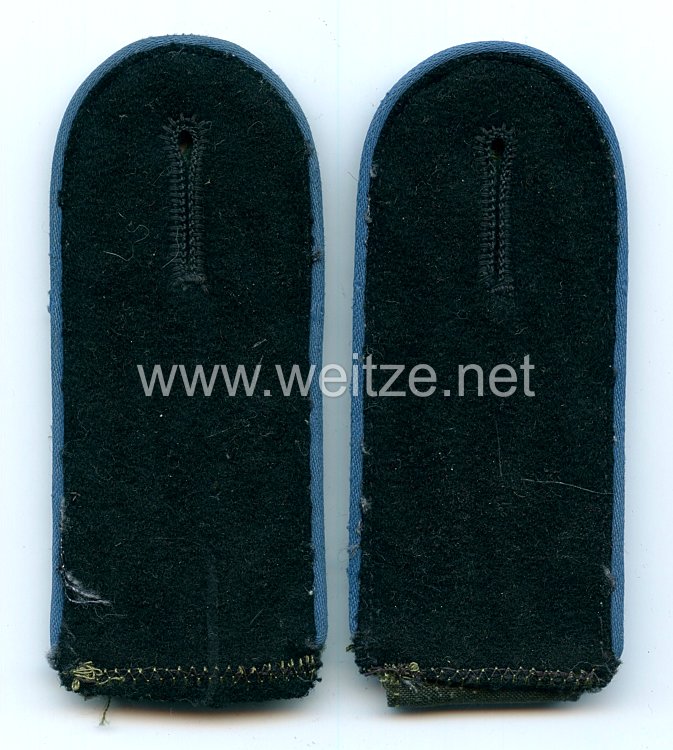
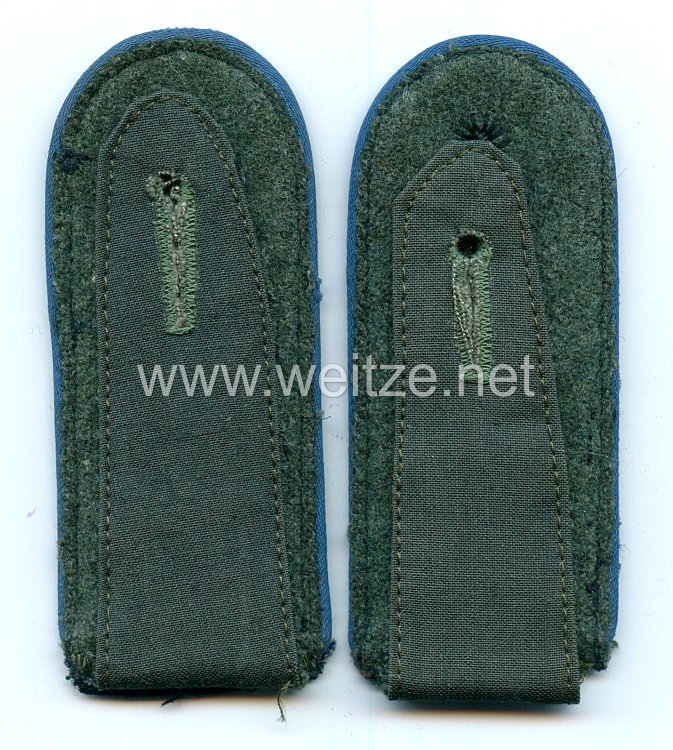
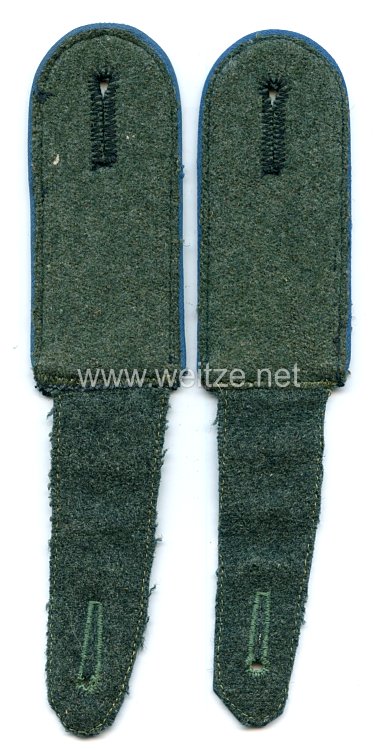
These Waffen-SS shoulder boards for enlisted personnel with light blue Waffenfarbe (branch color) represent an authentic example of uniform insignia used by motorized units during World War II. Dating from the production period of 1943/44, these shoulder straps display the characteristic light blue branch color prescribed for motor vehicle drivers and motorized troops.
The system of Waffenfarben in the Waffen-SS evolved from Wehrmacht traditions and served to quickly identify a soldier's branch of service. The light blue branch color was officially assigned to motor transport troops, while other units wore different colors: white for infantry, pink for armored vehicle crews, red for artillery, and so forth. This color coding enabled superiors and comrades to immediately recognize a soldier's function and specialization.
The shoulder boards for enlisted ranks differed significantly from those of NCOs and officers. While higher ranks wore braided or metal-trimmed shoulder pieces, enlisted men's shoulder boards consisted of simple base material with the respective branch color as backing or piping. The examples described here show the typical execution with loops for attachment to the uniform, which were sewn on during the period - a characteristic feature of field use.
Motor transport troops played a crucial role in the military strategy of the Waffen-SS. The increasing motorization of the Wehrmacht and its associated formations required specialized personnel for the operation, maintenance, and repair of all types of vehicles. Motor vehicle drivers were not merely simple drivers but often trained mechanics who had to be capable of performing repairs under field conditions. Their importance grew particularly after 1942, when German forces operated simultaneously on multiple fronts and logistics came under increasing pressure.
The production period of 1943/44 was a phase of considerable material shortage in the German Reich. The Allied bombing offensive had significant impacts on production capacity, while simultaneously the need for uniforms and equipment increased due to high losses on all fronts. This led to various simplifications in uniform manufacture. Nevertheless, the system of Waffenfarben was largely maintained, as it was considered essential for military organization.
The loop construction described here corresponds to the standard design for shoulder boards of this period. The loops were drawn through the shoulder section of the uniform tunic and fastened on the inside, ensuring secure attachment. The fact that these loops were sewn on during the period indicates that these shoulder pieces were actually worn and did not remain as warehouse stock.
The Waffen-SS developed an extensive system of rank insignia and markings over the course of the war. Unlike the Wehrmacht, which could look back on a long tradition, the Waffen-SS had to develop its own uniform regulations, which, while oriented toward military standards, also integrated unique elements. Shoulder boards, however, remained a connecting element between both organizations.
For collectors and historians, such original pieces are of considerable interest as they represent authentic witnesses to military everyday culture. The stated condition 2 (worn) indicates recognizable signs of use, which underscores authenticity and indicates that these shoulder boards were actually worn by a soldier in service. Signs of wear may include discoloration, slight damage, or wear patterns that were inevitable in field use.
The study of such uniform components contributes to understanding organizational structure, production conditions, and military daily life during World War II. They document not only military hierarchies but also the economic and industrial framework conditions of the war years. These items serve as tangible links to understanding how military organizations functioned and how soldiers were identified within the complex structure of armed forces during this period.