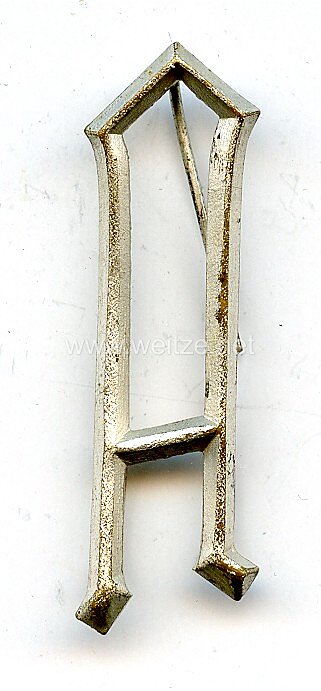
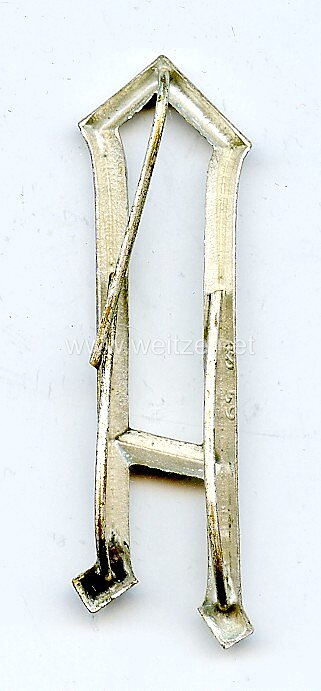
SA Single Collar Tab Insignia for a Pharmacist
The SA single collar tab for a pharmacist presented here represents a fascinating example of the complex rank insignia and uniform structure of the Sturmabteilung (SA) during the National Socialist period. This unworn overlay type in excellent condition documents the detailed hierarchy and specialization within this paramilitary organization.
The Sturmabteilung, officially founded on August 3, 1921, developed a comprehensive system of uniform regulations and insignia from the early 1930s onward. Collar tabs served as essential identifying marks for rank, function, and affiliation with special units or departments. The SA collar tab system was particularly standardized and expanded after the seizure of power in 1933.
The pharmacist within the SA structure belonged to the organization's medical service, designated as the SA-Sanitätswesen (SA Medical Service). This department was systematically expanded to ensure medical care for SA members. Pharmacists had an important function in the provision and administration of medicines and medical supplies for SA units.
The collar tab overlay for pharmacists was characterized by specific symbols identifying the pharmaceutical service. Typically, the Rod of Asclepius or pharmaceutical symbols were used, often in conjunction with the characteristic brown background of the SA uniform. Execution was usually in metal embroidery or as a metal overlay on fabric backing.
The manufacture of such collar tabs was subject to strict quality regulations and was carried out by authorized manufacturers. Companies such as Assmann, Deschler, and other specialized military effects manufacturers produced these insignia according to SA leadership specifications. The unworn condition presented here suggests that the piece was either procured as a replacement but never mounted, or comes from warehouse stocks.
In the context of the SA organization, medical personnel were divided into various ranks and functions. The pharmacist could hold different service grades, from simple pharmaceutical assistants to higher positions as SA-Sanitäts-Apotheker (SA Medical Pharmacist). The corresponding collar tabs varied according to rank and specific function.
According to the SA clothing regulations, which were revised several times, collar tabs were mandatory and had to be properly attached to the uniform. The exact positioning and execution were regulated in detail. The brown uniform of the SA with its various insignia became one of the most recognizable visual symbols of the Nazi era.
The importance of the SA medical service grew particularly in the years 1933-1934, when the SA reached its peak with several million members. However, after the “Röhm Affair” in June 1934, the SA lost considerable significance and was effectively stripped of power. The medical personnel remained in place, but the organization was drastically reduced in size.
From a military-historical perspective, such unworn collar tabs are important documents of uniform studies and phalerisics. They enable the reconstruction of complex organizational structures and provide insight into the self-representation and internal hierarchy of paramilitary organizations. The preservation condition as “unworn” makes such pieces particularly valuable for museum collections and scientific studies.
The classification as condition 2 according to the usual evaluation criteria for militaria indicates very good preservation, with possibly minimal storage or aging traces, but without damage or heavy wear. This underscores the documentary value of the object.
Today, such artifacts primarily serve historical research and education. They document a dark chapter of German history and help understand the structures and self-image of Nazi organizations. Museums and research institutions preserve such objects as testimonies of the period, always emphasizing the critical historical context.