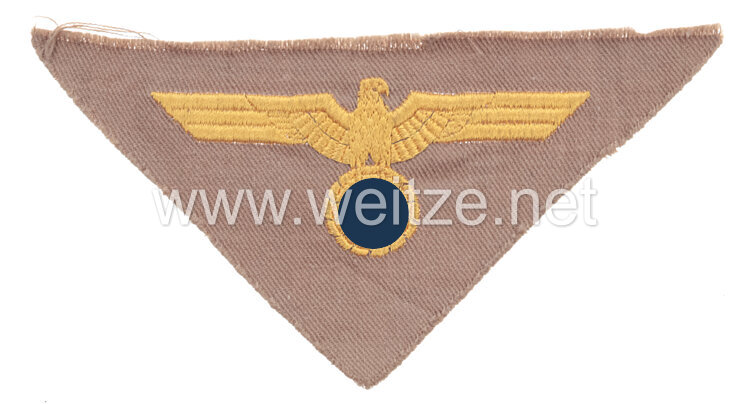
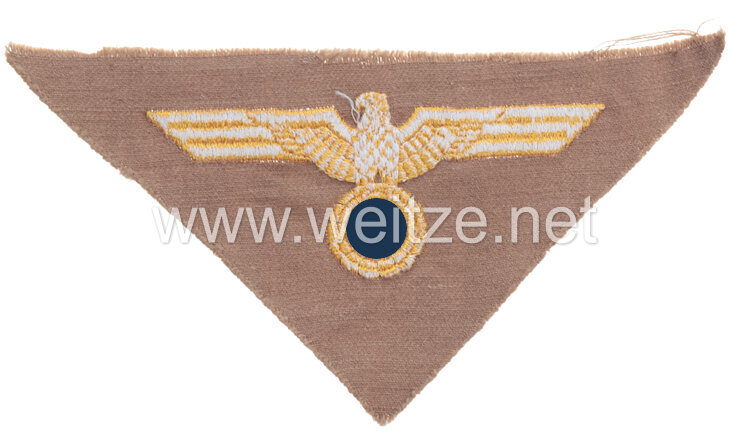
Kriegsmarine Breast Eagle for Tropical Field Blouse
The Kriegsmarine Breast Eagle for Tropical Field Tunic represents a fascinating example of German naval uniform insignia during World War II. This machine-embroidered national emblem in yellow execution on sand-colored backing was specifically developed for the tropical uniform of the German Kriegsmarine and represents the adaptation of military equipment to different climate zones and operational theaters.
The Kriegsmarine, the official designation of the German Navy from 1935 to 1945, required various uniform variants for its worldwide operations. While the traditional blue naval uniform was designed for temperate climates, deployments in North Africa, the Mediterranean region, and other warm areas required special tropical uniforms. The tropical field tunic was manufactured from lightweight, sand-colored or olive-green fabric and was significantly more breathable than the standard uniform.
The national emblem or breast eagle was a mandatory element of all German Wehrmacht uniforms and symbolized National Socialist state sovereignty. For the Kriegsmarine, the eagle was depicted characteristically with outstretched wings and a swastika in its talons. The position of the eagle was standardized on the right chest side of the uniform, above the breast pocket.
The machine-embroidered execution was the most widespread manufacturing method for uniform insignia during the war. In contrast to hand-embroidered variants, which were primarily reserved for higher-ranking officers, machine-embroidered insignia could be produced in larger quantities and were more cost-effective. The embroidery typically took place on a pre-formed backing fabric, which was then sewn onto the uniform.
The color scheme in yellow on sand color was specifically prescribed for the tropical uniform. This color choice differed significantly from the dark blue or black eagles on the standard Kriegsmarine uniforms. The yellow embroidery formed a clear contrast to the sand-colored background and ensured the visibility of the national emblem without being too obtrusive. The color choice followed the Army Regulation Sheets (HVBl) and specific naval regulations.
The Kriegsmarine employed tropical uniforms primarily in various operational areas. These included Mediterranean operations, particularly in support of Rommel's Afrika Korps, naval bases in North Africa, U-boat bases in warmer regions, and naval units overseas. Crews of commerce raiders and auxiliary cruisers operating in tropical waters also wore this uniform variant.
The production of such insignia was carried out by various textile manufacturers in the German Reich and in occupied territories. Well-known manufacturers included companies in Berlin, Hamburg, and Bremen. The quality of execution varied depending on the manufacturer and production period. Towards the end of the war, material quality often deteriorated due to raw material shortages.
An unworn specimen in condition 1 is today of particular collector-historical interest. Such pieces show no signs of wear, discoloration, or damage and remain in their original delivery condition. They enable historians and collectors to study the original quality and execution of these military equipment items. The preservation of such objects is important for military-historical research and the documentation of uniform studies.
The historical significance of such insignia lies not only in their military function but also in their role as contemporary historical documents. They testify to the organization, logistics, and worldwide expansion of German warfare during World War II. At the same time, they serve as a reminder of a dark period in German history and should be viewed exclusively in the context of historical education and research.
In modern militaria research, such objects serve to document manufacturing techniques, material usage, and uniform-related details. They contribute to understanding the everyday reality of soldiers and help to reconstruct history more comprehensively. Museums and scientific institutions preserve such objects as part of cultural heritage, always maintaining a historically-critical context.