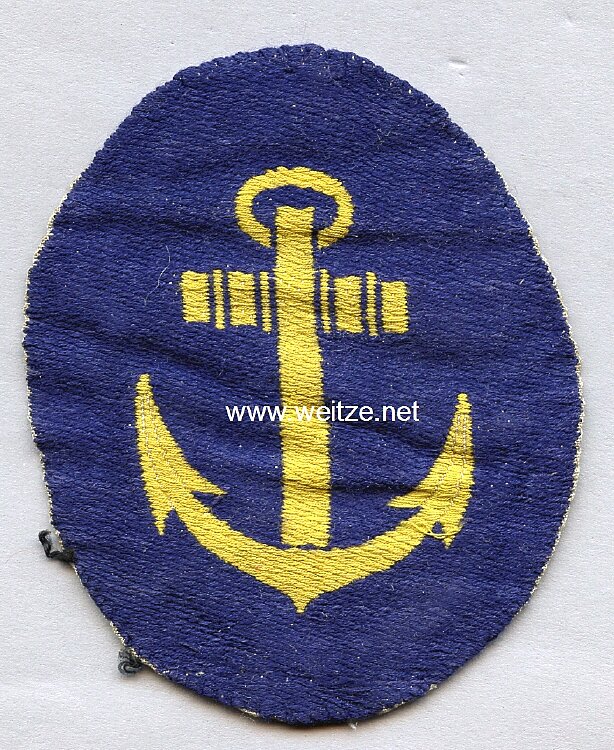
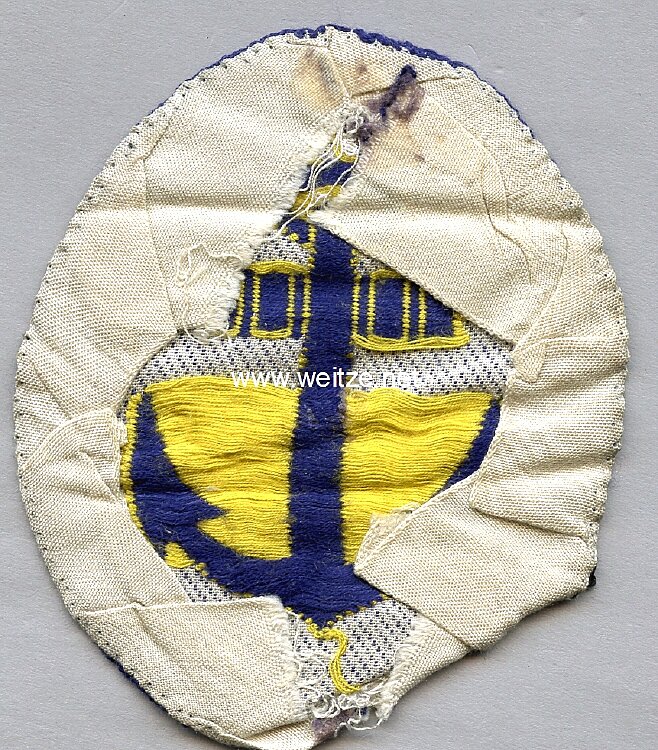
Kriegsmarine Sports Uniform Badge for Petty Officers
The Kriegsmarine Sports Uniform Badge for Petty Officers represents a fascinating example of German naval uniform regulations during the Second World War. These woven badges were specifically designed for the sports clothing of Kriegsmarine petty officers and reflect the strict hierarchy and order that prevailed in Nazi Germany.
The Kriegsmarine, the official designation of the German Navy from 1935 to 1945, experienced comprehensive expansion and modernization under the leadership of Grand Admiral Erich Raeder and later Karl Dönitz. With the reintroduction of universal conscription in 1935 and the open rejection of Versailles Treaty restrictions, Germany began the massive expansion of its naval forces.
The Kriegsmarine's uniform regulations were extraordinarily detailed and governed every aspect of military dress. This applied not only to parade and service uniforms but also to special garments such as sports suits. Physical fitness was a central component of military training, and accordingly, special uniforms with corresponding rank insignia were prescribed for athletic activities.
The woven construction of these badges was technically demanding and required specialized textile manufacturers. Unlike embroidered or metal versions, these badges were completely woven from colored yarns, making them more cost-effective to produce while simultaneously more durable for use on sports clothing. The weaving technique allowed for precise representation of the characteristic Kriegsmarine insignia - the Reich eagle with swastika and specific rank badges.
For petty officers (Maate and Obermaate), these badges were particularly important as they represented the middle leadership level of the Kriegsmarine. The petty officer ranks included various grades such as Maat, Obermaat, Bootsmann, Oberbootsmann, and Stabsoberbootsmann. Each of these ranks had its own specific badges that also had to be worn on sports clothing to maintain the military hierarchy even outside formal service.
Sports training in the Kriegsmarine followed strict guidelines and included various disciplines such as track and field, swimming, rowing, and boxing. The Reich Sports Badge and navy-specific sports tests were integral parts of military training. During these activities, soldiers wore special sports suits that were adorned with the appropriate rank insignia.
The production of these badges was carried out by various suppliers authorized by the Wehrmacht. Quality control was strict, and the badges had to meet certain standards. The woven variant was particularly widespread in the later war years when material and resource shortages led to simplified production methods.
The described condition “lightly worn, condition 2” indicates that this specimen was actually used, which gives it special historical value. Such worn pieces are authentic testimonies of military daily life and differ from unworn warehouse stock or modern reproductions.
After the collapse of the Third Reich in May 1945, the Kriegsmarine was dissolved and all its insignia and badges became obsolete. The Allied forces prohibited the wearing of National Socialist symbols, and many of these items were destroyed or lost. The surviving specimens are today important historical artifacts preserved in museums and private collections.
From today's perspective, such objects are significant sources for military historical research. They document not only the uniform regulations and textile craftsmanship of the time but also the all-encompassing militarization of German society under National Socialism. The fact that even sports clothing required specific rank badges underscores the total permeation of military life with hierarchical structures.
Collectors and historians today value these badges as important objects of study, whereby the historical context and critical examination of the Nazi era must always remain paramount. The scholarly engagement with such objects serves to understand this dark period of German history and as a warning against the dangers of militaristic and totalitarian systems.