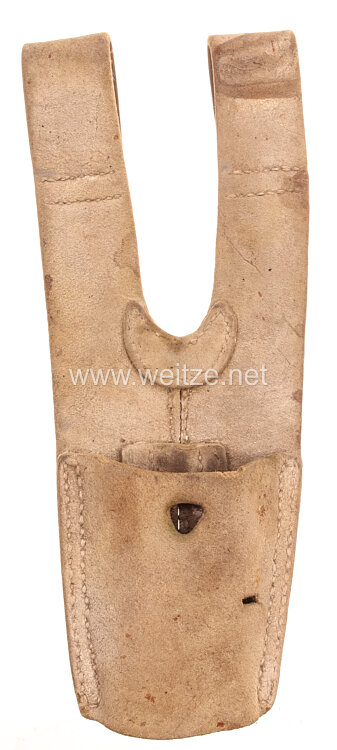
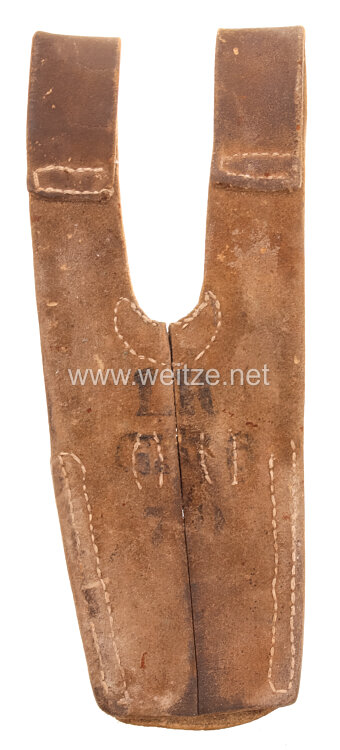
Italian Belt Frog for a Fascine Knife circa 1840/60

Made of thick blackened leather, two carrying loops, designed for a non-detachable side arm and an additional socket bayonet with scabbard, reverse with ink stamp, worn piece in good condition, rare. Condition 2-
451220
150,00

Italian Belt Frog for a Fascine Knife circa 1840/60

The Italian belt frog for a fascine knife from the mid-19th century represents a fascinating period in military history, characterized by technical innovation and the reorganization of European armies following the Napoleonic Wars. This particular piece of equipment, manufactured from thick whitened leather, served the practical purpose of carrying pioneer and infantry equipment in the Italian states before the unification of Italy.

During the period between 1840 and 1860, the Italian peninsula found itself in a phase of political fragmentation alongside simultaneous military modernization. The various kingdoms and duchies – including the Kingdom of Sardinia-Piedmont, the Kingdom of the Two Sicilies, and the Papal States – maintained separate armies with differing equipment standards. The fascine knife, a robust cutting tool with a broad blade, was an indispensable component of pioneer equipment and served both military and field engineering purposes.

The construction of this belt frog demonstrates the practical necessity of carrying multiple weapons simultaneously. Equipped with two carrying loops, it enabled the concurrent carrying of a non-socket side arm – presumably the fascine knife itself – as well as an additional socket bayonet with scabbard. This combination was characteristic of pioneer troops and sappers, who required both tools for entrenchment work and weapons for combat.

The whitened leather used, also known as white leather or alum-tawed leather, had been treated through a special tanning process using alum or other mineral salts. This tanning method was widespread in the first half of the 19th century and produced a light-colored, relatively supple leather that was both durable and easy to maintain. The typical white or cream-colored appearance of the material corresponded to the military aesthetic standards of the era and facilitated equipment inspection.

The ink stamp on the reverse of this specimen points to the military administrative practices of the time. Such stamps served to mark ownership, unit, or depot and enabled the tracking of equipment items. Various stamping systems were used in the Italian armies, frequently containing regimental numbers, branch of service, or depot designations.

The historical significance of this period cannot be overstated. The years between 1840 and 1860 marked the preparatory phase for the Risorgimento, the Italian unification movement. Military reforms in Sardinia-Piedmont under King Charles Albert and later Victor Emmanuel II aimed to create an effective army modeled on French and Austrian examples. The standardization of equipment, including such carrying devices, was part of these modernization efforts.

The fascine knife itself, also known as a sapper's knife or pioneer knife, had a long military tradition. With its broad, heavy blade, it was designed for felling trees, constructing entrenchments and trenches, and cutting through obstacles. In 19th-century armies, pioneers, sappers, and sometimes special infantry companies typically carried these tools.

The combination with a socket bayonet is particularly revealing. The socket bayonet, which was fitted onto the gun barrel through a socket, was still widely used during this period, although the more modern socket bayonet was already in use. The necessity of carrying both weapons simultaneously arose from tactical considerations: the fascine knife was too heavy and unwieldy for immediate close combat, while the bayonet represented the primary melee weapon.

The preservation of such equipment items has become rare today. Leather equipment was subject to heavy wear, and after Italian unification in 1861, much of the older equipment was decommissioned or reworked. The fact that this specimen was worn, as evidenced by signs of use, yet remained in good condition, makes it a valuable testimony to the military everyday culture of the 19th century.

For collectors and historians, such objects provide important insights into the practical aspects of military service. They complement our understanding beyond uniforms and weapons and show how soldiers carried and organized their equipment in daily service. The Italian belt frog for fascine knives thus stands as exemplary for an era of transition in European military history, bridging the gap between Napoleonic-era equipment and the more standardized military materiel that would emerge following Italian unification.

The period also witnessed significant changes in military organization and tactics. The introduction of rifled muskets and improvements in artillery were transforming battlefield dynamics, yet traditional roles such as pioneer work remained essential. Equipment like this belt frog represents the continuity of certain military functions even as technology advanced, demonstrating that armies needed to balance innovation with proven practical solutions for field operations.

r