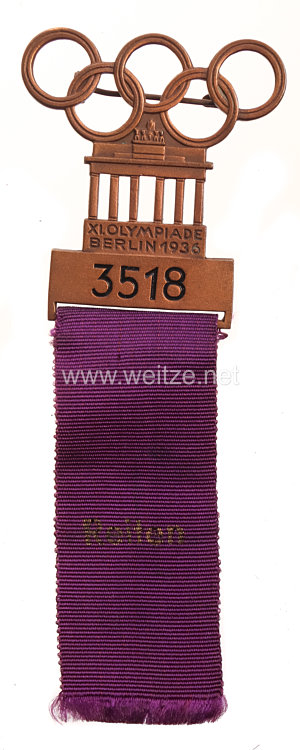
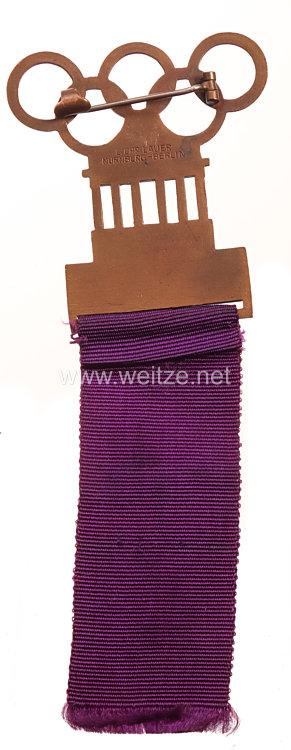
XI Olympic Games 1936 Berlin - Official Participant Badge for an Athlete in the Equestrian Discipline
The official participant badge of the XI Olympic Games 1936 in Berlin represents a significant artifact from one of the most controversial Olympic events in history. These badges were issued to active athletes who competed in the games and served as official proof of their participation rights as well as identification during the event.
The 1936 Olympic Games took place from August 1 to 16 in Berlin and were instrumentalized by the National Socialist regime as a propaganda event. Despite international calls for boycotts, 49 nations participated with a total of 3,961 athletes, which was a record at the time. The Games were held under the auspices of the International Olympic Committee (IOC) and the German Organizing Committee.
This badge was manufactured by the renowned maker L.Chr. Lauer of Nuremberg-Berlin. The Christian Lauer company was one of the leading manufacturers of orders, decorations, and badges in the German Reich and was frequently commissioned to produce official state and sporting awards. The badge is made of tombac, a copper-zinc alloy that was often used for decorative purposes due to its gold-like color and good processing properties.
Each participant badge bore an individual serial number, in this case number 3518, which was assigned to the respective athlete. This numbering enabled precise control and registration of all participants and simultaneously served as access authorization to competition venues and official events. The systematic numbering reflects the characteristic German organizational precision that was applied during the execution of these Games.
Particularly noteworthy is the attached dark purple ribbon inscribed with “Reiten” (Equestrian). The Olympic equestrian events of 1936 took place primarily at the Maifeld and in the Deutschlandhalle complex as well as in Döberitz. Equestrian sport was traditionally one of the most prestigious Olympic disciplines and included competitions in Dressage, Show Jumping, and Military (Three-Day Eventing). Only officers participated in equestrian competitions, as this was an Olympic requirement until 1948.
At the 1936 Games, 133 participants from 21 nations competed in equestrian sports. German riders achieved considerable success and won several medals, which brought additional prestige to the host Reich. The equestrian events attracted an international audience and were considered social highlights of the Games.
The color coding of the ribbons served for quick visual identification of the various sporting disciplines. Each sport had its own ribbon color, which greatly facilitated organization and access control at the different venues. The dark purple ribbon for equestrian sport was part of this sophisticated system.
From a military-historical perspective, these badges are particularly interesting because the 1936 Olympic Games took place at a time when Germany was already massively rearming and preparing for the coming conflict. Many of the participating athletes, especially in equestrian sports, were active or former military personnel. The Games were deliberately used to demonstrate the supposed peacefulness and normalcy of National Socialist Germany, while simultaneously showcasing the military and organizational strength of the regime.
The authenticity of such badges can be verified through several features: the correct maker's mark, material composition, quality of striking, numbering, and the condition and inscription of the ribbon. The present specimen exhibits all characteristic features of an original participant badge.
Today, these badges are sought-after collectors' items that are of great importance both in sports history and contemporary history. They document participation in a world-historical event that, despite its instrumentalization by the Nazi regime, produced outstanding athletic performances while simultaneously serving as a memorial to the dangers of politicizing sports.
The stated condition 2 corresponds in collector terminology to very good condition with only minor signs of use, which is remarkable for an object over 85 years old. This indicates that the badge was carefully preserved and has largely maintained its historical integrity.
These participant badges from the 1936 Olympics remain important historical documents that provide insight into the complex intersection of sports, politics, and military culture in the interwar period. They serve as tangible reminders of an era when international sporting competition was overshadowed by the gathering storm of the Second World War.