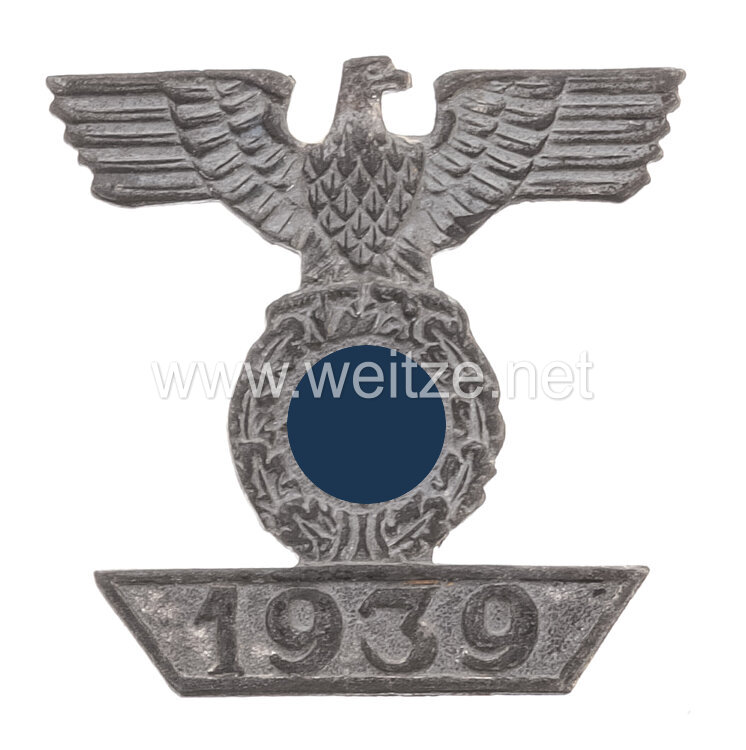
1939 Clasp to the Iron Cross 2nd Class 1914
The 1939 Clasp for the 1914 Iron Cross 2nd Class represents a fascinating testimony to German military history, connecting two world wars in a single decoration. This special award was instituted by decree of Adolf Hitler on September 1, 1939, the day of the German invasion of Poland and thus the beginning of World War II.
The historical significance of this clasp lies in its bridging function between the two world wars. Veterans of the First World War who had already received the Iron Cross 2nd Class during the period from 1914 to 1918 and who again distinguished themselves through bravery in the Second World War received this repeat clasp instead of a renewed award of the Iron Cross. This honored both their service in the First World War and their continued valor in the new conflict.
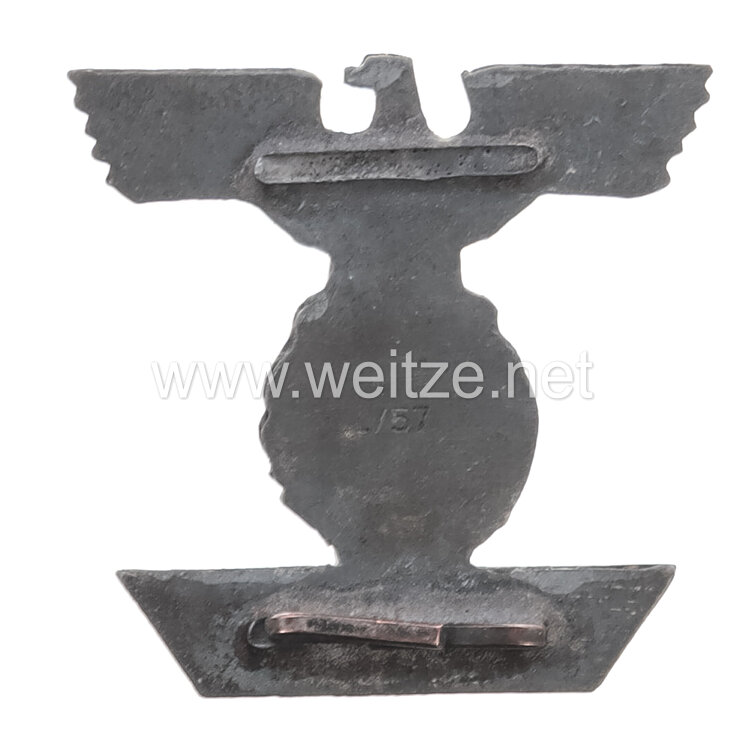
The present specimen was manufactured by the firm Boerger & Co. of Berlin, one of numerous medal manufacturers commissioned during World War II to produce military decorations. The reverse marking L/57 is a manufacturer's code used within the system introduced in July 1941 for identifying order producers. This coding was designed to ensure traceability while simultaneously concealing the actual manufacturing firm for strategic reasons.
The clasp is made of fine zinc, a material increasingly used particularly in later phases of the war, as precious metals and bronze were progressively needed for armaments production. The use of zinc was a practical solution that enabled cost-effective mass production while maintaining the symbolic significance of the decoration.
The repeat clasp displays in its design a stylized eagle with spread wings holding a swastika in its talons, as well as the year 1939. This motif differed markedly from the design of the 1914 Iron Cross, which bore the monogram of Kaiser Wilhelm II and the year 1914. The clasp was worn on the ribbon of the original 1914 Iron Cross 2nd Class, with the ribbon characterized by the distinctive black, white, and red colors of the German Empire.
The criteria for awarding the repeat clasp were clearly defined in the corresponding regulations. The bearer had to already be in possession of the 1914 Iron Cross 2nd Class and had to distinguish himself again through special bravery before the enemy in World War II. The award was made by military superiors and was documented in personnel files.
The absence of the upper pins on this specimen is a common finding among surviving pieces. The pins served to attach the clasp to the order ribbon and were subjected to considerable mechanical stress. Over the decades, these small metal pins were often lost or broke off, which does not, however, diminish the historical authenticity of the object.
The firm Boerger & Co. was one of many manufacturers producing orders and decorations on behalf of the German government. The quality of manufacture varied depending on the time of production and available materials. Early wartime productions often exhibited higher craftsmanship quality, while later specimens became increasingly simplified due to material shortages and time pressure.
From a historical perspective, the 1939 Repeat Clasp documents the continuity of German military tradition beyond the break of 1918. It symbolizes the Nazi regime's attempts to connect with Prussian-German military traditions and instrumentalize them for its own purposes. At the same time, it represents the personal fates of soldiers who experienced two world wars and fought in both conflicts.
Today, such repeat clasps are important objects of study for military historians and collectors. They provide insights into manufacturing techniques, material usage, and the organization of the German decorations system during World War II. Manufacturer markings such as the L/57 designation help identify production periods and manufacturing firms, contributing to the authentication of historical objects.
The clasp's place in the broader system of German military decorations is noteworthy. It formed part of a comprehensive hierarchy of awards that recognized various levels of achievement and service. The distinction between recipients of the 1914 Iron Cross who served again in 1939 and those who received the decoration for the first time in World War II reflects the complex social and military structure of the German armed forces during this period.