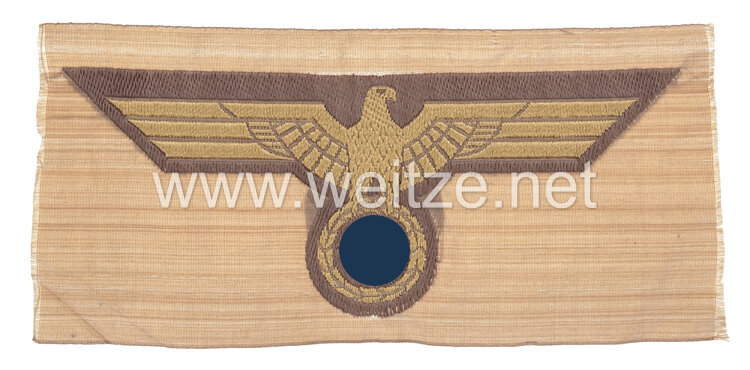
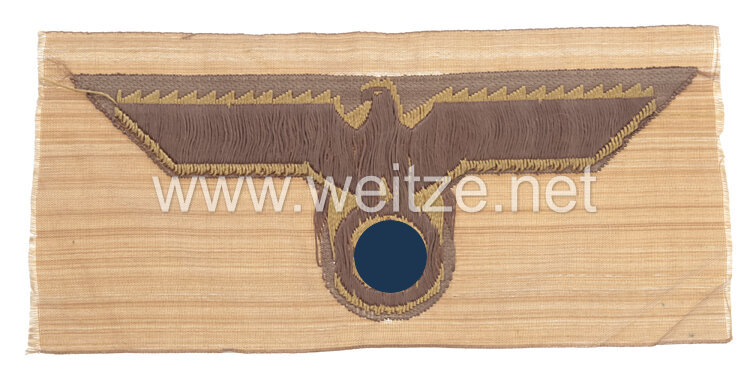
Kriegsmarine Breast Eagle for Tropical Field Blouse

Bevo-woven version in yellow on sand color. Unissued condition, condition 2+.
463819
250,00

Kriegsmarine Breast Eagle for Tropical Field Blouse

The Kriegsmarine Breast Eagle for the Tropical Field Tunic represents a specific insignia of the German Navy during World War II, designed for use in tropical and subtropical climates.

Historical Background

With the expansion of German Reich military operations into North African and Mediterranean territories from 1941 onwards, the necessity for specialized uniforms suited to hot climates became evident. The Kriegsmarine developed corresponding tropical uniforms that differed from standard uniforms in both material and coloration. These uniforms were primarily used by naval units stationed in the Mediterranean region, North Africa, and other warm areas.

Manufacturing and Materials

The example described here is manufactured using the Bevo weaving technique, named after Barmer Bandweberei Vogt, a leading manufacturer of woven insignia. This technique enabled machine production of fabric badges with fine details and was widespread during the war. The eagle is woven in yellow on a sand-colored background, corresponding to the typical coloration for Kriegsmarine tropical insignia. The sand-colored base harmonized with the beige to khaki-colored tropical uniforms.

Design and Symbolism

The breast eagle depicts the national eagle of the German Reich with outstretched wings, clutching a swastika in its talons. This representation was the official symbol of the Wehrmacht and its branches. Unlike the naval service uniform in classic blue, where the eagle was frequently attached in metallic or silver form, tropical insignia were designed as fabric badges for practical reasons.

Wearing and Usage

The breast eagle was mounted centrally on the right breast of the tropical field tunic, typically above the breast pocket. The field tunic itself was made from lightweight, breathable material and finished in a light sand tone. These uniforms were worn by naval personnel of various ranks deployed in warm climates, including crews of U-boats in the Mediterranean, harbor personnel at North African bases, and other naval units.

Production and Distribution

The manufacture of tropical insignia was carried out by various authorized producers, with the Bevo technique being one of the most common production methods. The insignia were issued through military supply channels but could also be privately procured. The yellow coloration of the eagle on a sand-colored ground was specific to the tropical version and differed markedly from the dark blue or black variants for standard uniforms.

Historical Significance

These insignia document the global expansion of German military operations during World War II and the necessary adaptations in equipment and uniforms. The Kriegsmarine's deployment extended far beyond European waters, and tropical insignia like this are material testimonies to this geographical expansion. Particularly in the Mediterranean, the Kriegsmarine played a significant role in supporting the Afrika Korps and in operations against Allied shipping routes.

Collector Value and Preservation

Unworn specimens in very good condition, such as the piece described here with a grade of 2+, are relatively rare today. Most tropical insignia were actually used and show corresponding signs of wear. The sandy environment and intense sun exposure in deployment areas frequently led to discoloration and material deterioration. Therefore, well-preserved, unworn pieces are of particular historical and collector interest and enable precise examination of original manufacturing quality and coloration.

Context in Naval History

The development and deployment of specialized tropical uniforms reflects the adaptability of the Kriegsmarine to diverse operational theaters. From the Arctic convoys to the Mediterranean and even operations in the Indian Ocean, German naval forces required appropriate equipment. The tropical breast eagle serves as a reminder of the lesser-known aspects of naval warfare during World War II, particularly the challenges of maintaining military effectiveness in extreme climates while adhering to regulations regarding uniform standards and insignia.