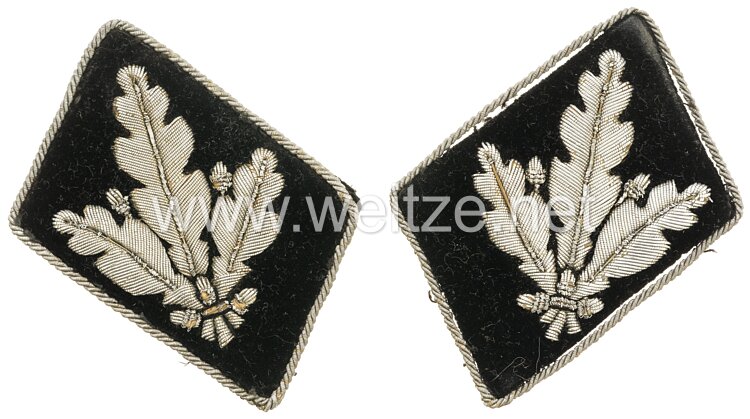
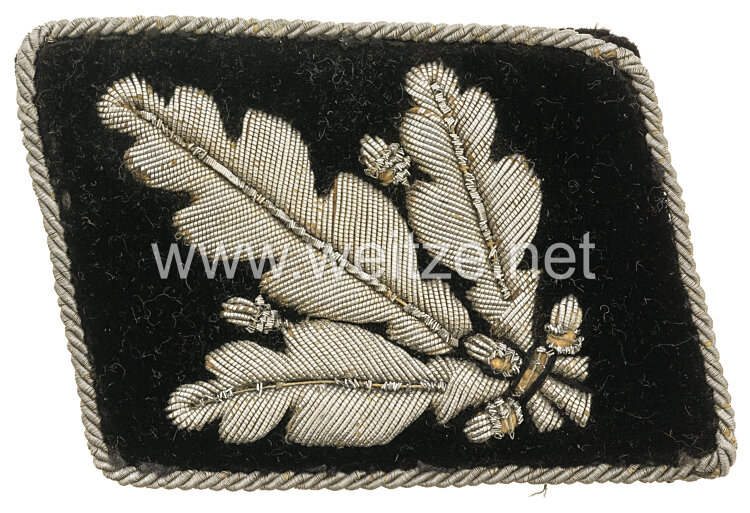
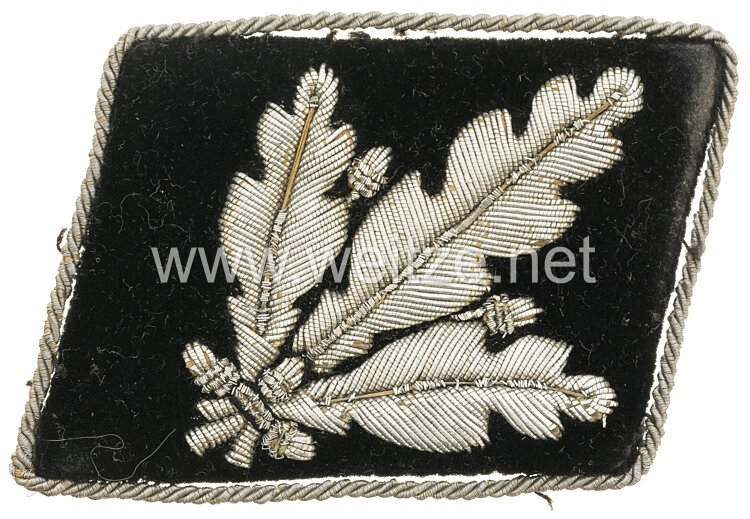
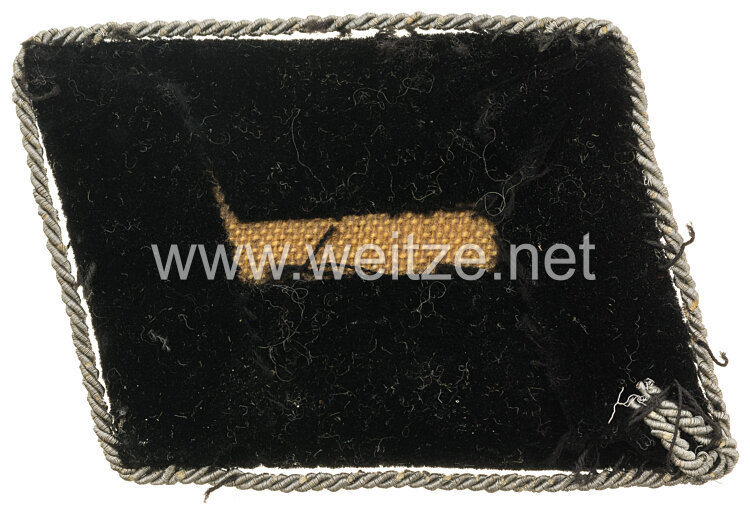
Waffen-SS Pair of Collar Tabs for an SS-Brigadeführer

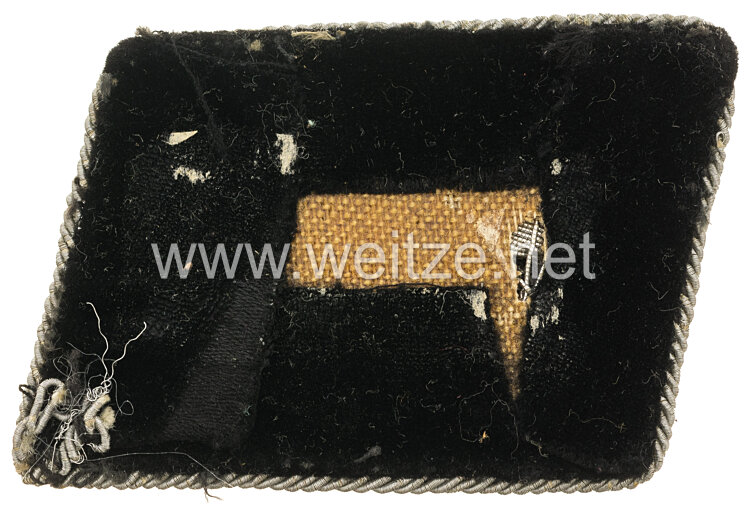
Pattern from 1941 onwards. Hand-embroidered metal thread execution on black velvet cloth. Clearly worn, condition 2-.
Very rarely found as worn collar tabs.
460318
4.200,00

Waffen-SS Pair of Collar Tabs for an SS-Brigadeführer

These collar tabs of an SS-Brigadeführer of the Waffen-SS from the period beginning in 1941 represent a significant testimony to the military rank insignia of National Socialist Germany. These hand-embroidered insignia made of metal thread on black velvet document the complex hierarchy and distinction system of the SS organization during World War II.

The rank of SS-Brigadeführer corresponded to a Major General in the Wehrmacht and represented a high leadership rank within the SS hierarchy. This rank was introduced in 1932 and was positioned between SS-Oberführer and SS-Gruppenführer. Holders of this rank typically commanded brigades or occupied important staff positions within SS structures.

The design from 1941 onwards marks an important phase in the development of SS uniforming. After the beginning of the war against the Soviet Union in June 1941, various simplifications and standardizations were implemented in uniform production. Nevertheless, higher-ranking officers often retained the option of wearing higher quality, hand-embroidered versions, as presented here.

The collar tabs (Kragenspiegel) were essential components of the SS uniform and fulfilled a dual function: on the right side, all SS members wore the characteristic runes, while rank insignia were attached on the left side. For a Brigadeführer, the rank insignia consisted of three oak leaves with a star, executed in aluminum or silver thread on a black velvet background.

The hand-embroidered execution with metal thread indicates private procurement or manufacture by specialized effects producers. During the war, numerous companies specialized in the production of uniform effects, including well-known manufacturers such as ASSMANN, BeVo, or RZM-approved enterprises. The hand-embroidered variant was more elaborate and expensive than machine-woven or machine-embroidered versions and was preferred by higher officers.

The black velvet as base material was characteristic of SS uniforming and differed distinctly from the Waffenfarben (branch colors) of the Wehrmacht. The black basic color of the SS uniform had its origins in the early 1930s and was intended to express elite consciousness and distinction. However, field-gray cloth was later also used for field uniforms of the Waffen-SS.

The described worn condition of these collar tabs gives them special historical value. Unlike unworn depot or dealer pieces, they document actual use in historical context. Signs of wear may include thread pull, slight oxidation of the metal thread, wear on the velvet, or attachment traces. Such authentic, worn pieces are significantly rarer on the collector market than unworn examples.

The Waffen-SS, which emerged from the SS-Verfügungstruppe, developed during World War II into a significant military formation with at times over 900,000 men. The organization was directly subordinate to Heinrich Himmler and operated parallel to the Wehrmacht. Brigadeführer of the Waffen-SS commanded important units on all fronts of the war.

From a historical perspective, such objects are significant material witnesses of a criminal organization. The SS was significantly involved in the crimes of the National Socialist regime, including the Holocaust and numerous war crimes. The scholarly examination of such objects always requires contextualization within historical responsibility and remembrance of the victims.

The authentication of such collar tabs requires in-depth knowledge of manufacturing techniques, materials, and construction details. Experts pay attention to the type of embroidery, the quality of the metal thread, the nature of the base material, the back design, and not least to signs of aging and use. The market for SS devotional items was and is unfortunately also affected by counterfeits, which is why scientifically sound expertise is essential.

In summary, these collar tabs of an SS-Brigadeführer represent a complex historical artifact that documents both the military hierarchy and the craft standards of uniform manufacturing in the Third Reich. Their significance lies in their testimonial value for historical research and education about this dark epoch of German history.

r