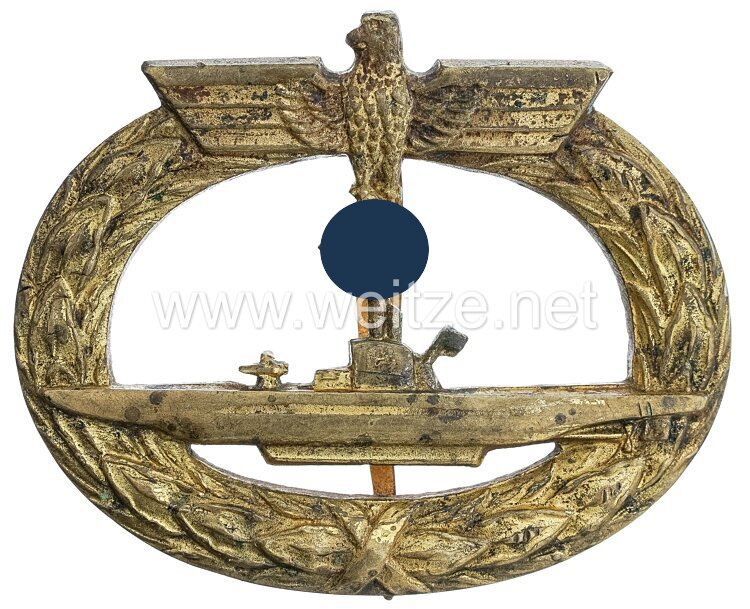
U-Boat War Badge

Non-ferrous metal, gilded, hand-curved slightly convex. Manufactured by Schwerin-Berlin.
467118
950,00

U-Boat War Badge

The U-Boat War Badge (U-Bootkriegsabzeichen) represents one of the most significant military decorations of the German Kriegsmarine during World War II. This award was instituted on October 13, 1939 by Grand Admiral Erich Raeder and was intended to honor the exceptional performance and courage of U-boat crews who served under extreme conditions.

This particular specimen was manufactured by the firm Schwerin-Berlin, one of the recognized producers of military badges during the National Socialist era. The construction from non-ferrous metal with gold plating and the hand-curved workmanship demonstrate the traditional manufacturing methods of these military decorations. Schwerin-Berlin, alongside other manufacturers such as Funcke & Brüninghaus or Friedrich Orth, was known for producing high-quality military insignia.

The award criteria for the U-Boat War Badge were clearly defined: Initially, a submariner had to complete at least two successful war patrols. Later, the regulations were modified several times. From February 1, 1940, the badge could be awarded after a single patrol if it lasted at least six weeks. Commanders could receive the decoration after their first successful patrol. Wounds sustained during U-boat service could also lead to the award being granted.

The badge's design typically features a Type VII U-boat at the center, surrounded by an oak leaf wreath and crowned by an eagle with swastika. This symbolism was intended to represent the connection between military technology, German tradition (oak leaves), and the National Socialist state. The oval form and detailed workmanship made the badge one of the more aesthetically sophisticated military honors of this period.

The U-boat arm played a central role in German naval warfare strategy. Particularly during the Battle of the Atlantic from 1939 to 1945, the Kriegsmarine attempted to interrupt Allied supply lines through U-boat deployment. The losses among U-boat crews were alarmingly high: of approximately 40,000 submariners, more than 30,000 did not return – a loss rate exceeding 75 percent. This illustrates the extreme dangers under which these servicemen performed their duties.

Life aboard a U-boat was characterized by cramped conditions, constant dampness, poor air quality, and the permanent threat from enemy destroyers and aircraft. The technical development of Allied detection systems, particularly radar and sonar (ASDIC), made U-boat patrols increasingly dangerous. The so-called “Black May” of 1943 marked a turning point when the German U-boat force suffered catastrophic losses.

Besides the regular U-Boat War Badge, other variants existed: The U-Boat War Badge with Diamonds, awarded only twice, as well as special versions for combat swimmers and midget submarines. These gradations reflected the hierarchy of achievements and the importance attached to submarine warfare.

From today's perspective, such military decorations are important historical artifacts that help us understand the military history of the 20th century. They document not only the technical and strategic aspects of warfare but also the mental and social history of an era. At the same time, handling such objects is sensitive, as they are inseparably connected with the National Socialist regime and its crimes.

The manufacture by Schwerin-Berlin and the craftsmanship with gold plating make this specimen a characteristic example of badge production of that time. The individual hand-curving shows that despite industrial manufacturing, traditional craftsman techniques were still applied, giving each piece a certain uniqueness.

The U-Boat War Badge remains a tangible reminder of the technological warfare, human sacrifice, and historical complexities of World War II naval operations. Its study contributes to our understanding of military culture, industrial production of honors, and the broader context of mid-20th century European history.

r