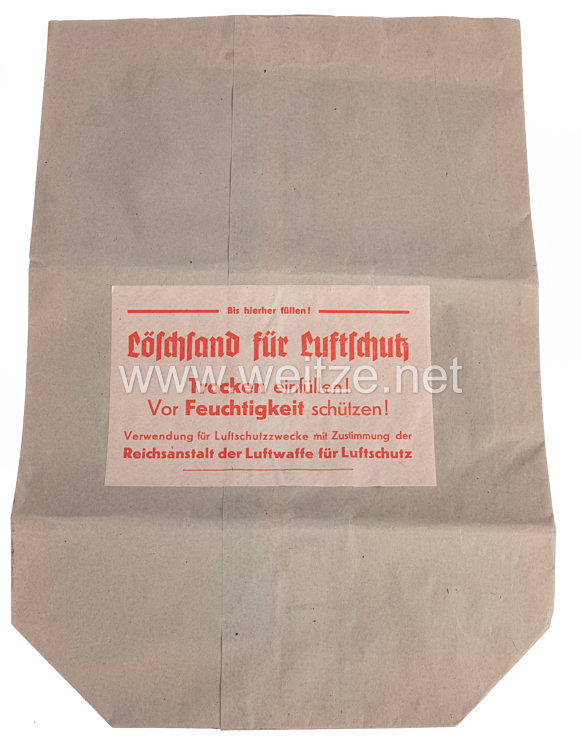
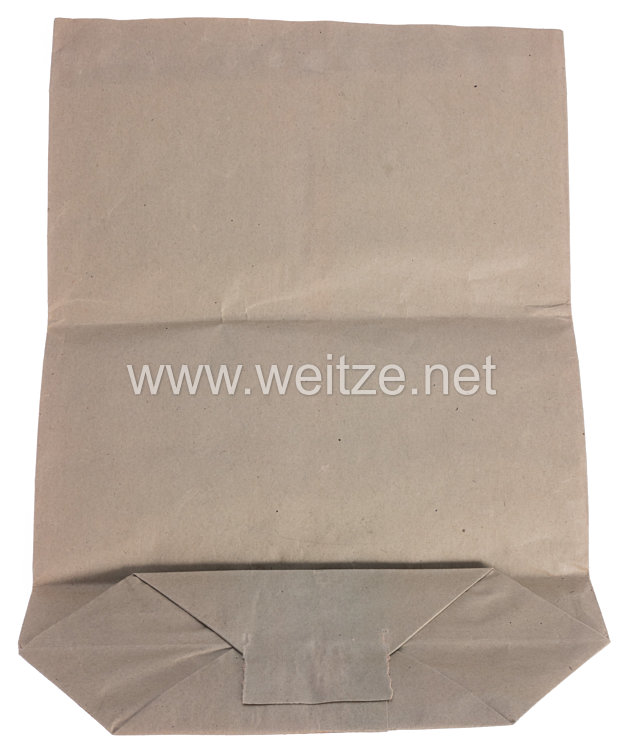
Reichsanstalt der Luftwaffe für Luftschutz - Paper Sack for Fire-Fighting Sand

Brown heavy-duty paper with paper label. Condition 2.
348518
30,00

Reichsanstalt der Luftwaffe für Luftschutz - Paper Sack for Fire-Fighting Sand

The paper sack for fire-fighting sand from the Reich Institute of the Luftwaffe for Air Raid Protection (Reichsanstalt der Luftwaffe für Luftschutz) represents an important element of civil air defense measures in Nazi Germany during World War II. These seemingly simple objects were part of a comprehensive system designed to protect the civilian population from the effects of Allied bombing raids.

The Reich Institute of the Luftwaffe for Air Raid Protection was established within the military organizational structure of the Third Reich and was responsible for the development, standardization, and supervision of air raid protection measures. This institution worked closely with the Reich Aviation Ministry (Reichsluftfahrtministerium) under Hermann Göring and coordinated the technical aspects of civil air defense.

This paper sack made of brown, heavy-duty paper with a paper label served to store fire-fighting sand, one of the most important fire-fighting materials in German households and public buildings during the war. From 1935 onwards, with increasing militarization and preparation for a possible war, air raid protection measures were systematically expanded. The Air Protection Law (Luftschutzgesetz) of 1935 made air raid protection a duty for all Germans and established the legal basis for comprehensive protective measures.

Fire-fighting sand was particularly important for combating incendiary bombs, especially the stick incendiary bombs used by the Allies. These incendiary bombs developed extremely high temperatures and could not be extinguished with water, as this could lead to explosive reactions. Sand proved to be an effective means of smothering the incendiary bombs and preventing their spread.

The standardization of packaging by the Reich Institute of the Luftwaffe for Air Raid Protection demonstrates the systematic approach of German authorities. Such sacks were produced in large quantities and distributed through the Reich Air Protection League (Reichsluftschutzbund) network and local air raid wardens. The label on the sack likely served to identify the contents and possibly also to provide instructions for correct use.

The use of brown, heavy-duty paper was due to the material shortages that Germany increasingly faced during the war. Despite the scarcity, functional solutions had to be found that allowed adequate storage of the sand. The sacks needed to be robust enough to bear the weight of the sand, while being manufacturable from available materials.

In the context of mandatory air raid protection, households and businesses were required to maintain certain quantities of fire-fighting materials. These included, in addition to sand, water in buckets, fire beaters, and other equipment. Air raid wardens regularly inspected compliance with these regulations and sanctioned violations.

The organization of air defense became increasingly important from 1943 onwards, as Allied bombing raids intensified. Operation Gomorrah against Hamburg in July 1943 and continued attacks on German cities demonstrated the necessity of effective fire-fighting measures. Nevertheless, the means were often insufficient given the intensity of the attacks and the resulting firestorms.

Today, such everyday objects of air raid protection are important historical artifacts that document the reality of life in Nazi Germany during the war. They illustrate the mobilization of the entire society for war and the impact of aerial warfare on the civilian population. For collectors and historians, they provide direct access to the material aspects of the German home front.