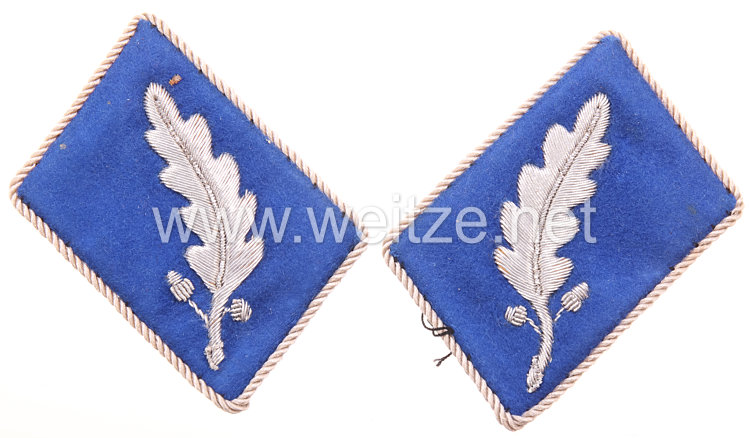
Pair of Collar Tabs for an SA-Standartenführer SA Gruppe Wartheland

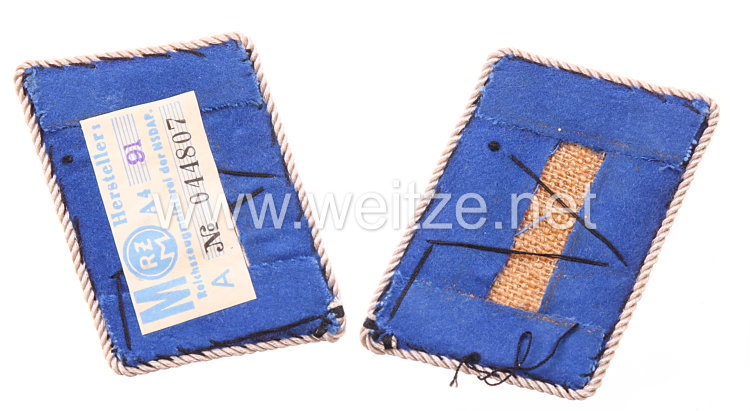
Hand-embroidered in metal thread on blue wool, circa 1939. Unworn, with RZM paper label, one small moth hole, otherwise condition 1a.
417918
750,00

Pair of Collar Tabs for an SA-Standartenführer SA Gruppe Wartheland

These collar tabs represent a significant example of paramilitary uniforming in National Socialist Germany, specifically for the Sturmabteilung (SA) in the newly created SA-Gruppe Wartheland. These rank insignia for an SA-Standartenführer document not only the hierarchical structure of the SA but also the territorial expansion and organizational structure of this paramilitary formation during World War II.

The Sturmabteilung, originally founded in 1920/21, evolved from a party army of the NSDAP into a massive paramilitary organization with several million members. After the so-called Röhm Affair of June 30, 1934, when the SA leadership was largely eliminated, the organization lost its political power but retained its organizational structure and symbolic significance. The SA was divided into various Groups corresponding to geographical regions.

The Wartheland (officially Reichsgau Wartheland) was an administrative unit created in occupied Poland following the German invasion in September 1939. The Reichsgau was established on October 26, 1939, by decree of Adolf Hitler and comprised mainly territories from the Polish voivodeships of Poznań and Łódź. The capital was Posen (Poznań). The creation of the SA-Gruppe Wartheland occurred during this territorial reorganization around 1939/40 to establish SA structures in the newly annexed territories.

The rank of Standartenführer corresponded in the SA hierarchy approximately to a colonel in the Wehrmacht and represented a senior leadership position. A Standartenführer typically commanded a Standarte, a unit of approximately 1,000 to 3,000 men. The rank insignia were strictly regulated according to the SA service rank insignia system, which changed several times over the years but became largely standardized from the mid-1930s onward.

The collar tabs described here are hand-embroidered in metal thread, indicating high-quality workmanship. The blue background color was characteristic of certain SA units or service functions. The system of collar tab colors in the SA was complex: different colors designated different service branches, groups, or functions. The blue base color might indicate special staff or administrative functions, though the exact assignment must be considered in the context of SA-Gruppe Wartheland.

The presence of an RZM paper label is of particular significance for authenticity and dating. The Reichszeugmeisterei (RZM) was the central procurement and inspection office of the NSDAP for uniforms and equipment. Founded in 1929, it supervised the manufacture and distribution of party and SA uniform items. Each licensed manufacturer received an RZM number, and products were provided with corresponding labels. This ensured standardization and was intended to prevent unauthorized production.

The condition as unworn makes these collar tabs particularly remarkable from both historical and collecting perspectives. Many uniform items were heavily used during the war or were lost. The fact that these rank insignia were never worn could have various reasons: they might have been procured as replacements, the wearer might have been promoted before wearing them, or historical circumstances (such as the war's end or organizational changes) prevented their use.

The SA-Gruppe Wartheland existed for only a relatively short period—from its founding around 1939/40 until its dissolution near war's end. The SA played various roles in occupied territories, from supporting civil administration to participating in occupation duties. However, by this time, the SA no longer held the significance it had in the early 1930s and stood in the shadow of the SS and Wehrmacht.

Such uniform items today are important historical artifacts that document the complex organizational and rank structure of the Nazi regime. They enable historians to reconstruct bureaucratic and hierarchical systems and trace the spread of National Socialist structures into occupied territories. At the same time, they serve as reminders of a criminal dictatorship and its systematic organization.