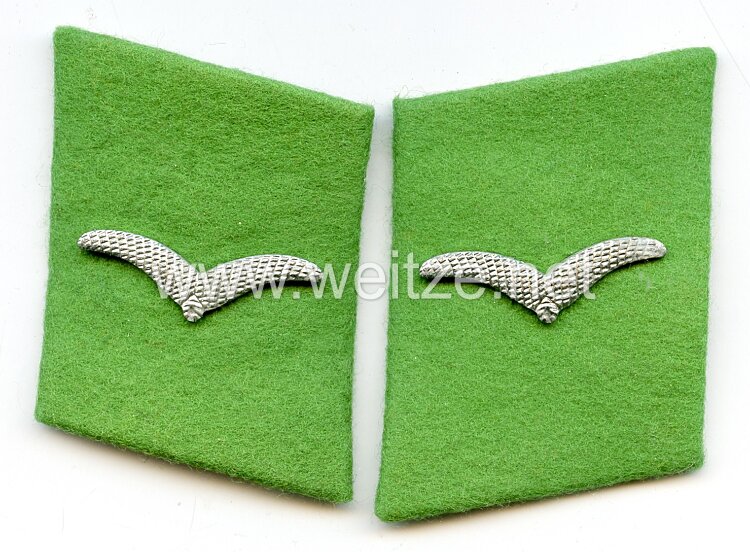
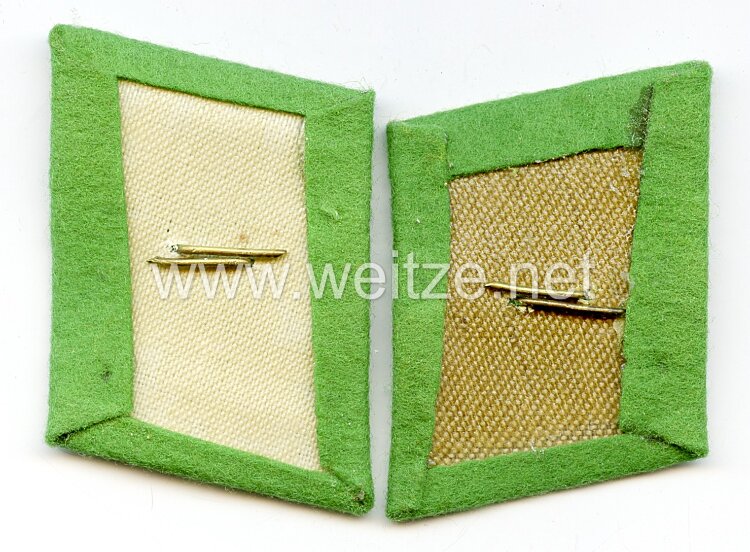
Luftwaffe Pair of Collar Tabs for a Soldier of the LW-Felddivision
Jäger green collar tabs. Worn, condition 2. Rare.
These collar tabs represent a significant chapter in German military history during World War II and document the organizational development of the Luftwaffe during the critical war years of 1942-1943.
The Luftwaffe Field Divisions originated from an initiative by Reichsmarschall Hermann Göring, who ordered the establishment of the Luftwaffe's own ground combat troops in autumn 1942. This decision was made against the background of considerable personnel surpluses in the Luftwaffe, while the Army urgently needed reinforcements on the Eastern Front. Between September 1942 and the end of 1943, a total of 22 Luftwaffe Field Divisions were established, numbered from 1 to 22.
The characteristic jägergrün (hunter green) collar tabs were introduced according to Luftwaffe-Verordnungsblatt 43, No. 127 of January 4, 1943. This regulation governed the specific uniform and insignia design for members of the Luftwaffe Field Divisions and marked an important step in standardizing their equipment. The jägergrün color clearly distinguished the Field Divisions from regular Luftwaffe units, which normally wore flight-blue uniforms, while still maintaining their affiliation with the Luftwaffe.
The collar tabs were worn in pairs on both sides of the uniform collar and served to identify unit affiliation. Unlike Army units, which used various branch colors, the Luftwaffe Field Divisions showed their special position between the Luftwaffe and ground troops through their uniform jägergrün design. These uniform pieces were typically worn on the field-grey M1940 or M1943 uniform.
The military reality of the Luftwaffe Field Divisions proved problematic, however. Although the troops were often motivated, they lacked the intensive infantry training of Army troops. Training time was frequently too short, and officers often came from flying units without adequate experience in commanding ground combat troops. This led to sometimes considerable losses on the Eastern Front.
The deployment of the Luftwaffe Field Divisions concentrated mainly on the Eastern Front, where they became involved in heavy defensive battles. Particularly in the Leningrad area, in the central front sector, and later during the retreat battles of 1943-1944, these divisions suffered high losses. The lack of combat experience and inadequate equipment for ground combat led to many of these divisions being dissolved or converted into regular Army divisions as early as 1943 and 1944.
In November 1943, Hitler finally ordered the transfer of the remaining Luftwaffe Field Divisions to the Army. These continued as Luftwaffen-Felddivisionen (L), but initially retained their characteristic uniform pieces. Full integration into the Army occurred gradually until 1944.
From a collector's perspective, these collar tabs are of particular interest today, as they document a relatively short period of use from approximately 1943 to 1944. Worn examples, like those described here, are witnesses to actual front-line service and are therefore historically particularly valuable. The rarity of these pieces is explained by the limited production period, the high losses of the units, and the later reorganization into the Army.
The collar tabs of the Luftwaffe Field Divisions symbolically represent the organizational rivalries within the German Wehrmacht branches, Göring's claims to power, and the increasingly desperate attempts to stabilize the military situation on the Eastern Front. They document a militarily significant, though ultimately failed, experiment in the organization of German armed forces during World War II.