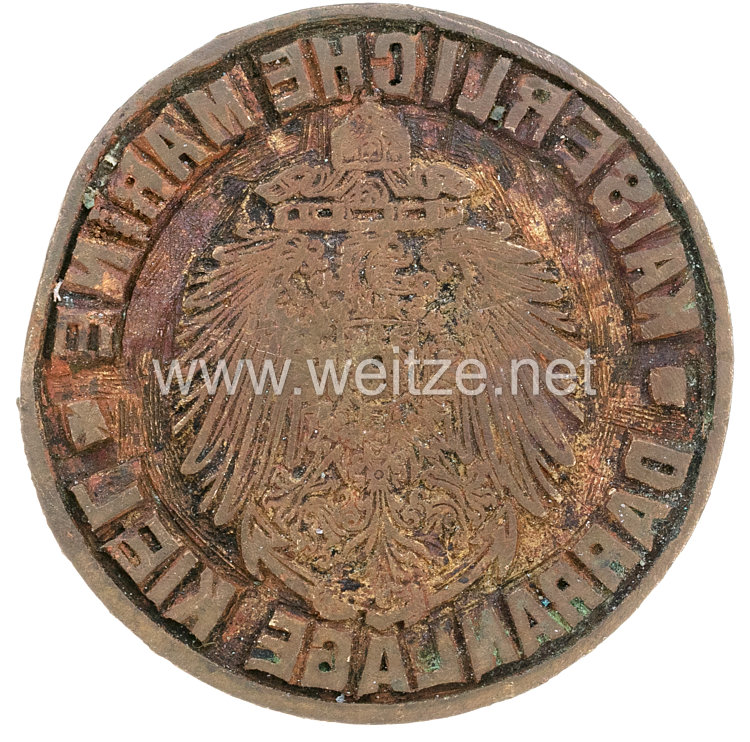
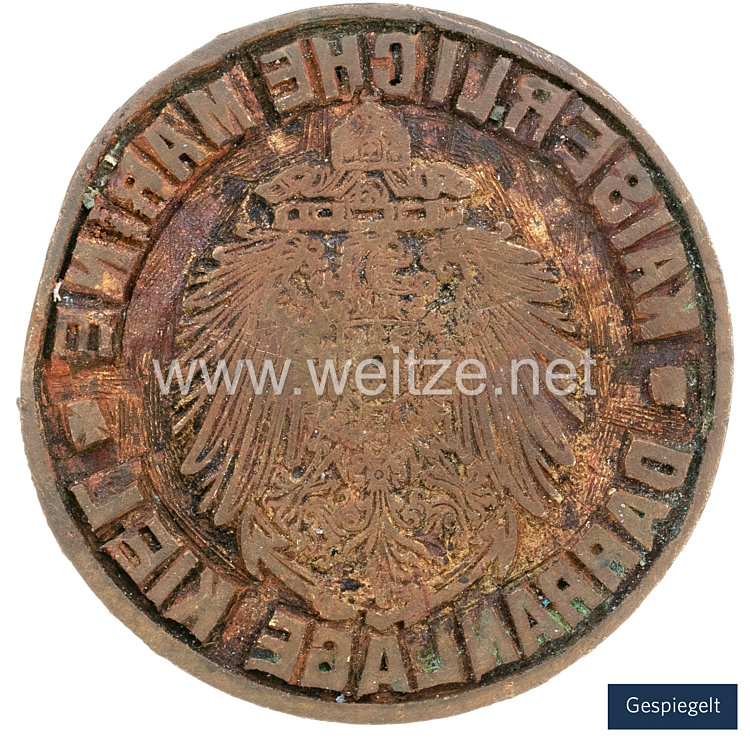
Imperial German Navy Seal/Signet “Darranlage Kiel”
Remaining stock from the former Reichsmarineamt (Imperial Naval Office), circa 1919.
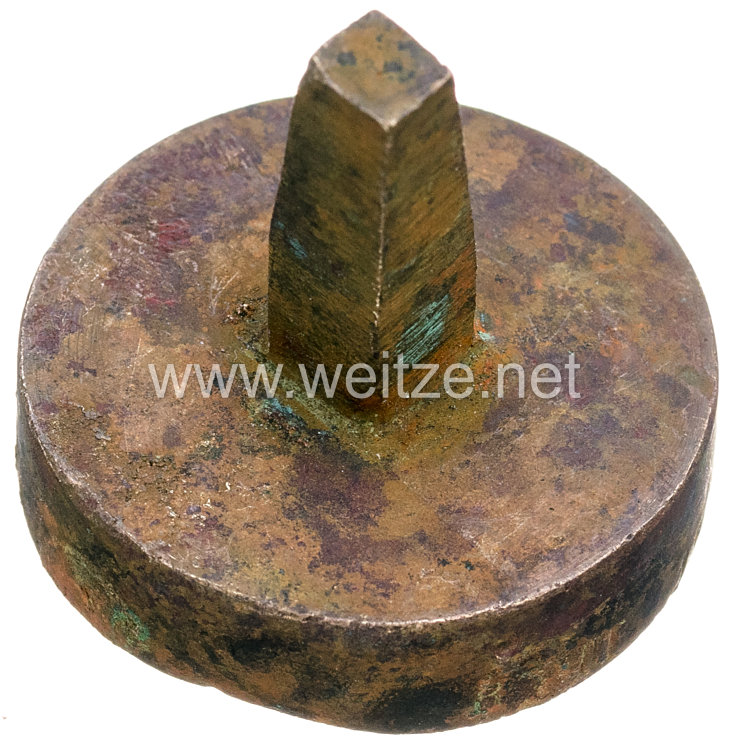
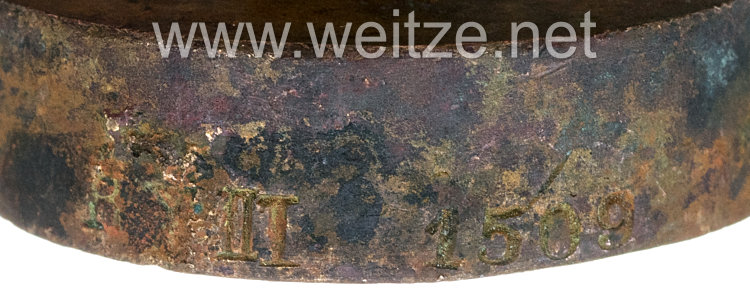
This seal of the Imperial German Navy (Kaiserliche Marine) represents a fascinating artifact of early 20th-century German naval bureaucracy. It is a seal stamp (Petschaft) from the Darranlage Kiel (drying facility Kiel), manufactured with a lead core covered by a brass shell and equipped with a spike on the reverse for mounting. The edge marking “R XIII 1509” refers to the administrative registration system of the Navy.
The Darranlage was a technical facility of the Imperial Navy, operated as part of the extensive infrastructure of the Kiel Naval Base. The term “Darre” designates a drying facility that was used in military contexts for various purposes, possibly for drying equipment, uniforms, or other material management tasks of the Navy.
Kiel developed into the most important naval base of the German Empire after the Reich's founding in 1871. Under Kaiser Wilhelm II, who attached particular importance to the Navy, the location was massively expanded. The opening of the Kaiser Wilhelm Canal (later Kiel Canal) in 1895 further enhanced Kiel's strategic significance. The Imperial Dockyard Kiel and numerous auxiliary facilities formed a complex military-industrial center.
Seals and seal stamps played a central role in Prussian-German military administration. They served for the authentication of documents, the sealing of confidential correspondence, and the marking of materials and facilities. Every department, every ship, and every military installation had its own seals with specific identification. This specimen with its registration number demonstrates the systematic recording even of smaller departments within the naval organization.
The marking “R XIII 1509” follows the typical numbering system of the Imperial Navy. The letter “R” probably stands for Reichsmarine or a specific registry department, while “XIII” represents a categorization within the administrative system, and the number 1509 designates the individual registration number of this seal.
The provenance from the former Reich Naval Office around 1919 is of particular historical significance. The Reich Naval Office (Reichsmarineamt) was founded in 1889 under Rear Admiral Alexander von Monts and reached its zenith under Grand Admiral Alfred von Tirpitz (1897-1916). It coordinated all aspects of naval affairs, from fleet planning through material management to personnel administration. After World War I and the collapse of the monarchy in November 1918, the institution was dissolved as part of the political and military reorganization.
The timeframe “around 1919” marks the turbulent transition phase from the Empire to the Weimar Republic. The High Seas Fleet had scuttled itself at Scapa Flow in June 1919, and the provisions of the Treaty of Versailles drastically reduced the German Navy. The remaining Reichsmarine was merely a shadow of the former Imperial Navy. In this context, large quantities of equipment, documents, and administrative materials were discarded or sold as surplus.
The material combination of lead core and brass shell was typical for official seals of this period. Lead provided the necessary mass and stability for the seal body, while brass as a shell ensured corrosion resistance and a representative appearance. The spike attachment on the reverse allowed secure mounting on a wooden handle or in a holder.
Such seals document today the administrative complexity of imperial military bureaucracy. The German Empire developed a sophisticated system of administration and control that manifested itself in the meticulous registration and identification even of the smallest departments. The Darranlage as a technical auxiliary facility received an official seal just like fleet units or main administrations.
As remaining stock from the dissolution of the Reich Naval Office, this object possesses not only material but also symbolic value. It represents the end of an era of German naval history and the transition from imperial great power to republican modesty. Today, such seals are important study objects for military historians and sought-after collectibles that provide authentic access to the history of the Imperial German Navy.