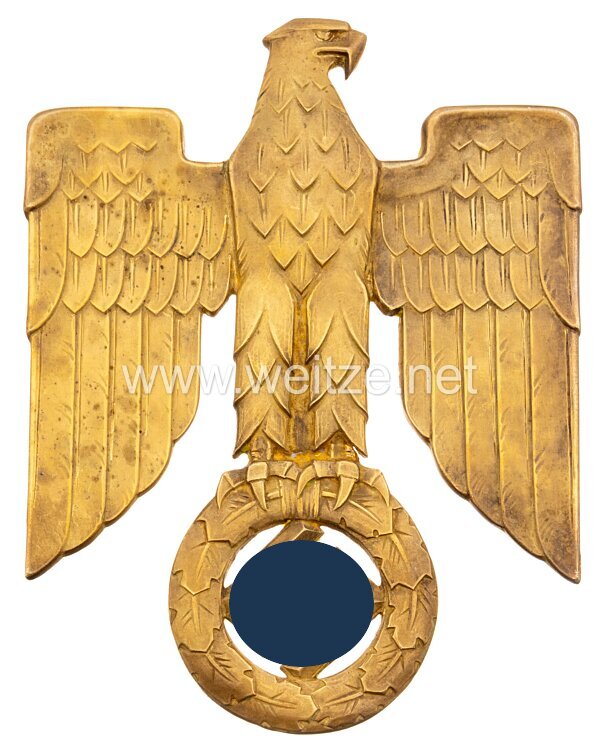
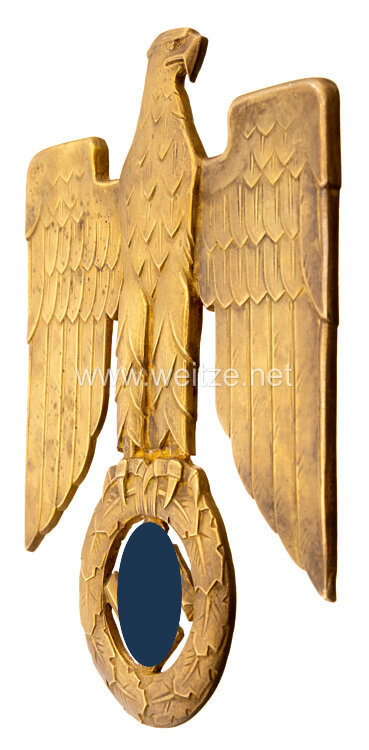
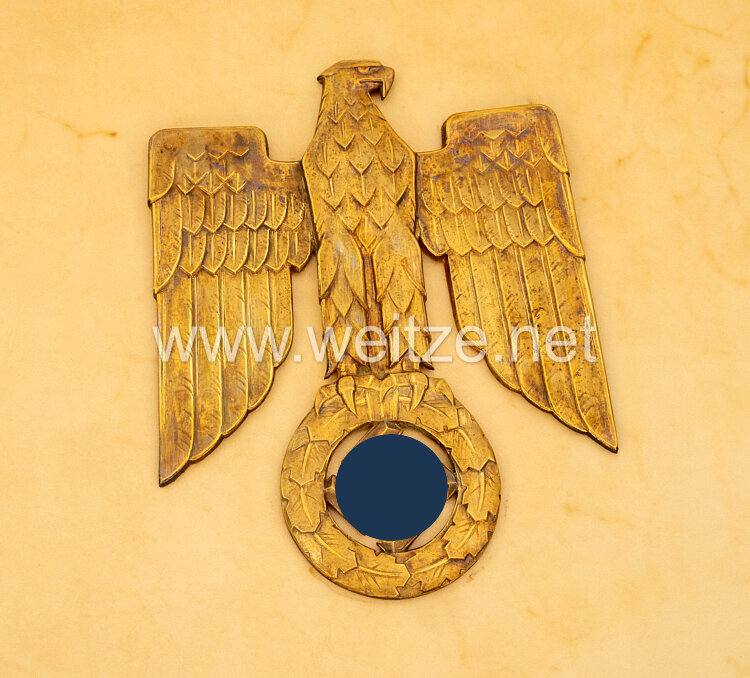
Large Eagle for the Award Document Folder of the Oak Leaves to the Knight's Cross of the Iron Cross

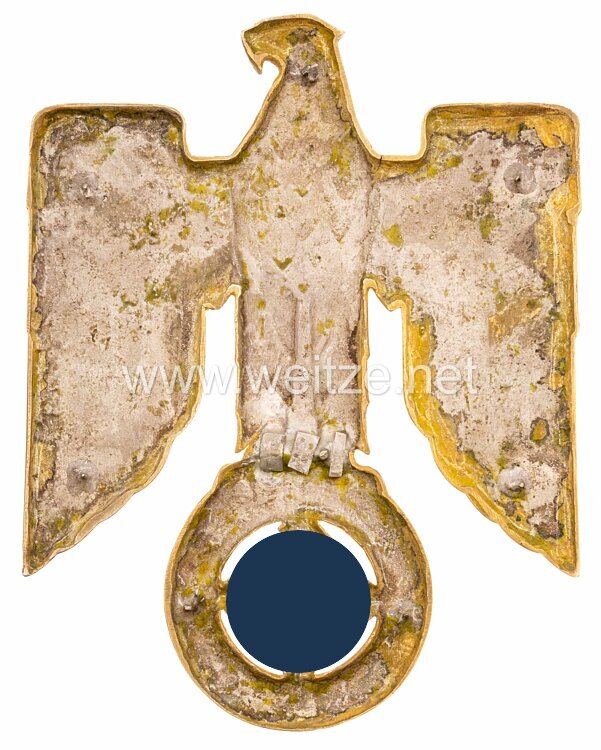
Large eagle in fire-gilt non-ferrous metal, height 14.6 cm, with remains of mounting pins on the reverse. Minor age wear, in good condition.
The eagle was affixed to the cover of the award document folder. 
Extremely rare, in the last 35 years we have never been able to offer an individual eagle.
453718

Large Eagle for the Award Document Folder of the Oak Leaves to the Knight's Cross of the Iron Cross

This large eagle for the award document folder of the Oak Leaves to the Knight's Cross of the Iron Cross represents an extremely rare example of the elaborate design of high-ranking military award documentation from the Second World War era. Standing 14.6 cm tall and crafted from fire-gilded base metal, this eagle served as a decorative element on the lid of the presentation folder in which the award certificate was presented.

The Knight's Cross of the Iron Cross was instituted on September 1, 1939, by Adolf Hitler as the highest military decoration of the German Reich. It built upon the Prussian tradition of the Iron Cross, which was first introduced in 1813 during the Wars of Liberation against Napoleon. The Knight's Cross itself already represented an extraordinary decoration, awarded for outstanding bravery and military leadership.

The Oak Leaves to the Knight's Cross were instituted on June 3, 1940, as the first grade of enhancement to the Knight's Cross. This decoration was reserved for soldiers already decorated with the Knight's Cross who had distinguished themselves through further extraordinary achievements. In total, the Oak Leaves were awarded only 890 times during World War II, underscoring their exceptional rarity and significance. Awards were made across all branches of service – Wehrmacht, Luftwaffe, and Kriegsmarine – as well as to members of the Waffen-SS.

The presentation of such high-ranking decorations was always accompanied by special ceremonial effort. Recipients received not only the actual decoration but also an elaborately designed award certificate presented in a specially crafted folder. These folders were adorned with the national emblem of the Third Reich – the eagle with swastika – which was attached to the lid as a three-dimensional, fire-gilded element.

The manufacture of these eagles was carried out in specialized workshops and subject to strict quality standards. The base metal used was fire-gilded, an elaborate process in which a gold alloy was applied to the carrier material through heating. The reverse typically features mounting pins with which the eagle was fixed to the leather binding of the folder. The size of approximately 14-15 cm in height was standardized and corresponded to official specifications for this use.

The extreme rarity of individual eagles on today's collector market is explained by several factors: First, the number of Oak Leaves awards was already very limited. Second, the folders usually remained in the possession of the recipients' families and were not separated. Third, many of these documents and objects were lost in the turmoil of the war's end and the post-war period. Fourth, numerous Nazi symbols were deliberately destroyed or hidden after 1945.

From a historical perspective, these objects are significant testimonies to the culture of orders and decoration practices of the Third Reich. They document the propagandistic effort with which military achievements were staged and honored. The elaborate design of the award documentation served not only to honor the individual but also to represent state power and appreciation.

For scholarly engagement with the military history of World War II, such objects are important sources. They provide insights into material culture, manufacturing techniques, and the symbolic significance of military decorations. At the same time, they raise questions about memory culture and how to deal with objects associated with a criminal regime.

The preservation of this specimen is remarkably good. The slight signs of age are to be expected for an object over 80 years old and do not significantly affect its overall condition. The remaining remnants of the mounting pins attest to the original use and authenticity of the piece.