Königreich Hannover Prunksäbel der Firma Knecht in Solingen als Geschenk an den König von Hannover Ernst August I. anlässlich seines Besuchs 1841
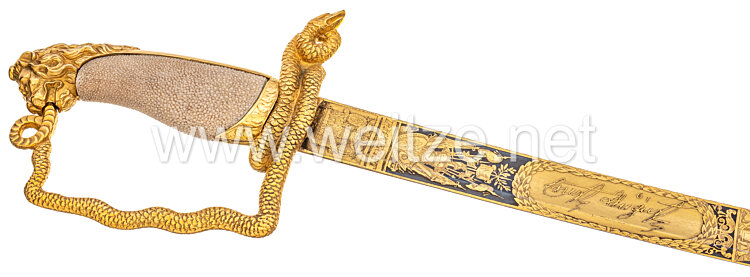
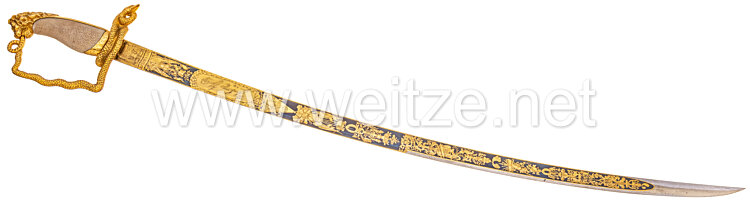
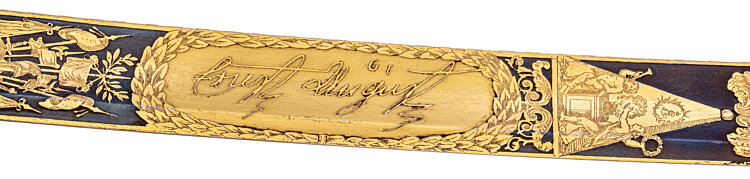
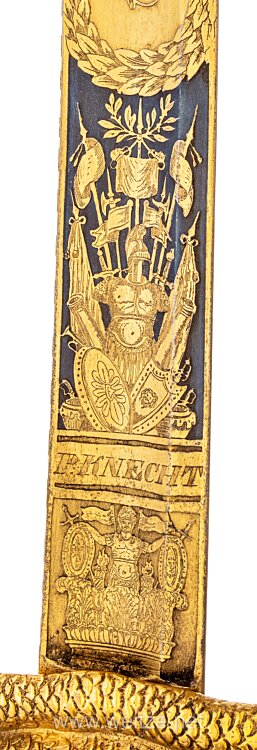
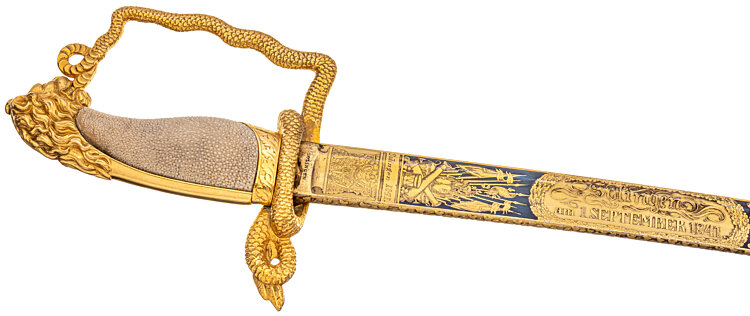
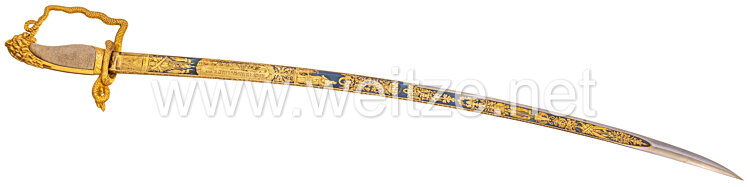
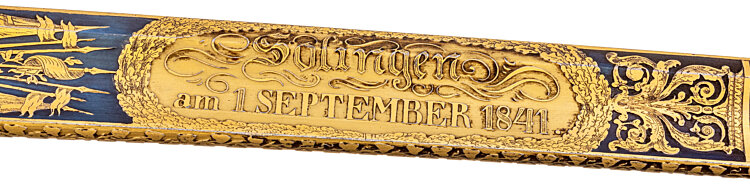
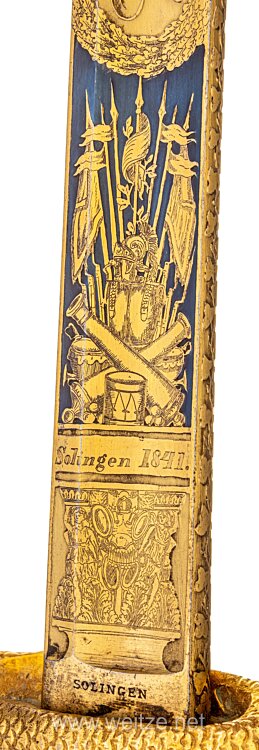
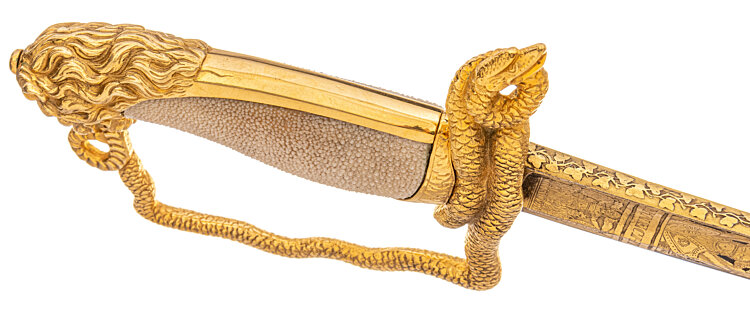
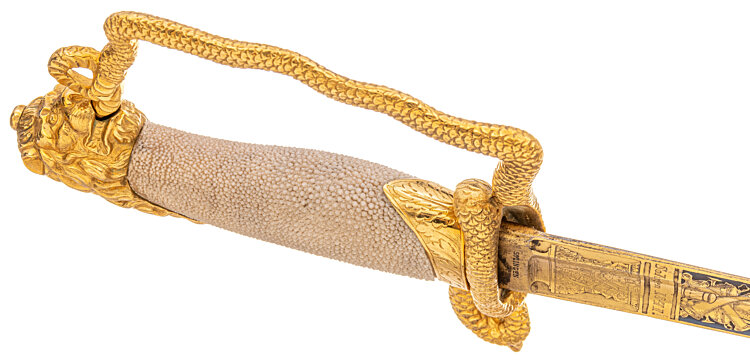
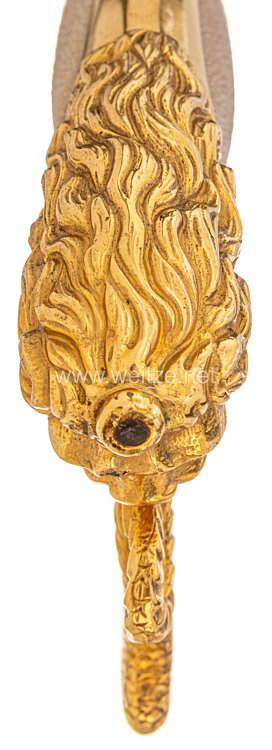
Die Waffe eine exquisite Sonderanfertigung in höchster Güte! Die leicht geschwungene Klinge 3.2 cm breit und 87.1 cm lang, beiderseits mit breiter Hohlbahn, die Klinge fast vollständig mit feinsten Ätzungen versehen sowie gebläut und vergoldet, die Ätzungen bestehend aus Ranken und Trophäen im Teils antikisierenden Stil,vorderseitig eine Pyramide mit einem Feuer-Altar davor und zwei Figuren mit Siegeskranz und Trompete, an der Spitze der Pyramide eingraviert die gekrönte Chiffre des Königs «♔EA», darunter in der vergoldeten Kartusche mit umlaufenden Lorbeerkranz die Faksimile Signatur des Königs "Ernst August" sowie Waffentrophäen, an der Wurzel mit Herstellerbezeichnung "P. Knecht". Rückseitig im Eichenlaubkranz die Geschenkwidmung "Solingen am 1. September 1841.", Waffentrophäen, zur Wurzel hin "Solingen 1841", auf der Fehlschärfe eingeschlagen «Solingen». Das Gefäß aus Messing vergoldet mit Löwenkopf, der Bügel in Form einer sich "windenden Schlange" gestaltet, der Griff mit feinster weißer Rochenhaut. Die Waffe wurde gemeinsam mit mehreren weiteren Geschenksäbeln und Mustern jeweils ohne Scheide übergeben. Zustand 2+.
Gesamtlänge 103 cm.
Es handelt sich bei der vorliegenden Waffe um ein Geschenk der Firma Peter Knecht an König Ernst August I. von Hannover anlässlich seines Besuchs der Firma in Solingen am 1. September 1841. Grund für den Besuch war die Absicht des Königs für die Hannoversche Armee neue Blankwaffen zu beschaffen. Das hier vorliegende Unikat diente dazu dem König die Kunstfertigkeit der Firma P. Knecht vorzuführen.
Von dem Besuch kündete auch das «Solinger Kreis-Intelligenzblatt» in seiner Ausgabe Nr. 70 vom 4. September 1841 auf Seite 4: "Solingen, den 1. September 1841. Heute um die Mittagszeit wurden die Bewohner unserer Stadt, durch die Ankunft Seiner Majestät des Königs von Hannover, ... auf das angenehmste überrascht. - Seine Majestät geruhten bei unserem Mitbürger Herrn Peter Knecht abzusteigen und ..., dessen bekannte Waffenfabrik - Waffen- und Kunst-Sammlungen in Allerhöchsten Augenschein zu nehmen. Der hohe Reisende legte das lebhafteste Interesse für unseren deutschen Gewerbefleiß an den Tag und sah die Verarbeitung aller einzelnen Theile ... bis zur Vollendung!" (https://zeitpunkt.nrw/ulbbn/periodical/zoom/7770529).
Ein Objekt von historischer und musealer Bedeutung!
Gesamtlänge 103 cm.
Es handelt sich bei der vorliegenden Waffe um ein Geschenk der Firma Peter Knecht an König Ernst August I. von Hannover anlässlich seines Besuchs der Firma in Solingen am 1. September 1841. Grund für den Besuch war die Absicht des Königs für die Hannoversche Armee neue Blankwaffen zu beschaffen. Das hier vorliegende Unikat diente dazu dem König die Kunstfertigkeit der Firma P. Knecht vorzuführen.
Von dem Besuch kündete auch das «Solinger Kreis-Intelligenzblatt» in seiner Ausgabe Nr. 70 vom 4. September 1841 auf Seite 4: "Solingen, den 1. September 1841. Heute um die Mittagszeit wurden die Bewohner unserer Stadt, durch die Ankunft Seiner Majestät des Königs von Hannover, ... auf das angenehmste überrascht. - Seine Majestät geruhten bei unserem Mitbürger Herrn Peter Knecht abzusteigen und ..., dessen bekannte Waffenfabrik - Waffen- und Kunst-Sammlungen in Allerhöchsten Augenschein zu nehmen. Der hohe Reisende legte das lebhafteste Interesse für unseren deutschen Gewerbefleiß an den Tag und sah die Verarbeitung aller einzelnen Theile ... bis zur Vollendung!" (https://zeitpunkt.nrw/ulbbn/periodical/zoom/7770529).
Ein Objekt von historischer und musealer Bedeutung!