Hannover

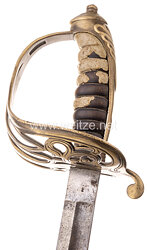
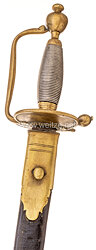
Kingdom of Hannover Pallasch M 1852 for Officers of the Garde du Corps

Circa 1860. Heavy blade approximately 3.9 cm wide at the ricasso and 86 cm long, with wide fullers on both sides, stamped “–” on the back edge, on the spine the maker (of the blade) “Dawl[…] Birm[…]”, the blade with only a few small spots, some nicks on the cutting edge, the point partially sharpened. Pierced steel hilt entirely following the Austrian Model 1850, ray skin grip with complete but somewhat loose silver wire binding. The finger loop intact, the pommel cap slightly bent, the guard basket thereby somewhat loosened. Steel scabbard with two ring bands and movable suspension rings. Condition 2.

Overall length 106.5 cm.

A highly interesting and rare weapon! It corresponds entirely to the Hanoverian cavalry saber M 1852, which in turn is based on the Austrian cavalry saber M 1850, but features a substantially heavier blade, which in this case was manufactured in Great Britain and then imported. This pallasch was carried from 1852 until the end of the Austro-Prussian War of 1866. The piece comes from a collection of Hanoverian edged weapons.
487345
3.000,00

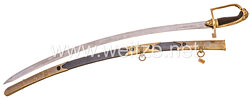
Great Britain/Kingdom of Hanover Saber for Enlisted Men of the Light Cavalry Model 1796 from the Era of King William IV

Circa 1830. Heavy, curved blade with fullers on both sides, the lower two-thirds of the blade etched on both sides, on the inside face the cipher “WIV”, on the outside face the depiction of a mounted cavalryman with raised saber. Blade length approx. 79.2 cm, width at ricasso approx. 3.8 cm, the etchings somewhat worn, fine pitting toward the ricasso, cleaned. Steel hilt with simple knuckle guard with langet and quillon finials, the pommel with pommel ears, leather-covered grip with almost completely preserved and intact wire wrapping. Steel scabbard with two ring bands and movable suspension rings, cleaned, spotted. Condition 2.

Overall length approx. 94 cm.

William IV (born August 21, 1765 in Buckingham House, London; died June 20, 1837 at Windsor Castle) was King of the United Kingdom of Great Britain and Ireland from 1830 to 1837 and, in personal union, King of Hanover. He was the direct successor of his older brother George IV. They belonged to the House of Hanover, a branch line of the House of Welf. The personal union between Great Britain and the Kingdom of Hanover ended with the accession of King Ernest Augustus I in 1837.

This piece comes from a collection of Hanoverian edged weapons.

The Model 1796 was used during the Napoleonic Wars mainly by British dragoons, hussars, and the light cavalry of the “King's German Legion”. After the end of the Napoleonic Wars, many of these weapons continued to be used.


483503
1.800,00

Kingdom of Hanover Saber M 1796 for Enlisted Men of the Queen's Hussar Regiment, D Company

Chamber piece circa 1840. Massive, approximately 4.1 cm wide and 82 cm long, curved blade with wide fullers, the short ricasso stamped on the outside “R”, steel hilt with simple knuckle guard with groove for the sword knot and shield-shaped quillon finials, full pommel cap with finials, leather-covered wooden grip, the quillon finial on the inside stamped “K H D 93”, (the marking “K H” with various following letter and number combinations is also found on the fur caps of the enlisted men of the Queen's Hussar Regiment). Steel scabbard with two ring bands and movable suspension rings, stamped on the inside at the chape “R ST”. The metal parts cleaned, fine rust pitting and some staining. Condition 2.

Overall length 100.5 cm.

Sabers of the M 1796 pattern were manufactured in large numbers and in many variants. The pattern was carried by the British cavalry and the former Hanoverian troops in England, the cavalry of the King's German Legion, as well as the Prussian troops during the Napoleonic Wars and the Wars of Liberation. After the war, the saber pattern was also adopted by the newly established army of the Kingdom of Hanover.
488055
1.950,00

Kingdom of Hanover Saber for a Non-Commissioned Officer of the Light Cavalry from the Era of King George III

Similar to the English saber Model 1788, circa 1800. Bright, strongly curved blade with wide fullers on both sides, length approximately 84.5 cm, width at the forte 3.7 cm, the surface somewhat spotted and partly pitted. Brass hilt with simple stirrup guard and long oval langet, the leather grip covering renewed, the hilt somewhat loose. Leather-covered wooden scabbard with brass fittings with two suspension rings. Condition 2-.

Overall length 101 cm.

Such weapons are found in many countries of Germany and Europe during this period. Attribution to a specific army is not always possible from the piece itself. However, since this piece comes from a collection of Hanoverian weapons, attribution to the Kingdom of Hanover is likely.
483288
1.200,00

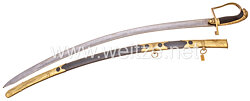
Kingdom of Hannover Eagle-Head Saber from the Personal Property of King Ernst August I of Hannover as Chief of his Leib-Husaren Regiment

Circa 1840. Curved bright steel blade, 3.2 cm wide and 84 cm long, with pandur point, double fuller on both sides, unmarked, of outstanding quality. Gilt brass hilt with eagle head and smooth knuckle guard, black ebony grip with fine waffle pattern, with floral decoration on both quillons and on the knuckle guard at the eagle's beak. The eagle head and decoration executed in finest hand engraving. Steel scabbard with brass ring bands and movable suspension rings. Accompanied by the old inventory number from the Marienburg Castle armory. The weapon shows minimal wear and is in excellent condition. Condition 2.

Overall length 101 cm.

The sabers of the Hanoverian cavalry did not have eagle heads; this design was reserved exclusively for the King. On the large equestrian statue in Hannover as well as in paintings of the King in hussar uniform, he is clearly shown wearing the eagle-head saber. Another very similar piece from the King's possession is located in the Bomann Museum in Celle. 

The present piece originates from the Welf Marienburg Castle and was sold at Sotheby's auction in October 2005.
458833

King's German Legion/Kingdom of Hanover Sword for Officers of the Line Battalions of the KGL and Later for Musicians and Bandsmen in the 7th Infantry Regiment

Manufactured circa 1810. Location Aurich. Straight blade approximately 2.7 cm wide at the ricasso and 63.3 cm long with fullers on both sides, marked on the short false edge on the outside edge with the punch mark “St”, on the inside edge of the blade with the punch mark “CK”, the blade cleaned, with rust pitting. Brass hilt with simple crossguard with faceted pommel button, “kidney-shaped” quillon block and “urn-shaped” pommel, the grip with brass wire binding, the quillon block stamped on the underside of the ricasso side “7.E.I.3.” (7th Infantry Regiment E Company (=5th Company) Weapon I.3). Black lacquered leather scabbard with two brass mounts, the throat with carrying stud. Condition 2.

Overall length approximately 79 cm.

The sword of this pattern is based on the British Infantry Officer's Sword M 1796, but differed from it among other things in the type of grip binding. Originally it was carried in the line battalions of the King's German Legion (KGL). After the dissolution of the KGL and the reorganization of the Hanoverian Army in the years 1815/16, the sword initially remained reserved for the company sergeant majors of the line infantry regiments. From 1838, the musicians and bandsmen of these regiments also received the sword from the royal arsenals. The version for company sergeant majors and bandsmen differed only in the grip binding: copper wire for the sergeant majors, brass wire for the bandsmen. The sword remained in active service until 1866, over 55 years of service!
511344
1.450,00

Kingdom of Hanover Saber Model 1852 for Officers of the Foot Troops

Circa 1860. Slightly curved blade, approximately 2.6 cm wide at the ricasso and 77.8 cm long, with fuller on both sides, etched on both sides approximately at the center, with scroll decoration on both sides and the royal cipher “GRV” (Georg V, King from 1851-66), maker's mark following English pattern on the obverse side, quality mark “Eisenhauer” on the spine, manufacturer “C. Bernstorff & Eichwede in Hannover” on the reverse side. The blade shows rust pitting at the point. Nickel silver hilt, the basket pierced with floral patterns and the royal cipher “GRV” on the front, slot for the sword knot at the top, shagreen grip with intact wire binding, finger loop present, the basket slightly deformed. Steel scabbard with two suspension bands and movable suspension rings, slightly dented and with surface rust. Condition 2.

Overall length approximately 95.5 cm.

This piece comes from an old collection of Hanoverian edged weapons. According to the collector's tradition, the saber belonged to First Lieutenant “Theodor von Trampe” of the 6th Infantry Regiment (Verden/Nienburg).
487425
2.800,00

Kingdom of Hanover French Saber Model 1801/03 for Enlisted Men of the Light Cavalry

Circa 1810/20. Curved blade approximately 3.7 cm wide at the ricasso and 88.7 cm long with fullers on both sides and a yatagan point, no markings. Steel hilt with one main guard and two side bars, elongated oval langet, full pommel cap without tabs, leather-covered grip with areas of loss to the leather, hilt slightly loose. Steel scabbard with two ring bands and movable suspension rings, the drag stamped “K”. Condition 2.

Overall length approximately 106 cm.

A wonderfully balanced and agile weapon! This piece comes from an old collection of Hanoverian edged weapons. After the end of the Napoleonic Wars, the army of the Kingdom of Hanover, among others, acquired large stocks of weapons from the French Army.
487510
1.200,00

Kingdom of Hannover Model 1852 Saber for Officers of the Foot Troops

Circa 1860. Slightly curved blade, approximately 2.8 cm wide at the forte and 80.7 cm long, with fullers on both sides, etched on both sides approximately at the center, featuring foliate decoration on both sides and the royal cipher “GRV” (Georg V, King from 1851-66), on the obverse a mark following English pattern, on the back the quality proof “Eisenhauer”, on the reverse the maker “C. Bernstorff & Eichwede in Hannover”. The blade darkened. Nickel silver hilt, the guard pierced with floral patterns and the royal cipher “GRV” at the front, top with slot for the sword knot, shagreen grip with intact wire binding, without finger loop. Black lacquered steel scabbard with one ring band and movable suspension ring. Condition 2.

Overall length approximately 102.5 cm.
487427
2.500,00

Kingdom of Hanover Austrian "Saber M 1850" as Pallasch for Officers of the Gardes du Corps/Guard Cuirassiers

Austrian manufacture for the Hanoverian Army, circa 1850. At the ricasso approximately 2.2 cm wide and 83.2 cm long fullered double-edged blade, the lower quarter of the blade etched and gilt with the maker “J. Haussmann in Wien”. Steel hilt with pierced guard basket featuring floral patterns, with two incised lines toward the finial, full grip cap with raised thumb rest, the pommel grooved, ray skin grip with intact wire binding. Steel scabbard with one ring mount with suspension hook for Hanoverian style of carry. Condition 2.

Overall length 100 cm.

This piece comes from a collection of Hanoverian edged weapons. It is known that edged weapons were also supplied to the Kingdom of Hanover from Bavaria and Austria. Thus, the Hanoverian saber Model 1852 is closely modeled after the Austrian saber Model 1850, and the Pallasch Model 1852 also shows strong similarities to this weapon. The quality of the weapon indicates a high-ranking bearer of the same.
487423
3.000,00

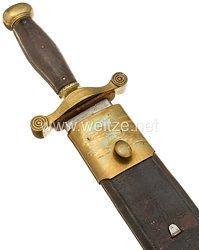
Kingdom of Hanover Pioneer Fascine Knife (Engineer Corps)

Brass hilt with leather-wrapped grip, the latter somewhat damaged, stamped on the guard "J.C.B.27", meaning "Engineer Corps, 2nd Company, Weapon No. 27", unusually shaped blade without maker's mark or acceptance or inspection stamp, single fuller, asymmetrically widening toward the point (bolo-type), the black leather scabbard with brass fittings does not match the weapon, stamped "B.50", the chape torn on the side, normal age wear, otherwise unissued and well-preserved, very rare as worn only for a short period, approximately from 1850 to 1866. Condition 2-
483819
1.850,00

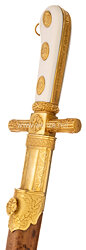
Kingdom of Hannover Presentation Hirschfänger Hunting Sword as a Gift from King Georg V to “Head Forester Rundspaden” from the Year 1865

The Hirschfänger of high-quality manufacture. The 3.2 cm wide and 54 cm long blade with double-sided wide fuller, the point double-edged ground, the lower half of the blade decorated on both sides with gilded engravings, on the obverse side a forest scene and on the reverse side a “huntsman” in the woods, on the spine the manufacturer “C. Bernstorff & Eichwede Fabricanten in Hannover”, the blade towards the ricasso stained on spine and edge. The hilt finely chased and fire-gilded, the grip scales of genuine ivory (the CITES certificate from the year 2023 is included), the quillons in the form of a column with oak leaf tendrils, surrounding the grip the inscription in raised form, the background granulated: “Dem Oberförster Rundspaden zu Grohnde zu seinem 50 Jähr. Dienstjubiläum am 20 April 1865”. Brown leather scabbard with fire-gilded, likewise finely chased mounts, the locket on the reverse with the inscription “Von den Forstgenossenschaften Grohnde, Jüntorf, Hajen, Börry, Völtenhausen, Voremberg, Tündern, Hagenohsen und Kirchohsen”. The locket sits loosely, the by-knife is missing. Condition 2.

Overall length 70 cm.
A magnificent weapon as a gift from the King to his long-serving Head Forester. A very fine work!

455677
9.500,00

Kingdom of Hanover Hirschfänger hunting sword for Jäger or forestry officials

 Rare Hirschfänger hunting sword from the Kingdom of Hanover, manufactured circa 1860. The approximately 54 cm long blade is elaborately engraved on both sides: on one side the typical Hanoverian coat of arms motif with rampant horse under crown, on the other side initials of the former owner, also under a crown. Cross-guard and pommel cap are made of nickel, the original brown leather scabbard shows a repair in the lower section, fittings are of nickel, the completely preserved auxiliary knife makes this piece complete. An interesting Hirschfänger in condition 2-
Overall length: 690mm
498096
1.500,00

Kingdom of Hanover Pallasch for the Cuirassier Regiments

Circa 1850. Heavy blade with double fullers on both sides, approximately 3.25 cm wide at the ricasso, 95.7 cm long, the ricasso stamped “R” and “St” as well as additional marks. Brass hilt with one main guard and three side bars, the guard plate stamped “R ST”, leather-covered grip with intact wire wrapping. Steel scabbard with two ring bands and movable suspension rings, the drag stamped “St”. Condition 2.

Overall length approximately 116 cm.

After the end of the Napoleonic Wars, the Prussian and Hanoverian armies adopted the Pallasch Model XI and XIII from French army stocks for their cuirassiers. Gradually, these pieces were also supplemented and replaced by domestic products. In Hanover, the Pallasch based on the French model remained in service until 1859.
486970
2.500,00

Kingdom of Hanover Pallasch Saber for Officers of the Gardes du Corps/Cuirassier Guards

Circa 1850. Double-edged blade with central fuller, approximately 2.2 cm wide at the ricasso and 81.5 cm long, with the quality mark “Eisenhauer” on the false edge of the obverse side, and the maker's mark of Clemen & Jung, Solingen on the reverse. Steel hilt with pierced basket guard featuring floral patterns and two grooves leading to the final scroll, complete knuckle bow with fluted pommel and raised thumb rest, shagreen grip without wire binding, retaining inventory tag “125” from the Royal Hanoverian collection at Marienburg Castle. Black leather scabbard with steel mounts, throat locket with long suspension ring. Condition 2.

Overall length 98 cm.

This piece originates from the Welfenschloss Marienburg, the Royal Hanoverian collection, the majority of which was sold at Sotheby's auction in 2005.
487433
3.500,00

Kingdom of Hanover Dress Saber for an Officer of the Guard Regiment from the Era of King Ernest Augustus I

Circa 1840. Heavy, nickel-plated, slightly curved double-edged fullered blade with fuller, bearing on the back the maker's mark “C. Bernstorff & Eichwede in Hannover”, blade length approx. 85.5 cm, width at ricasso approx. 3.2 cm. Gilt brass hilt, foldable towards the quillon side, the guard basket bearing the cipher “EAR” (Ernst August Rex, King from 1837-51), ray-skin grip with complete silver wire binding, only slightly loosened. Leather scabbard with gilt brass mounts, the throat with long suspension ring. Very well preserved. Condition 2+.

Overall length 102 cm.

This exceptionally high-quality weapon is certainly a special commission for King Ernest Augustus himself, who was known to have had a great interest in the manufacture of edged weapons.

The firm Bernstorff & Eichwede was a foundry in Hannover, whose history dates back to the 18th century and whose products can still be found today as monuments in Hannover or Berlin. In 1844 and 1855 the company's products were awarded gold medals. From 1852 onwards, the company was permitted to bear the quality designation “Hofbronzefabrik” (Court Bronze Foundry).

The piece originates from Marienburg Castle of the House of Welf, the royal Hanoverian collection, which was largely sold at Sotheby's auction in 2005.
483144
8.300,00

Kingdom of Hanover Saber for Infantry Enlisted Men

Similar to the French briquet, these weapons were carried from 1838 to 1866, slightly curved wedge blade with “ST” stamp on the false edge additionally “III F 25*”, brass hilt also with “ST” on the crossguard, black leather scabbard with brass fittings, the throat with the typical carrying hook, differently stamped “III.E.77.”, worn piece, but still very well preserved. Condition 2-
485303
800,00

Great Britain/Kingdom of Hanover Saber for Light Cavalry Officers Model 1796 from the Era of King George III

Heavier version for dragoons. Circa 1800. Curved blade, the lower two-thirds of the blade with fuller, blued on both sides and decorated with extensive gilt engravings, on the obverse side the large cipher “GR” (Georg Rex), below it a dragoon on horseback, on the reverse side the coat of arms with the motto “Honi soit qui mal y pense” and “Dieu et mon droit”. Blade length approximately 82.5 cm, width at ricasso 4 cm, the blade stained and with surface rust, the edge with small nicks. Steel hilt with simple knuckle guard with langet and quillon finials, leather-wrapped grip, the wire binding out of shape. Without scabbard. Condition 2-.

Overall length 95 cm.

George III (*1738) was King of Great Britain and Ireland from 1760 to 1820. In the Holy Roman Empire he ruled from 1760 as Elector of Brunswick-Lüneburg, from which the Kingdom of Hanover and the Duchy of Brunswick emerged in 1814. The personal union between Great Britain and the Kingdom of Hanover continued under his successors King George IV and William IV and ended with the accession of King Ernest Augustus I in 1837.
The Electoral Hanoverian Army maintained its independence but often fought alongside British troops and was uniformed and equipped according to British model. The army of the Electorate was dissolved after the French occupation of Hanover in 1803, but a large portion of the officers and soldiers went to Great Britain and were reconstituted there as the King's German Legion. In 1816 the Hanoverian Army was reestablished.

This piece comes from a collection of Hanoverian edged weapons.

The Model 1796 was used during the Napoleonic Wars primarily by British dragoons, hussars and the light cavalry of the “German Legion”.


483424
1.800,00

Great Britain/Kingdom of Hanover Pallasch Model 1796 for Officers of the Heavy Cavalry

Circa 1800. Blade approximately 3.2 cm wide at the ricasso and 83.5 cm long, the lower quarter with central fuller on both sides, the blade decorated with engravings on both sides up to approximately the middle, on the obverse the royal cipher “GR” (Georgius Rex, George III, d. 1820), on the reverse the coat of arms with the motto “Honi soit qui mal y pense” and “Dieu et mon droit”, near the tang the maker's mark “Osborn, V Gunby's warranted”. Gilt brass hilt with simple knuckle guard and raised crossguard, heart-shaped counterguard, the grip sleeve in “twisted wire” appearance made of sheet metal. Leather scabbard with gilt brass mounts, the chape is loose. Condition 2.

Overall length approximately 102 cm.

George III (b. 1738) was King of Great Britain and Ireland from 1760 to 1820. In the Holy Roman Empire he ruled from 1760 as Elector of Brunswick-Lüneburg, from which the Kingdom of Hanover and the Duchy of Brunswick emerged in 1814.

The model was used during the Napoleonic Wars by the British heavy cavalry and the cavalry of the King's German Legion. The Legion included two regiments of heavy dragoons.

This piece comes from an old collection of Hanoverian edged weapons.
488052
1.950,00

Kingdom of Hanover Saber for Light Cavalry Officers in Highest Quality Execution with Damascus Blade!

Circa 1840. Blade of finest damascus steel, approximately 2.95 cm wide at the ricasso and 84 cm long. Steel hilt with one main guard and two side bars, almond-shaped center ferrule, leather-wrapped grip with complete wire binding, slightly loose, attached inventory tag “512” from the Royal Hanoverian Collection at Marienburg Castle. Steel scabbard with two suspension bands and movable carrying rings. Condition 2.

Overall length 102.5 cm.

This weapon originates from the Royal Hanoverian Collection at Marienburg Castle, which was largely auctioned at Sotheby's in 2005.
487457
3.500,00

Kingdom of Hanover Saber Model 1852 for Officers of the Foot Troops from the Era of King George V

Circa 1860. Slightly curved blade with fullers on both sides, the lower half of the blade etched on both sides with a pattern of scrollwork and trophies, on the obverse false edge the maker “B. Bernstorff aus Eichwede Hannover”, on the reverse the quality mark “Eisenhauer”. Blade length approximately 72 cm, width at the ricasso approximately 2.3 cm, the blade with a few small spots, the edge with minor nicks. Pierced nickel silver hilt, at the front the cipher “GRV” (Georg V, King from 1851-66), shagreen grip with intact wire binding, the shagreen with losses. Nickel-plated steel scabbard with two suspension rings and movable carrying rings, on the reverse side the nickel plating damaged in two places, showing rust pitting there. Condition 2.

Overall length 90.3 cm.


483442
2.500,00

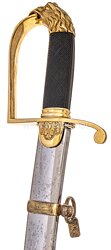
Kingdom of Hannover Lion Head Saber for Officers of the Royal Garde-Grenadier Regiment

Circa 1830. Approximately 3.4 cm wide and 78.9 cm long, slightly curved blade with broad fullers on both sides and a spear point, etched on both sides, the etchings in the form of vine patterns extending almost to the point, above the vines on each side the “All-Seeing Eye”, on the obverse side centrally the “flaming grenade” above the cipher “KGG”, on the reverse side the crowned coat of arms with the motto “Honi soit qui mal y pense” and “Dieu et mon droit” as well as the lion and unicorn, the blade slightly spotted. Partially chased and gilt brass hilt with lion head with paws crossed behind the head, on the obverse side on the center ferrule the “flaming grenade”, on the reverse side the cipher “KGG”, black ebony grip with checkered pattern, the quillon ending with a rectangular volute, the grip with minor damage near the pommel, with stress cracks on both sides at the bottom. Leather-covered steel scabbard with brass fittings. Condition 2. Accompanied by the old inventory number from the armory of Marienburg Castle.

Overall length 92 cm.

A very rare weapon from the era of King George IV and William IV. The Garde-Grenadier Regiment was formed after the reorganization of the Hanoverian Army in 1816 from former members of the King's German Legion. A similar example is today in the Historisches Museum Hannover. The present piece comes from the Welf Castle Marienburg and was sold at Sotheby's auction in October 2005.
453590
6.500,00

Kingdom of Hannover Lion Head Saber for Officers of the Royal Guard Grenadier Regiment

Circa 1830. Approximately 3 cm wide and 73.2 cm long, slightly curved wedge blade with pandur point, etched on both sides, the etchings in the form of vine patterns extending almost to the point, on the inside (tierce side) the “flaming grenade” above the cipher “KGG”, on the outside (quarte side) above the vines the “All-Seeing Eye”, in the center the crowned coat of arms with the motto “Honi soit qui mal y pense” and “Dieu et mon droit” as well as the lion and unicorn, encircling the base of the blade the engraving “C.W. Eichstaedt Hof Schwerdtfeger à Hannover”, the etchings slightly worn, the blade slightly spotted, a notch in the edge. Partially chased and gilt brass hilt with lion head with paws crossed behind the head, on the tierce side of the center ferrule the “flaming grenade”, on the quarte side the cipher “KGG”, black ebony grip with waffle pattern, the cross guard terminating in an angular volute, the gilding worn, the grip with minor damage on the tierce side near the pommel. Black lacquered leather scabbard with brass mounts, the throat piece somewhat loose. Condition 2. Accompanied by the old inventory number from the Marienburg Castle armory.

Overall length 88 cm.

A very rare weapon from the era of King George IV and William IV. The Guard Grenadier Regiment was formed after the re-establishment of the Hanoverian Army in 1816 from former members of the King's German Legion. A similar example is located today in the Historisches Museum Hannover. The present piece originates from the Welf Castle Marienburg and was sold at Sotheby's auction in October 2005.


453582
6.500,00

Kingdom of Hanover Pioneer Fascine Knife (Engineer Corps)

Brass hilt with leather-wrapped grip, one damage/loss present, crossguard not stamped, unusually shaped blade without maker's mark or acceptance or inspection stamp, single fuller, widening asymmetrically toward the point (bolo-type), black leather scabbard with brass fittings, throat locket stamped “SC232”, the leather is somewhat shrunk, therefore the blade does not fit completely inside, minor age-related traces such as corrosion at the blade point, otherwise unissued and well preserved, very rare, as only carried for a short period, approximately from 1850 to 1866. Condition 2
341774
1.800,00

Kingdom of Hannover Thrusting Sword from the Estate of then Lieutenant General Bernhard Prince zu Solms Braunfels, with Solid Gold Seal Pommel

This is a gift from the King, dated 1847. Blade measuring approximately 2.2 cm at the ricasso and 80.8 cm in length with fullers on both sides, indistinct maker's mark on the short false edge on the inside, maker “Küll” on the outside. Gilt brass hilt with simple knuckle bow and heart-shaped guard, the guard inscribed “Bernhard Prinz zu Solms Braunfels am 27ten März 1847”, the guard with slight play, the grip with silver wire binding, at the top the pommel button fashioned as a seal of solid 18-karat gold, finely engraved with the coat of arms of the Kingdom of Hannover. Leather scabbard with brass mounts, only slightly shrunk. Condition 2.

Overall length 107.5 cm

Prince Bernhard zu Solms-Braunfels (*1800, † 1868) was a Hanoverian and Prussian General of Cavalry. He began his military career in 1821 in the Prussian Army and entered the Hanoverian Army in 1839 as Major General à la suite. In 1845 he was promoted to Lieutenant General and in 1855 to General of Cavalry à la suite.

https://de.wikipedia.org/wiki/Bernhard_zu_Solms-Braunfels_(Offizier,_1800)

This piece comes from an old collection of Hanoverian edged weapons.
487870
6.500,00

Kingdom of Hanover ex-British Saber Model 1796 for Enlisted Men of the Royal Gendarmerie

Heavy, curved blade approximately 3.7 cm wide at the ricasso and 82.8 cm long with wide fullers on both sides, stamped “4” on the reverse side, maker's mark “[...] S Craven” on the back, the point slightly out of alignment. Steel hilt with simple knuckle guard with langet, shield-shaped quillon finials, front side stamped “K.G I0”, complete pommel cap with pommel ears, leather-wrapped grip. Steel scabbard with two ring bands and movable suspension rings, stamped “K.G I0” below the throat. Metal parts cleaned and with light surface rust. Condition 2.

Overall length 98 cm.

The abbreviation “K.G” stands for Royal Gendarmerie. This unit consisted of only 12 men and performed orderly duties for the King. It was under the command of the commander of the Garde du Corps and was recruited from veteran cavalry soldiers. The weapons remained in service until 1866.

This piece comes from an old collection of Hanoverian edged weapons.
487862
2.200,00

Kingdom of Hannover Pallasch M 1852 for Officers of the Garde du Corps from the Estate of Baron Otto von Klenck

Circa 1860. Heavy blade approximately 3.6 cm wide at the forte and 86.8 cm long, with wide fullers on both sides, stamped “—” on the back edge, the chappe is missing. Pierced steel hilt entirely following the Austrian Model 1850 pattern, ray skin grip with complete but slightly loose silver wire wrap, the thumb rest engraved “O. V. Klenk”. Steel scabbard with two ring bands and movable suspension rings. Condition 2.

Overall length 105.5 cm.

The weapon corresponds entirely to the Hanoverian cavalry saber M 1852, which in turn is based on the Austrian cavalry saber M 1850, but features a considerably heavier blade. This pallasch was worn from 1852 until the end of the Austro-Prussian War in 1866. The piece comes from a collection of Hanoverian edged weapons.

Baron Otto von Klenck died in 1911 at the age of 81 in Gmunden (Austria). He entered the Hanoverian Army as a cadet in 1845. In 1847 he transferred to the Garde-Husaren-Regiment and rose to the rank of Rittmeister by 1859. In 1862 he was appointed adjutant to the then Crown Prince Ernst August Ernst August ((II.) von Hannover (1845*, 1923†)). (He probably transferred to the Gardes du Corps at this time). In 1866 he participated in the Battle of Langensalza. After the lost war and the annexation of Hannover, he went into exile in Austria with the royal family. There he was entrusted with the administration of the court stables in 1872 and also assumed the office of Marshal of the Court in 1878. In 1891 he was finally appointed Oberstallmeister with the predicate “Excellency”.

Ernst August (II.) von Hannover also died in Gmunden in 1923.

A piece of museum significance!
487350
3.900,00

Königreich Hannover ex britischer Säbel Modell 1796 für Mannschaften der Königs-Gendarmerie

Schwere, geschwungene, an der Wurzel ca. 3.8 cm breite und 82.2 cm lange Klinge mit beidseitiger breiter Hohlbahn, keine Markierungen. Stahlgefäß mit einfachem Bügel mit Einstrich, schildförmige Parierstangenlappen, der rückseitige gestempelt «C III 72», ganze Griffkappe mit Griffkappenlappen, belederter Griff. Stahlscheide mit zwei Ringbändern und beweglichen Trageringen, unterhalb des Mundblechs gestempelt «K.G 12 B III 60». Die Metallteile gesäubert und flugrostig. Zustand 2.

Gesamtlänge 99 cm.

Das Kürzel „K.G“ steht für Königs-Gendarmerie“. Diese Truppe bestand aus nur 12 Mann und leistete Ordonanz-Dienste beim König. Sie unterstand dem Kommandeur der Garde du Corps und ergänzte sich aus altgedienten Soldaten der Reiterei. Die Waffen waren noch bis 1866 im Einsatz.

Bei diesem Stück sind die Scheide und die Waffe nicht nummerngleich, wurden aber wahrscheinlich noch damals auf der Kammer zusammengeführt. Auf dem vorderen Parierstangenlappen wurde der Stempel «K.G» offensichtlich verputzt.

Das Stück stammt aus einer alten Sammlung hannoverischer Blankwaffen.
487857
1.850,00

Königreich Hannover Säbel für Offiziere Leichte Infanterie aus der Zeit Zeit König Ernst Augusts I.

Um 1840/50. Vernickelte, leicht geschwungene Steckrückenklinge, zur Wurzel hin beidseitig geätzt, quartseitig der Hersteller «Prosser … London», auf dem Rücken gestempelt «017 024», Länge der Klinge ca. 89 cm, Breite an der Wurzel ca. 3.25 cm, Scharten an der Schneide überpoliert. Durchbrochen gearbeitetes Stahlgefäß mit der Chiffre «♔EAR» (Ernst August Rex, König von 1837-51) im Korb, Rochenhautgriff mit intakter Drahtwicklung. Lederscheide mit Stahlbeschlägen, das Mundblech mit langem Tragehaken. Zustand 2+.
Gesamtlänge 106 cm.

Bei der sehr qualitätvollen Waffe handelt es sich mit Sicherheit um eine Sonderanfertigung für einen hohen, adligen Offizier im direkten Umfeld des Königs, bzw. für den König selbst, der bekanntermaßen ein großes Interesse an der Fertigung von Blankwaffen hegte.

Nach der Formationsänderung 1838 bestanden vier leichte Bataillone, das Garde-Jäger-Bataillon und das 1. bis 3. „Leichte Bataillon“, die 1857 in Jäger umbenannt wurden.

Das Stück stammt aus dem Welfen-Schloss Marienburg, der königlichen hannoverschen Sammlung, die 2005 auf der Sotheby's Auktion größtenteils versteigert wurde.
483246
3.500,00

Großbritannien/Königreich Hannover Säbel für Mannschaften der leichten Kavallerie Modell 1796 aus der Zeit König Georgs III.

Um 1800. Blanke, stärker geschwungene Keilklinge, ohne Verzierungen oder Markierungen. Länge der Klinge ca. 72.2 cm, Breite an der Wurzel ca. 3.6 cm, die Klinge leicht fleckig, die Schneide mit kleinen Schlagkerben. Stahlgefäß mit einfachem Bügel mit Einstrich und Parierstangenlappen, belederter Griff mit intakter Drahtwicklung. Stahlscheide mit zwei Ringbändern und beweglichen Trageringen, gereinigt, fein rostnarbig. Zustand 2.

Gesamtlänge ca. 87.5 cm.

Georg III. (*1738) war von 1760 bis 1820 König von Großbritannien und Irland. Im Heiligen Römischen Reich regierte er ab 1760 als Kurfürst von Braunschweig-Lüneburg woraus 1814 das Königreich Hannover und das Herzogtum Braunschweig entstanden. Die Personalunion zwischen Großbritannien und dem Königreich Hannover bestand noch unter seinen Nachfolgern König Georg IV. und Wilhelm IV. und endete mit der Thronbesteigung König Ernst August I. 1837.
Die Kurhannoversche Armee bewahrte sich ihre Unabhängigkeit, kämpfte aber oft an der Seite der britischen Truppen und war nach britischem Vorbild uniformiert und ausgerüstet. Die Armee des Kurfürstentums wurde nach der französischen Besetzung Hannovers 1803 aufgelöst, aber ein großer Teil der Offiziere und Soldaten ging nach Großbritannien und wurde dort als King’s German Legion wieder aufgestellt. 1816 kam es dann zur Neugründung der hannoverschen Armee.

Das Stück stammt aus einer Sammlung hannoveranischer Blankwaffen.

Das Modell 1796 wurde während der Napoleonischen Kriege hauptsächlich von den britischen Dragonern, Husaren und der leichten Kavallerie der "Deutschen Legion" verwendet.


483501
1.400,00

Königreich Hannover Artillerie-Faschinenmesser für Angehörige der Fußartillerie .

Gereinigte und etwas schartige Keilklinge, im Bereich der Fehlschärfe gepunzt, Messinggefäß mit einfachem Parierbügel, belederter Holzgriff, auf dem Parierlappen der Truppenstempel "A.B. L.85" eingraviert, schwarze Lederscheide mit Messingbeschlägen, das Mundblech nicht identisch mit "C. 17" markiert, normale Alters- und Gebrauchsspuren, gut erhalten, selten. Zustand 2-
498578
1.650,00

Königreich Hannover Säbel Modell 1852 für Offiziere der Kavallerie aus der Zeit König Georgs V.

Um 1860. Leicht geschwungene, blanke, beidseitig gekehlte, ca. 78.8 cm lange und an der Wurzel 2.6 cm breite Klinge, die Klinge fleckig. Durchbrochen gearbeitetes Stahlgefäß mit Rochenhautgriff, die Drahtwicklung am Griff und die Fingerschlaufe intakt, die Griffkappe mit Daumenauflage, der Korb hinten mit den zwei Einstrichen für das Portepee, am Korb ein kleiner Bruch. Stahlscheide mit zwei Ringbändern und beweglichen Trageringen, ohne Mundblech, gereinigt, fleckig. Zustand 2-.

Gesamtlänge 96 cm.

Der hannoveranische Säbel Modell 1852 ist dem österreichischen Säbel Modell 1850 nachgebildet und gleicht diesem fast völlig. Das Stück stammt aus einer Sammlung hannoveranischer Blankwaffen.


483446
1.200,00

Königreich Hannover Degen für Offiziere Infanterie

Um 1820/30. An der Wurzel ca. 1.9 cm breite und 77.5 cm lange Gratklinge, das untere Drittel der Klinge gebläut und mit vergoldeten Gravuren verziert, Hersteller «L.H.J in Solingen», Bläuung und Vergoldung sehr schön erhalten. Vergoldetes Messinggefäß mit herzförmigem Stichblatt, hochgestellter Parierstange und einfachem Bügel, der Griff mit feiner Silberdrahtwicklung, diese sehr leicht aus der Form, anhängend die Inventar-Marke «262» der königlichen hannoverschen Sammlung Schloss Marienburg. Ohne Scheide. Zustand 2+.

Gesamtlänge ca. 92 cm.

Eine sehr schöne, leichte Waffe. In dieser Qualität für einen höheren Offizier. Die Waffe stammt aus der königlichen hannoverschen Sammlung auf Schloss Marienburg, die 2005 auf der Sotheby's Auktion größtenteils versteigert wurde.
487518
1.300,00

Königreich Hannover Säbel Modell 1852 für Offiziere der Kavallerie aus der Zeit König Georgs V.

Um 1860. Leicht geschwungene, blanke, beidseitig gekehlte, ca. 80.1 cm lange und an der Wurzel 2.2 cm breite Klinge, die Klinge fleckig und fein rostnarbig. Durchbrochen gearbeitetes Stahlgefäß mit Rochenhautgriff, die Drahtwicklung am Griff intakt, die Fingerschlaufe abgerissen, die Griffkappe mit der für dieses Modell typischen Daumenauflage, der Korb hinten mit den zwei typischen Einstrichen für das Portepee. Stahlscheide mit zwei Ringbändern und beweglichen Trageringen, fleckig und teils rostnarbig. Zustand 2-.

Gesamtlänge 98 cm.

Der hannoveranische Säbel Modell 1852 ist dem österreichischen Säbel Modell 1850 nachgebildet und gleicht diesem fast völlig. Das Stück stammt aus einer Sammlung hannoveranischer Blankwaffen.


483459
1.100,00

Königreich Hannover Hirschfänger für Soldaten vom Feldjägercorps .

Schwere Keilklinge mit mittigem Ort, auf der Fehlschärfe eine kleine Marke "R", auf dem Klingenrücken eine "2" eingeschlagen, zweiteiliges Messinggefäß mit wuchtigem Griff und einfachem Parierbügel, dieser markiert "FJC 201", die Vernietung am Knauf ist manipuliert, das Stück kommt ohne Scheide, deutlichere Alters- und Gebrauchsspuren, ausgesprochen selten. Zustand 2-3

Klingenlänge etwa 415 mm
Gesamtlänge (unversorgt) etwa 545 mm


Nach Vollmer wurde das Feldjägercorps in den Befreiungskriegen aufgestellt und hatte 1816 eine Stärke von 327 Mann, 1820 nur noch 50 Mann und 1861 wurde es aufgelöst.


483512
1.600,00

Königreich Hannover Säbel Modell 1796 für Offiziere der leichten Kavallerie

Um 1810/20. Leicht geschwungene, an der Wurzel ca. 3.4 cm breite und 80.5 cm lange Steckrückenklinge mit Schör. Stahlgefäß mit einfachem Bügel mit Einstrich, „schnabelartig“ verlängerte ganze Griffkappe, Rochenhautgriff ohne Drahtwicklung, anhängend die Inventar-Marke «291» der königlichen hannoverschen Sammlung Schloss Marienburg. Stahlscheide mit zwei Ringbändern und beweglichen Trageringen. Die Metallteile gereinigt und leicht fleckig. Zustand 2.

Gesamtlänge 97 cm.

Das Stück stammt aus dem Welfen-Schloss Marienburg, der königlichen hannoverschen Sammlung, die 2005 auf der Sotheby's Auktion größtenteils versteigert wurde.

Die Säbel des Modells M 1796 wurden in großen Stückzahlen und in vielen Varianten hergestellt. Getragen wurde das Modell von der britischen Kavallerie und den ehemals hannoverischen Truppen in England, der Kavallerie der Kings German Legion, sowie den preußischen Truppen während der Napoleonischen Kriege bzw. der Befreiungskriege. Nach dem Krieg wurde das Säbel-Modell auch von der neu aufgestellten Armee des Königreichs Hannover übernommen.
487436
1.800,00