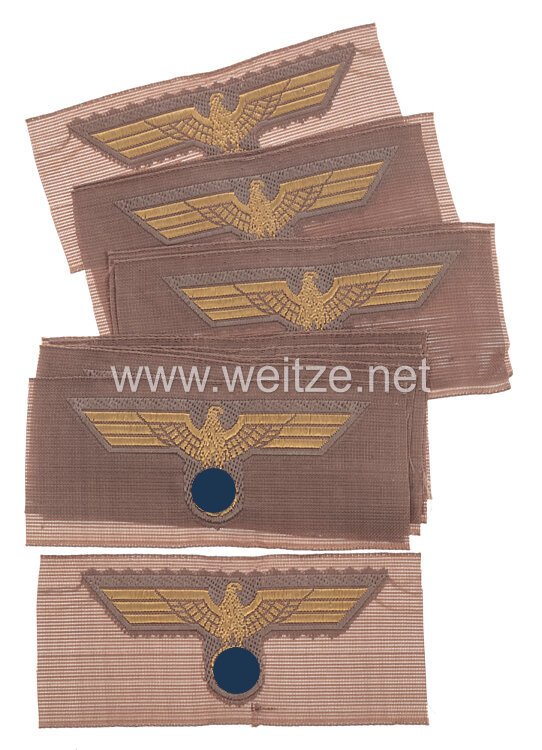
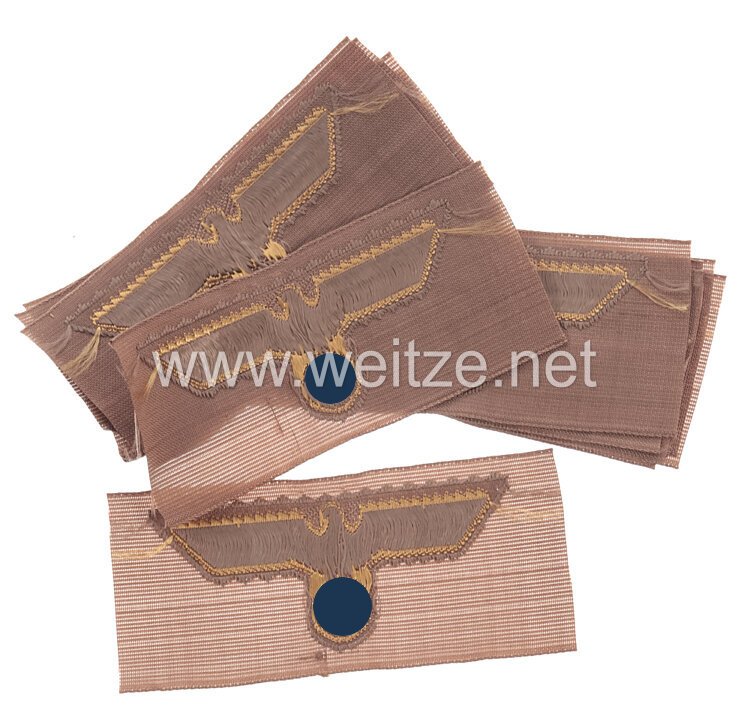
Kriegsmarine Afrikakorps Tropical Eagle for Side Cap or Tropical Field Cap

Bevo-woven version in yellow on sand color. Unworn, condition 2-, rare.
463816
100,00

Kriegsmarine Afrikakorps Tropical Eagle for Side Cap or Tropical Field Cap

The Kriegsmarine Afrika Korps Tropical Eagle represents a fascinating example of German military insignia from World War II. This specialized badge was designed for members of the Kriegsmarine (German Navy) deployed to the North African theater of operations, intended for attachment to the Schiffchen (garrison cap) or the tropical field cap.

The manufacturing was carried out using the characteristic BeVo weaving technique, a highly developed weaving process developed by the company Bandfabrik Ewald Vorsteher in Wuppertal. The acronym “BeVo” derives directly from the company name. This technique enabled the production of detailed, durable cloth insignia that withstood the extreme climatic conditions of North Africa better than metal counterparts. The color combination of yellow on sand color was deliberately chosen to match the tropical uniform while ensuring visibility of the national emblem.

The Kriegsmarine's deployment in North Africa was less extensive than that of the Army, but nonetheless of strategic importance. Naval personnel served in various capacities: as liaison officers to Italian forces, in port administrations along the North African coast, coordinating supply deliveries across the Mediterranean, and in specialized units such as naval coastal batteries. Following the landing of the German Afrika Korps under Field Marshal Erwin Rommel in February 1941, the Kriegsmarine's presence in the region was reinforced.

The Wehrmacht's tropical uniforms were systematically developed and introduced from 1940/41 onwards. The Oberkommando der Wehrmacht (High Command of the Armed Forces) recognized the necessity of special equipment for deployment in hot climate zones. The tropical uniform typically consisted of olive-brown or sand-colored fabric and included various headgear, including the garrison cap and tropical field cap. The latter, often referred to as the tropical Schiffchen, was a lightweight, foldable headgear suitable for the North African climate.

The eagle badge itself followed the traditional iconography of the Hoheitsadler (National Eagle) of the Third Reich, but in a form adapted for tropical climates. The eagle with spread wings, holding a swastika in its talons, had been the official symbol of the Wehrmacht since 1935. The Kriegsmarine had specific variants that differed in details from those of the Army and Air Force.

The rarity of such Kriegsmarine tropical insignia can be explained by several factors: First, the number of naval personnel deployed in North Africa was relatively small compared to the Army and Air Force. Second, the African campaign ended in May 1943 with the capitulation of the Axis powers in Tunisia, limiting the production period and thus the total number of badges manufactured. Third, many such equipment items were lost or destroyed during and after the war.

The BeVo weaving technique itself deserves special attention. Unlike embroidered or printed badges, BeVo insignia were produced on special Jacquard looms. This enabled mass production while maintaining high detail accuracy. The threads used were often artificial silk or cotton, and the color fastness was remarkable for the time. Unworn specimens, like the one described, still display the original color brilliance and sharp contours of the woven pattern.

In the context of uniformology, such insignia are important sources for understanding military hierarchies, organizational structures, and material culture of World War II. They document not only the technical skills of the German textile industry but also the adaptability of military administration to different operational areas and climate zones.

For collectors and historians, the condition is of crucial importance. An unworn specimen in condition 2- means the badge is nearly mint, with only minimal storage traces. Such pieces are particularly valuable for historical research, as they document the original manufacturing quality and intended appearance without the wear traces of actual field use.

The study of these insignia contributes to our understanding of how military organizations adapted to diverse operational environments and how material culture reflected both practical necessities and symbolic representation of military authority and national identity during this period of history.