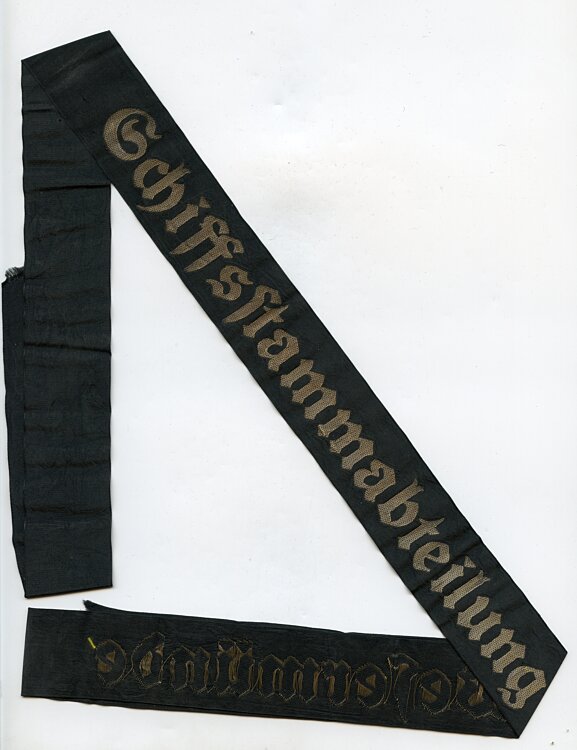
Cap Tally "Schiffsstammabteilung Wesermünde"

Metallic thread woven construction, 116 cm long, worn condition. Condition 2.
108015
45,00

Cap Tally "Schiffsstammabteilung Wesermünde"

The cap tally of the Schiffsstammabteilung Wesermünde (Ship Base Division Wesermünde) represents an important aspect of the maritime tradition of the German Kriegsmarine. These cap tallies, executed in metal-thread weaving, served to identify membership in a specific unit and were an essential component of the naval uniform.

The Schiffsstammabteilungen (abbreviated SSA, Ship Base Divisions) were established in the German Navy as organizational units for crews not assigned to a specific vessel. They served for the administrative management and training of naval personnel between ship assignments or during shore leaves. The Schiffsstammabteilung Wesermünde was located in the city of the same name, known today as Bremerhaven, which represented one of the most important naval bases on the German North Sea coast.

Wesermünde was created in 1924 through the merger of several municipalities and developed into a significant naval location. The strategic position at the mouth of the Weser River made the city an important starting point for German naval operations. The Ship Base Division stationed there was responsible for the care and organization of naval personnel who were being prepared for various ship assignments or looked after between deployments.

The cap tallies of the Kriegsmarine were traditionally made from black ribbon and bore the name of the unit or ship in gold lettering. The metal-thread woven execution present here indicates high-quality workmanship, in which metal threads were directly incorporated into the fabric. This technique ensured lasting shine and special durability of the inscription. The standard length of approximately 116 cm corresponded to the regular specifications of naval clothing regulations.

The use of cap tallies in the German Navy goes back to a long tradition dating to the Imperial Navy of the 19th century. According to the clothing regulations of the Kriegsmarine, the ribbons were worn on the peaked cap (Tellermütze) and formed a characteristic part of the sailor's uniform. The inscription not only served identification purposes but also promoted esprit de corps and connection to the respective unit.

In the organization of the Kriegsmarine, the Ship Base Divisions played an important role in personnel management. They functioned as home stations for sailors and petty officers who were not permanently assigned to a ship. This could have various reasons: new recruits waiting for their first sea posting, personnel in training, wounded on convalescent leave, or crew members from decommissioned ships.

The metal-thread weaving as a manufacturing technique was more elaborate than simple embroidery and was often produced by specialized manufacturers. The quality of such cap tallies varied depending on the manufacturer and time of production. Throughout the war years, simplifications occurred in the manufacture of uniform parts, but cap tallies retained their significance as identification markers.

The condition of the tally as "worn" documents its authentic use by a member of the Schiffsstammabteilung Wesermünde. Such personal equipment items today bear witness to the individual fates of the men who served in the Kriegsmarine. They are important historical documents for understanding the organizational structure and daily life in the German Navy.

The city of Wesermünde played a significant role in German naval strategy during the war. In addition to the Ship Base Division, various other naval offices and facilities were located there. After the war's end, the city was merged with Bremerhaven in 1947 and received its present name.

Today, such cap tallies are important collector's items and objects of study for military historians. They enable the reconstruction of the organizational structure of the Kriegsmarine and document the diversity of units and offices. Each cap tally tells the story of a specific unit and its members, thus contributing to the understanding of German naval history.

The metal-thread woven execution represents a particular quality level that was maintained even during wartime resource constraints. These items serve as tangible links to the past, preserving the memory of the organizational complexity and human dimension of naval service during this historical period.