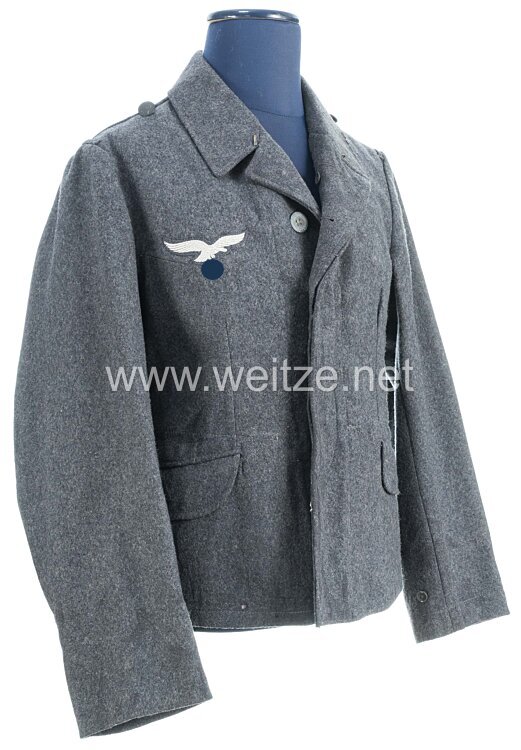
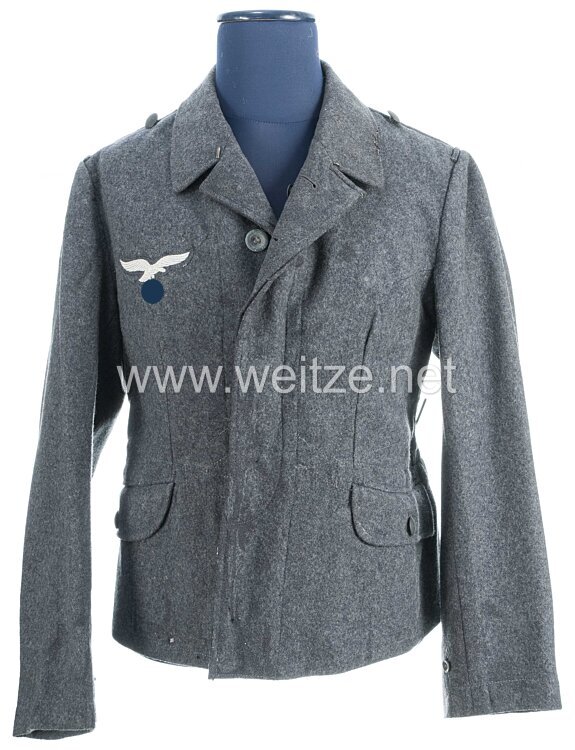
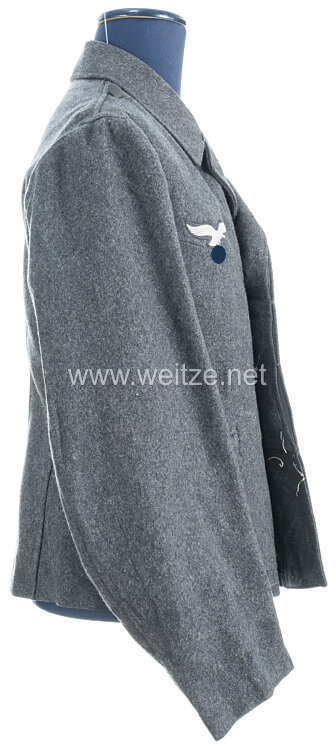
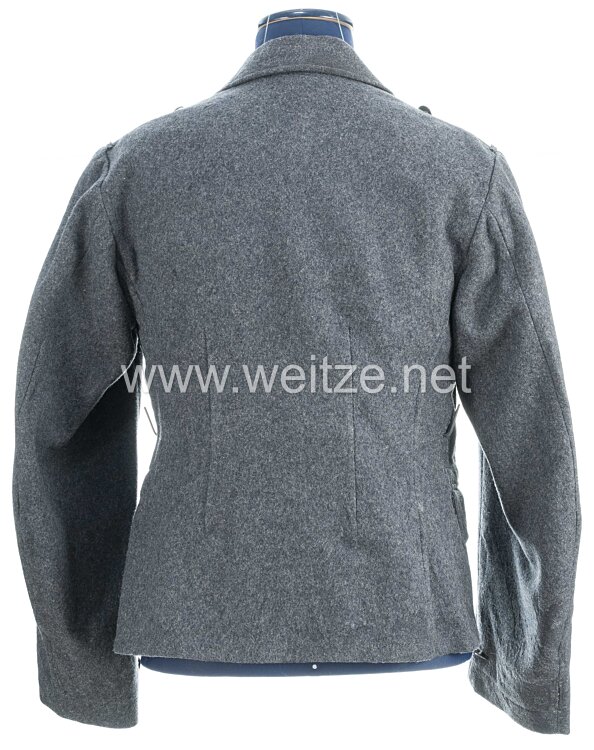
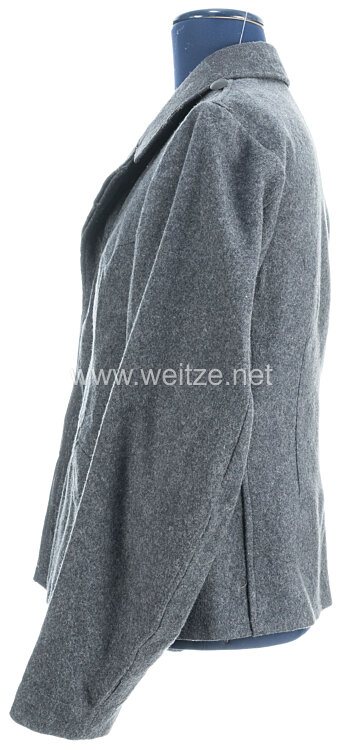
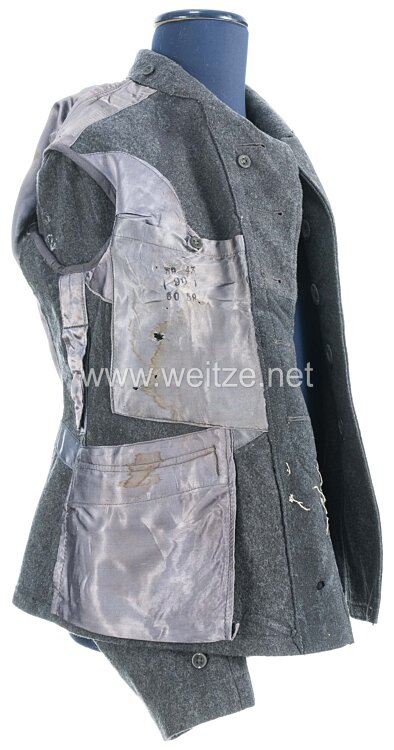
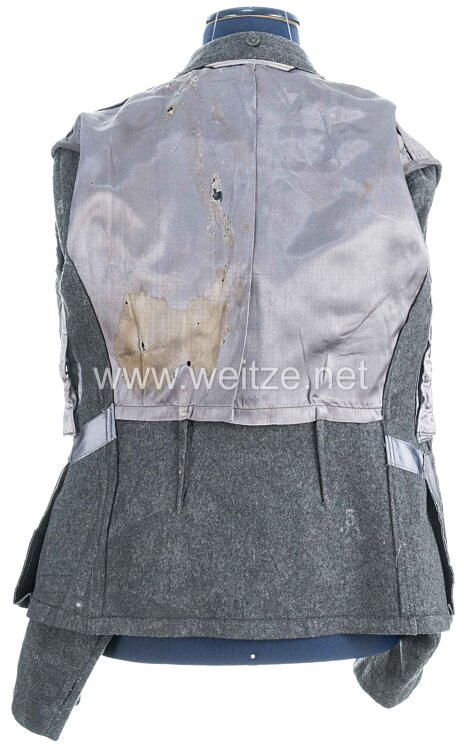
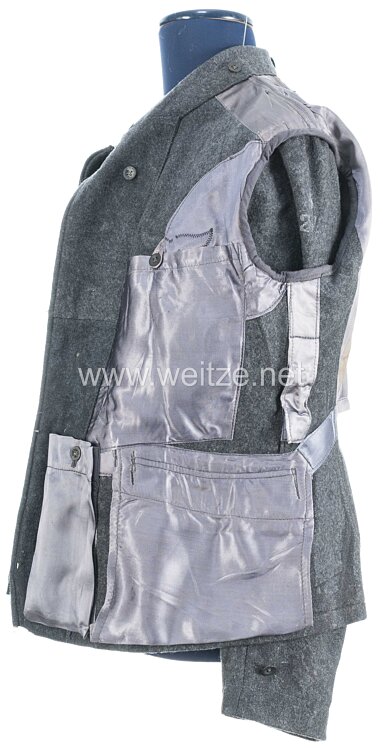
Luftwaffe Flight Blouse for Enlisted Men

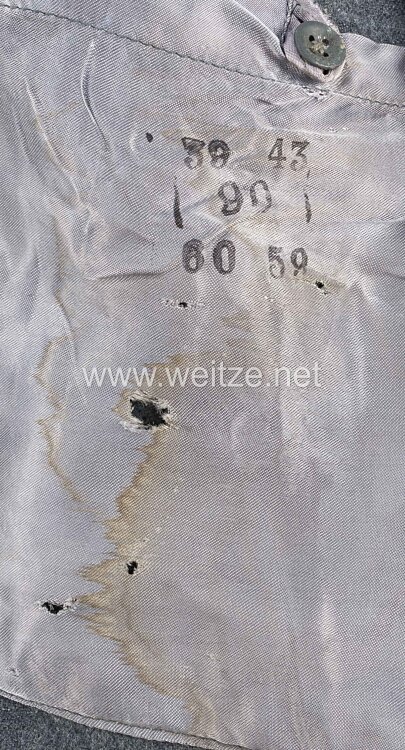
This is a depot find, untouched since 1945. Cloth in the typical enlisted man's execution in blue-gray, the breast eagle in machine-embroidered execution, originally sewn, loops for shoulder straps are present. Interior with silk lining and size stamp. Sleeve length 59 cm, back length 59 cm, chest circumference 76 cm. Unworn, however moth traces on the chest, moth damage on the collar. Condition 3.
448115
850,00

Luftwaffe Flight Blouse for Enlisted Men

The Luftwaffe Fliegerbluse for Enlisted Men represents an essential element of the German Air Force uniform during World War II. This specific uniform tunic was designed for ordinary soldiers and non-commissioned officers of the Luftwaffe and differed significantly from officers' versions in material, workmanship, and details.

The Luftwaffe, officially founded in 1935 and initially built up in secret, quickly developed its own uniform system that distinguished itself from the Army and Navy. The characteristic blue-grey color (Fliegerblau) became the hallmark of the Luftwaffe and was meant to symbolize the connection with the element of air. The exact shade was precisely defined in the Army Service Regulations (H.Dv.) and later Luftwaffe regulations.

The enlisted men's version of the Fliegerbluse differed from officers' variants through several characteristics: the cloth material was simpler and more coarsely woven, the workmanship less elaborate, and the insignia were usually machine-embroidered. The breast eagle, the central sovereignty symbol of the Wehrmacht, was typically machine-stitched onto the fabric for enlisted men's tunics, while officers' versions often featured hand-embroidered or woven eagles of higher quality.

The construction of the Fliegerbluse followed the Luftwaffe clothing regulations, first issued in 1935 and updated several times. The garment featured shoulder strap loops to which rank insignia were attached. These loops were firmly connected to the jacket and allowed for easy buttoning and unbuttoning of shoulder boards during promotions or transfers.

The silk lining inside the jacket was a quality feature that, despite being an enlisted version, indicated a certain level of value. As the war progressed, substitute materials were increasingly used, so early productions often still featured higher quality materials. The size stamp inside served military logistics and enabled quick assignment of uniforms according to standard sizes.

The measurements of this tunic (sleeve length 59 cm, back length 59 cm, chest circumference 76 cm) correspond to a smaller size, suggesting a younger or smaller-statured soldier. The Wehrmacht increasingly recruited younger age groups, especially in the later war years.

The term “depot find” describes uniforms and equipment items that originated from military warehouses and often remained unissued. After the capitulation in 1945, numerous Wehrmacht depots were confiscated or sealed by the Allies. Many of these warehouses remained untouched for decades until they were discovered in the post-war period. Such depot finds are of particular historical interest because they preserve the original condition without later modifications or signs of wear.

The unworn condition of this tunic is remarkable and indicates that it was never issued or used. This could have various reasons: it may have been produced shortly before the end of the war when the supply situation had already collapsed, or it remained in the depot for other logistical reasons.

The mentioned moth damage is typical of textile storage damage over decades. Moths of the Tineidae family preferentially attack wool textiles and leave characteristic feeding marks. This damage is common in historical uniforms stored under suboptimal conditions and, while diminishing the state of preservation, is of documentary interest as evidence of storage history.

The Luftwaffe produced millions of uniform items during the war at various manufacturing facilities throughout the Reich and in occupied territories. The Wehrmacht's clothing economy was a complex system of military tailoring workshops, civilian suppliers, and forced labor. Toward the end of the war, quality increasingly deteriorated due to material shortages.

Today, such uniform pieces are important material witnesses to military history and are preserved in museums, collections, and for scientific research. They document not only military organization and hierarchy but also textile production, logistics, and the everyday reality of soldiers in World War II.

r