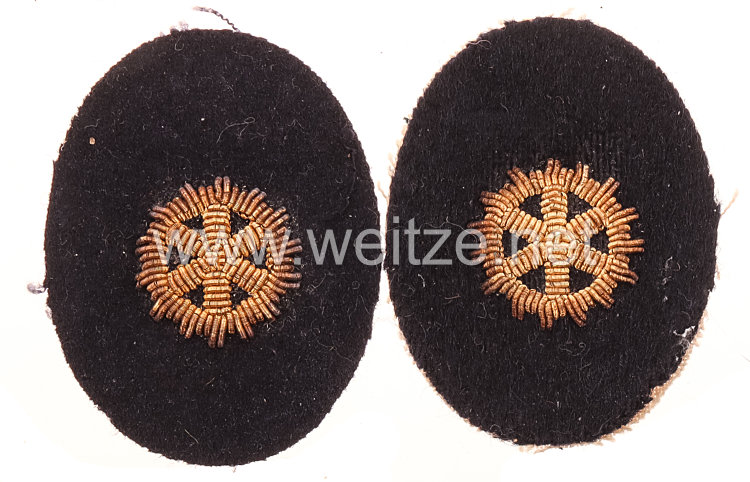
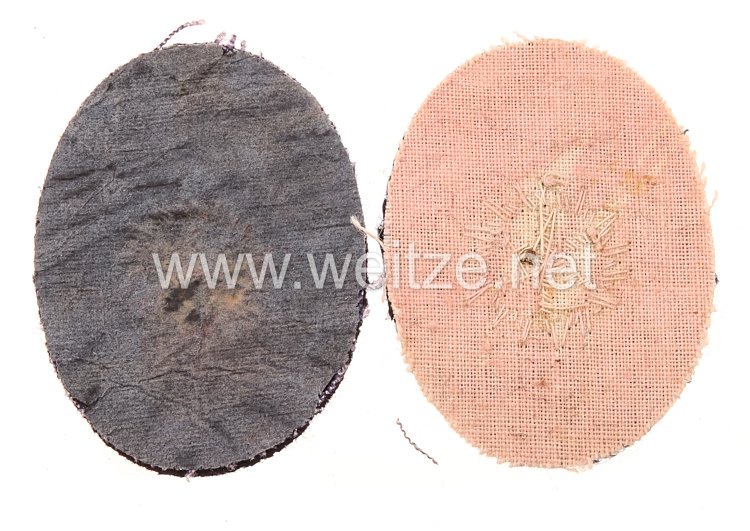
Kriegsmarine Pair of Sleeve Insignia for an Officer and Engineer
These sleeve insignia for an officer and engineer of the Kriegsmarine represent a significant example of the military distinction system of the Third Reich. These hand-embroidered metal-thread rank insignia document the complex hierarchy and specialization within the German Kriegsmarine during World War II.
The Kriegsmarine, as the official designation of the German Navy from 1935 to 1945, developed a sophisticated system of rank and function insignia. Following the reintroduction of general conscription and the associated expansion of German armed forces, the Reichsmarine was renamed Kriegsmarine in 1935. Uniform regulations were continuously adapted and refined, with the Dress Regulations for the Kriegsmarine (M.Dv. Nr. 53) specifying exact requirements for uniforms and insignia.
Sleeve insignia for Kriegsmarine officers were worn on dark blue uniform jackets and consisted of characteristic gold braids and rings indicating respective ranks. Engineering officers occupied a special position within the naval organization. They were responsible for technical aspects of ship operations, particularly machinery, electrical engineering, and other technical systems. To identify their special function, engineering officers wore additional markings that distinguished them from executive officers.
The differentiation was achieved through the color of the intermediate stripes between the gold sleeve rings. While executive officers wore no intermediate stripes, engineering officers displayed pink to purple stripes between their rank insignia. This color coding enabled immediate identification of technical officers aboard ship and within the naval hierarchy. The system of intermediate stripes was also used for other specializations: medical officers wore dark blue, administrative officers dark green, and ordnance officers light red.
The hand-embroidered execution in metal thread was characteristic of higher-quality officer insignia. While simpler versions were machine-made or produced from woven material, hand-embroidered insignia were more elaborate in production and correspondingly higher in quality. The use of metal threads – typically gold-plated or silver-plated wires wound around a core thread – gave the insignia their characteristic luster and durability.
The officer corps of the Kriegsmarine was divided into various rank levels, from Leutnant zur See (sub-lieutenant) to Großadmiral (grand admiral). The number of sleeve rings indicated the respective rank: one narrow ring for Leutnant zur See, one and a half rings for Oberleutnant zur See, two rings for Kapitänleutnant, two and a half for Korvettenkapitän, three for Fregattenkapitän, three rings with a broader upper ring for Kapitän zur See, and so on ascending the hierarchy. Admiral ranks were distinguished by broader braids and additional gold embroidery.
Technical officers, particularly engineers, played a crucial role in the Kriegsmarine. The increasing technologization of naval warfare required highly qualified specialists. Steam turbines, diesel engines, electrical systems, fire control systems, and later radar and sonar equipment made engineering officers indispensable members of ship crews. Their training took place at specialized naval schools and included both theoretical and practical components.
The insignia presented here as a pair illustrate the practice that officers possessed multiple sets of sleeve insignia. These were worn on different jackets depending on the uniform type – dress uniform, service dress, or mess dress. The careful storage and maintenance of these insignia was part of military discipline and tradition.
After the war ended in 1945, the Kriegsmarine was dissolved, and many uniform parts and insignia passed into private collections. Today, such objects are important historical documents that provide insight into the organizational structure, hierarchy, and technical specialization of the German Kriegsmarine. They document the material culture of a specific historical epoch and are significant for military-historical research.