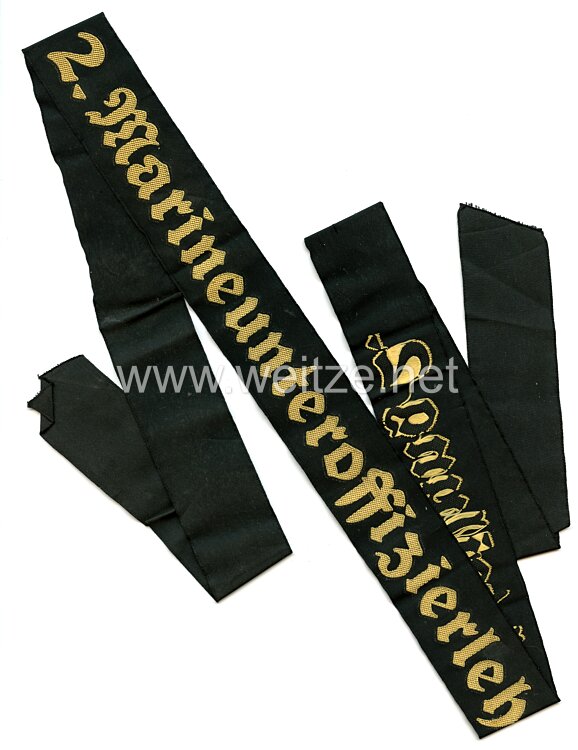
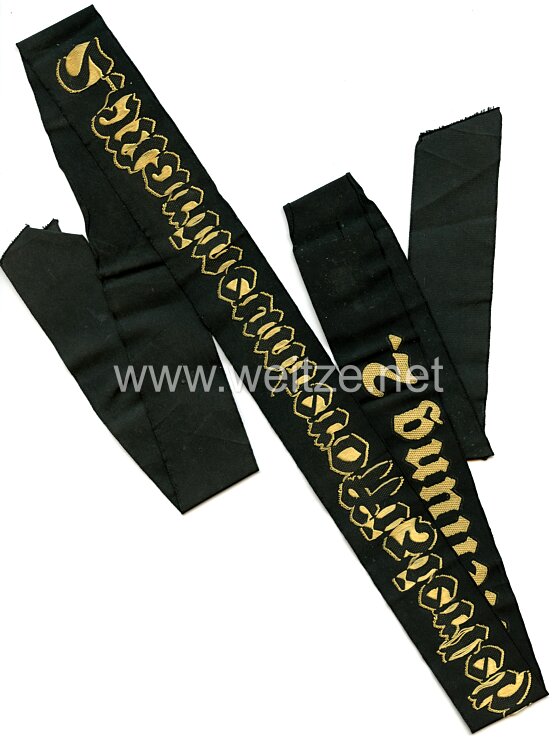
Kriegsmarine Cap Tally “2. Marineunteroffizierlehrabteilung 2.”

Cotton thread woven construction, length approx. 110 cm, condition 2-.
454315
20,00

Kriegsmarine Cap Tally “2. Marineunteroffizierlehrabteilung 2.”

This cap tally of the 2nd Marine Petty Officer Training Division 2 represents an authentic artifact from the German Kriegsmarine during World War II. Cap tallies were an essential component of German naval personnel uniforms, serving both identification purposes and fostering esprit de corps within different units.

The Marine Petty Officer Training Divisions (Marineunteroffizierlehrabteilungen) were specialized training facilities of the Kriegsmarine responsible for the education and advancement of petty officers. These training divisions played a crucial role in building and maintaining a professional non-commissioned officer corps, which was considered the backbone of the navy. Petty officers were responsible for the practical training of enlisted personnel and formed the vital link between common sailors and commissioned officers.

The cap tally itself is made of woven cotton thread, which corresponded to the standard manufacturing method for such equipment items. The typical length of approximately 110 centimeters allowed the band to be attached around the peaked cap (Schirmmütze), with both ends bearing printed or woven inscriptions hanging down at the back. The black base color with golden-yellow lettering in Gothic script corresponded to the official regulations of the Kriegsmarine for cap tallies.

The history of German naval cap tallies dates back to the Imperial Navy (Kaiserliche Marine), where they were first introduced in the second half of the 19th century. After World War I, the Reichsmarine adopted this tradition, and finally the Kriegsmarine continued it from 1935 onwards. The uniform regulations of the Kriegsmarine precisely specified how cap tallies were to be manufactured, which fonts were to be used, and which units were authorized to carry their own bands.

For training facilities such as the Marine Petty Officer Training Divisions, specific cap tallies were of particular importance. They indicated membership in a specific training unit and were often worn only during the training period. After successful completion of training, petty officers would receive cap tallies of their assigned operational units, such as ships or shore establishments.

The numbering “2” in the designation suggests this was the second of possibly several parallel training divisions for naval petty officers. The Kriegsmarine maintained an extensive training system at various locations during World War II, predominantly along the Baltic Sea coast, where conditions for maritime training were favorable.

The manufacturing technique of these cap tallies was performed by specialized textile companies producing under contract to the Kriegsmarine. The weaving technique enabled durable and relatively cost-effective production, with the lettering woven directly into the band. This distinguished them from earlier or higher-quality versions where the inscription was sometimes embroidered.

In the context of collecting history, cap tallies from training units are often rarer than those from famous warships. While tallies from renowned ships such as “Bismarck” or “Tirpitz” are more frequently collected and also more often counterfeited, tallies from training facilities represent a more authentic cross-section of the actual organizational structure of the Kriegsmarine.

The preservation of such textiles over more than seven decades presents special challenges. Cotton threads are susceptible to moisture, light exposure, and mechanical stress. The indicated condition reflects the typical signs of aging expected for such objects.

From a historical perspective, these cap tallies document not only the military organization but also the importance that the Nazi regime placed on training and indoctrination of young soldiers. The Kriegsmarine expanded considerably between 1935 and 1945, creating an enormous need for well-trained petty officers. The training divisions were therefore essential institutions for building German naval power.

Today, such artifacts serve as important historical sources for understanding the structure, organization, and daily life of the Kriegsmarine. They represent tangible connections to individual experiences of sailors who passed through these training facilities, even as we must contextualize them within the broader historical framework of Nazi Germany's military apparatus.

r