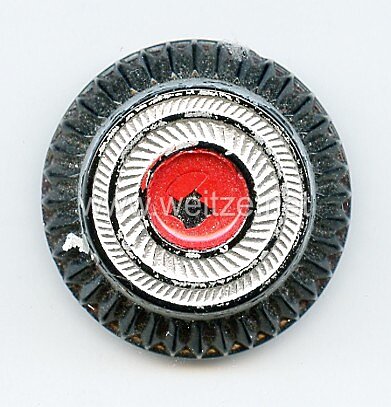
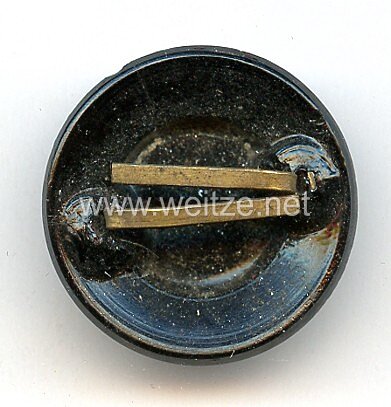
Kriegsmarine Cockade for Enlisted Men's Visor Cap

circa 1943/44. Manufactured from glass (!), color lacquered, reverse with 2 attachment prongs. Unissued condition, Condition 2.
451115
20,00

Kriegsmarine Cockade for Enlisted Men's Visor Cap

This Kriegsmarine cockade for the enlisted men's visor cap (Tellermütze) represents a fascinating example of material improvisation during the late stages of World War II. Dating to approximately 1943/44, this specimen documents the increasing resource shortages that confronted the German Reich during the final war years.

The visor cap had been a traditional component of German naval uniforms since the Imperial Navy era. Following the establishment of the Kriegsmarine in 1935 under the leadership of Grand Admiral Erich Raeder, uniform regulations were precisely defined in the Dress Regulations for the Kriegsmarine (Anzugsordnung für die Kriegsmarine, A.O.K.). The cockade, as a national insignia, was an indispensable element of this headgear, displaying allegiance to National Socialist Germany.

Particularly noteworthy about this example is its manufacture from glass, representing an extraordinary deviation from standard production practices. During the early war years, cockades were typically manufactured from metal, often nickel-plated brass or zinc alloys. As the war intensified and strategically important metals became increasingly scarce for weapons production, German armaments industry had to resort to alternative materials.

From 1942/43 onward, the raw materials situation deteriorated dramatically. The Reich Office for Metals (Reichsstelle für Metalle) ordered strict rationing measures, with non-ferrous metals being reserved primarily for war-critical production such as ammunition, aircraft construction, and U-boat building. This led to a proliferation of substitute materials in uniform equipment: plastics, pressed materials, wood, and indeed glass came into increased use.

The use of glass as a material for military insignia was technically demanding. The glass had to be thin enough not to be too heavy, yet simultaneously robust enough to withstand the rigors of military daily life. The colored lacquering was applied to the reverse side, displaying the characteristic colors of the Reich War Flag - black, white, and red. The two fastening prongs on the back served for secure mounting to the cap crown.

The unworn condition of this specimen is remarkable and suggests it may have been produced toward the war's end but never issued. From 1944 onward, the Kriegsmarine was severely depleted by Allied air raids on German ports and the increasing destruction of U-boats. Production of uniform items occasionally exceeded actual needs, as simultaneously the number of active naval personnel declined through losses.

The cockade itself traditionally displayed national identification in the form of concentric circles. The outer areas were rendered in the Reich colors, while the center frequently featured an additional element - such as an eagle or anchor. For enlisted ranks, the design was simpler than officer versions, which often featured additional metal borders or more elaborate decoration.

The manufacture of such glass insignia likely occurred in specialized facilities of the German glass industry, possibly in Thuringia or the Ore Mountains (Erzgebirge), where traditional centers of glass processing existed. These factories were obligated under the war economy to produce military equipment items.

From a collecting perspective, glass cockades from the final war years are extremely rare today. Many were never issued, were lost at war's end, or were destroyed. The condition grade 2 (very good) of this specimen, with intact lacquering and undamaged glass, makes it a valuable historical document.

The Kriegsmarine cockade stands as an exemplar of the material constraints of total war, as proclaimed by Joseph Goebbels in Berlin's Sportpalast in February 1943. Even seemingly insignificant objects like uniform insignia reflect the increasing desperation and shortage that characterized the German Reich in its final phase. It documents the transition from traditional, high-quality pre-war manufacturing to the improvised substitute production of the war years.

This artifact serves as a tangible reminder of how comprehensive warfare affected every aspect of military life, down to the smallest details of uniform decoration. The ingenuity required to continue producing regulation insignia while conserving critical war materials demonstrates both the organizational capacity and the ultimate futility of the German war effort in its closing stages.