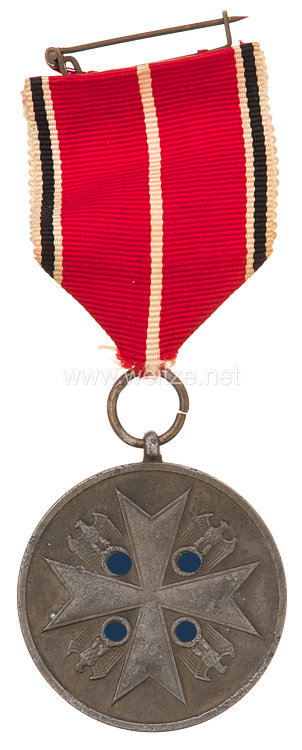
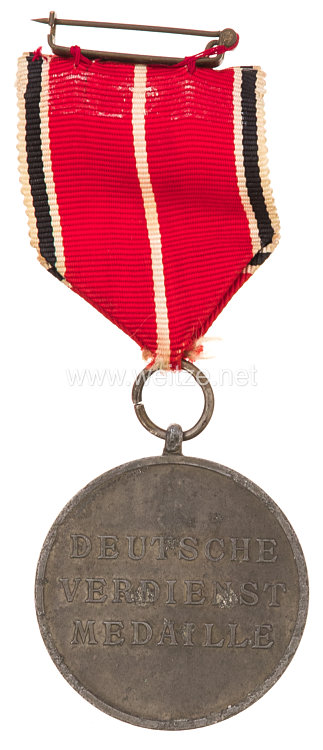
German Bronze Merit Medal
The German Bronze Merit Medal (Deutsche Bronzene Verdienstmedaille) ranks among the most significant civilian decorations of National Socialist Germany and was awarded during World War II. This medal represents an important chapter in the history of German orders and decorations.
The decoration was instituted by Adolf Hitler on September 1, 1939, the day of the invasion of Poland and thus the beginning of World War II. The Merit Medal was part of a comprehensive system of awards that included various grades: the Bronze Merit Medal as the lowest level, followed by the Silver Merit Medal and finally the Golden Merit Medal.
The present example displays characteristic features of wartime production. With a diameter of 38 mm, it conforms to official specifications. Particularly noteworthy is the manufacture from fine zinc instead of bronze, indicating wartime material shortages. From the middle of the war onwards, substitute materials had to be increasingly used as bronze was needed for the armaments industry. The medals made of fine zinc were subsequently bronzed to imitate the appearance of regular bronze versions.
Production by the Hauptmünzamt Wien (Main Mint Vienna) is of particular historical significance. Following the “Anschluss” (annexation) of Austria in 1938, the Vienna Mint was integrated into the German minting system. The marking “30” in the ring clearly identifies this manufacturing facility. The Vienna Main Mint produced large quantities of orders and decorations for the German Reich during the war.
The medal's design followed clear specifications. The obverse typically featured a swastika within an oak wreath, while the reverse bore the inscription “Für Verdienste” (For Merit). The mentioned block lettering refers to the typeface used, which was designed to be matter-of-fact and clear, conforming to the aesthetic ideal of the time.
The awarding practice of the Bronze Merit Medal was comprehensive. It was conferred upon civilians and members of paramilitary organizations who had distinguished themselves in various fields. This included achievements in the war economy, air raid protection, provision of supplies to the population, or other activities important to the war effort. The medal could also be awarded to foreigners who had rendered services to the German Reich.
The original ribbon in its characteristic colors - red with black side stripes - conforms to official wearing regulations. It was worn on the left breast, with the accompanying pin attachment enabling fastening to civilian clothing. When multiple decorations were worn, precise hierarchies existed for correct placement.
The condition of this medal reflects its history. The faded bronzing is typical for pieces made of fine zinc, as the applied bronze layer has oxidized and changed over the decades. This is an authentic aging characteristic observable in many wartime productions made from substitute materials.
From a historical perspective, such decorations document the mobilization of entire society during total war. The Nazi regime systematically used orders and decorations for motivation and control of the population. Mass production of awards was intended to reward loyalty and encourage further efforts.
After the war ended in 1945, wearing all National Socialist decorations was prohibited by Allied Control Council laws. To this day, public display of orders with Nazi symbols in Germany is only permitted for scientific or educational purposes. This legal regulation underscores the continuing historical responsibility in dealing with this legacy.
For collectors and historians, such pieces offer important insights into production methods, awarding practices, and the material culture of the Third Reich. Identification through maker marks such as the “30” of the Vienna Main Mint enables precise attribution and dating. The study of these objects contributes to understanding historical contexts without relativizing the criminal nature of the regime.