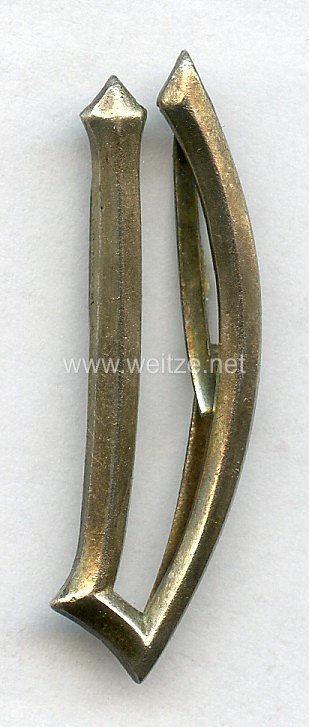
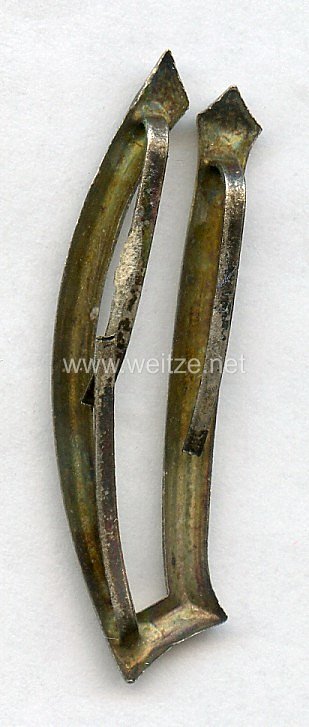
SA Single Collar Tab Insignia Overlay for Administrative Personnel
This SA single collar tab for a member of the administration represents a characteristic example of the rank insignia of the Sturmabteilung (SA) during the National Socialist period. This particular collar tab served to identify administrative personnel within the SA organization and was part of the comprehensive uniform system that reflected the paramilitary structure of the SA.
The Sturmabteilung was founded in 1920/21 as the security force of the NSDAP and developed into the largest paramilitary organization of the Weimar Republic by 1933. After the seizure of power, the SA grew to several million members. The uniform system and rank insignia played a central role in the self-representation and organization of this formation. Collar tabs were essential components of the service uniform and enabled immediate identification of rank and affiliation.
The administrative units of the SA were responsible for administrative, organizational, and economic tasks. They formed the backbone of the bureaucratic structure necessary to manage an organization of this magnitude. Administrative personnel handled personnel files, finances, procurement, quartermaster services, and other administrative functions. Their collar tabs differed from those of storm and staff units through specific coloring or symbols.
SA collar tabs were typically worn in pairs on the brown shirt collar, with each tab conveying specific information about the wearer. The RZM (Reichszeugmeisterei) was responsible from 1929 onwards for supervising and certifying NSDAP equipment and uniform parts. Items with RZM markings were considered officially approved equipment. The absence of such marking on this specimen could indicate various manufacturing circumstances: production before full implementation of the RZM system, manufacture by an uncertified producer, or fabrication for internal use.
The unworn condition of this collar tab overlay is of particular historical interest. Such never-used pieces are rarer than worn examples and provide insights into original manufacturing quality and material composition. Reasons for the unworn condition can be manifold: the end of the war before delivery, overproduction, personal circumstances of the intended wearer, or the dissolution of SA structures after 1945.
The materials of such collar tabs were typically felt or cloth as a base, with embroidered or woven symbols and insignia. The coloring followed strict regulations: administrative members often wore specific colors that differed from the crimson collar tabs of political leaders or other ranks. Manufacturing occurred both in specialized uniform factories and by smaller craft businesses.
After the Röhm Affair of June 30, 1934, in which the SA leadership was eliminated, the organization increasingly lost significance. The SS took over many of its functions, and the SA was relegated to a largely symbolic organization. Nevertheless, its administrative structures remained in place until the end of the war, albeit in reduced scope.
The condition designation 2- in the collector's world indicates a very good to excellent state of preservation, with possibly minimal storage traces but without signs of use. Such evaluations are important for historical documentation and understanding the transmission history of these objects.
Today, such artifacts serve exclusively for historical research and education. They are testimonies to a dark period of German history and are preserved in museums, archives, and scientific collections to illustrate to future generations the mechanisms of totalitarian systems. Uniforming and rank insignia were essential elements of National Socialist techniques of domination, visually manifesting hierarchy, belonging, and ideological coordination.