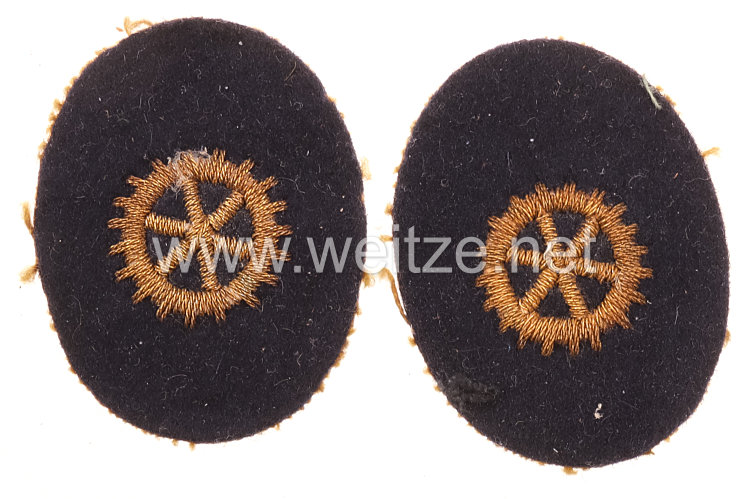
Kriegsmarine Pair of Sleeve Insignia for an Officer and Engineer

machine embroidered, seawater-resistant threads, condition 2.
Condition may vary.

443514
20,00

Kriegsmarine Pair of Sleeve Insignia for an Officer and Engineer

The Kriegsmarine sleeve insignia for officers and engineers represent a significant element of German naval uniform regulations during the Second World War era. These machine-embroidered insignia with seawater-resistant threads were not merely decorative elements but served the clear identification of rank and function within the maritime armed forces of the German Reich.

The Kriegsmarine was officially established on June 1, 1935, when the German Reich rejected the provisions of the Treaty of Versailles as part of its rearmament program. Under the leadership of Grand Admiral Erich Raeder and later Karl Dönitz, the Kriegsmarine developed into a significant naval force. Uniform regulations were precisely detailed in the Dress Regulations for the Kriegsmarine (M.Dv. Nr. 412), which contained detailed provisions regarding wear, materials, and execution of various uniform components.

The sleeve insignia for officers traditionally consisted of golden-yellow braids on a dark background, with the number and arrangement of stripes indicating the respective rank. The engineering officers of the Kriegsmarine wore special identification: their sleeve insignia featured a purple or pink stripe between the golden braids, indicating their technical specialization. This distinction was of great practical importance aboard warships, where rapid identification of specialist personnel in emergency situations could be life-saving.

The production of these insignia was carried out by specialized manufacturers approved by the Kriegsmarine. Machine embroidery enabled consistent quality and faster production compared to hand-embroidered variants, which were primarily reserved for higher ranks. The use of seawater-resistant threads was a technical necessity that addressed the special requirements of naval service. The salt-laden sea air, humidity, and frequent weather exposure presented particular challenges to uniform durability.

The material composition of these insignia reflects the technological state of German textile industry in the 1930s and 1940s. The specially treated threads had to be not only seawater-resistant but also retain their color under extreme conditions. The dark blue cloth base corresponded to the traditional color of the German Navy, which had its roots in the Imperial Navy (Kaiserliche Marine).

Throughout the war, production conditions changed considerably. While high-quality materials were initially used, increasing raw material shortages and the intensification of Allied bombing raids on German industrial facilities led to quality fluctuations. Nevertheless, the Kriegsmarine endeavored to maintain certain standards in uniforming, as these were considered essential for troop morale and discipline.

The engineering officers played a crucial role in the Kriegsmarine. They were responsible for the technical operation of increasingly complex warships, U-boats, and shore installations. Their training took place at specialized naval schools, and they enjoyed high regard within the armed forces. The color coding of their sleeve insignia emphasized their special position and expertise.

Following the end of World War II in May 1945, the Kriegsmarine was dissolved. Original insignia from this period are today sought-after collectors' items and important historical artifacts. They document not only military hierarchy and organization but also the craftsmanship quality of German textile processing of that era. Collectors and historians particularly value well-preserved examples with original seawater-resistant threads, as these represent authentic witnesses to military dress regulations.

Research into such uniform components contributes to understanding daily life in the German Kriegsmarine and helps reconstruct the organizational structures and technical requirements of naval warfare. They are material testimonies to a significant, albeit dark, epoch of German history.

r