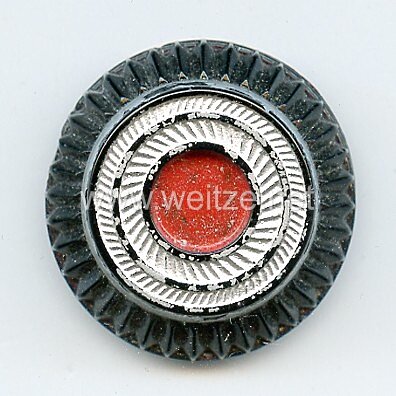
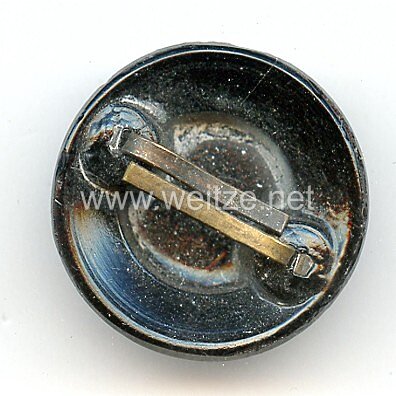
Kriegsmarine Cockade for Enlisted Men's Visor Cap
The Kriegsmarine Cockade for the Peaked Cap represents a fascinating example of uniform insignia worn by enlisted personnel of the German Navy during World War II. This particular specimen, dated to 1943/44, represents a remarkable development in the manufacture of military equipment during the late war years.
The Tellermütze (peaked cap), also known as the service cap, was an integral part of the Kriegsmarine uniform. It was worn by officers, non-commissioned officers, and enlisted men alike, with variations depending on rank. The cockade, mounted centrally on the front of the cap, served as a national emblem and identified the wearer as a member of the German Navy.
What makes this specimen particularly remarkable is its construction from glass. This represents a significant deviation from standard cockades, which were typically made from metal, often aluminum or silver-plated tombac. The use of glass as a material reflects the increasing material shortages that the German Reich faced from 1943 onwards. Metals, especially those needed for armaments production, were increasingly rationed and reserved for war-critical purposes.
German war management found itself forced to resort to substitute materials (Ersatzstoffe) in the late war years. This affected nearly all areas of military and civilian production. Glass offered itself as an alternative, as it was abundantly available in Germany and the glass industry possessed the necessary manufacturing capacities. The colored lacquer finish of the cockade in the traditional colors of black, white, and red reproduced the familiar design of the Reich cockade.
The rear attachment with two prongs corresponded to the standard construction for cap cockades. These prongs were pushed through the fabric of the peaked cap and bent over on the inside to secure the cockade firmly. This construction method was practical and allowed for replacement of the cockade when necessary.
The “unworn” condition of this specimen is of particular historical significance. It suggests that this cockade was either never issued or that it was part of a warehouse stock that survived the end of the war. Many such items were confiscated by Allied troops after 1945 or kept by German civilians as souvenirs.
The Kriegsmarine itself was officially founded in 1935, after Germany rejected the restrictions of the Treaty of Versailles. Under the command of Grand Admiral Erich Raeder and later Karl Dönitz, the Kriegsmarine grew into a significant naval force. Uniform regulations were strictly controlled and set forth in detailed dress regulations that contained precise specifications for all uniform parts and insignia.
Glass cockades like this specimen are relatively rare in collections today. Their fragility made them susceptible to damage, both during the war and in the post-war period. The fact that this piece has remained unworn and in good condition makes it a valuable historical document of wartime material economy and the improvisations to which the German Reich was forced in the final war years.
The use of substitute materials in uniform manufacturing is an important aspect of World War II military history. It documents not only the economic constraints of warfare, but also the industrial creativity and adaptability under extreme conditions. Such objects serve today as tangible witnesses to a time when even seemingly insignificant details of military equipment were shaped by the effects of total war.
For military historians and collectors, items like this glass cockade provide crucial insights into the deteriorating material situation of Nazi Germany. They represent a physical manifestation of the strategic pressures and resource constraints that ultimately contributed to Germany's defeat. Each such artifact tells a story not just of military tradition and regulation, but of the larger economic and industrial reality of a nation at war.