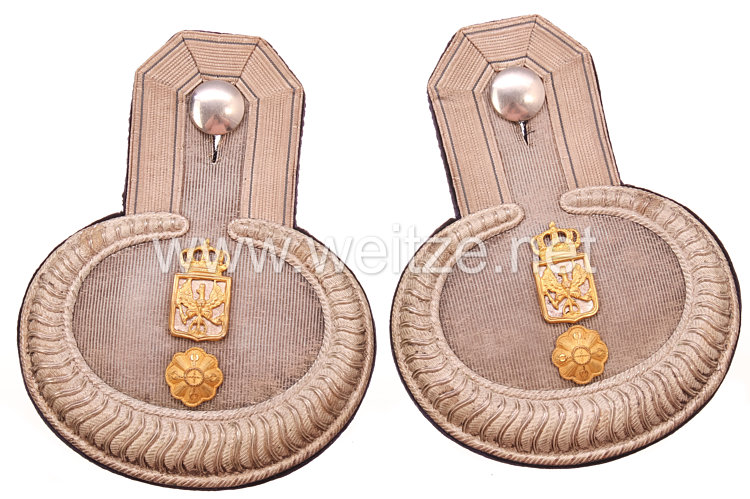
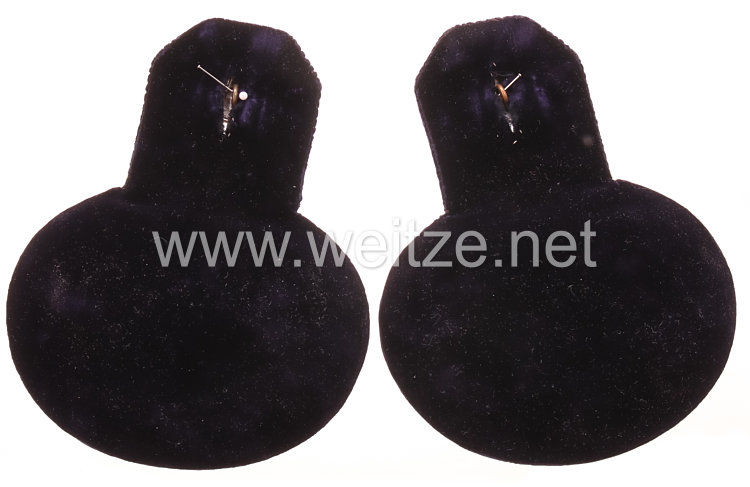
Prussia Military Intendantur Pair of Epaulettes for a Secretary
These epaulettes of a Secretary in the Prussian Military Intendantur dating from around 1910 represent a fascinating chapter of German military history and the Prussian civil service system. They illustrate the strict hierarchical order and detailed uniform regulations that characterized the German Empire until its end in 1918.
The Military Intendantur was a central administrative institution of the Prussian and later the entire German army. Its mission consisted of organizing the supply, provisioning, clothing, and accommodation of the troops. This complex logistical challenge required an extensive administrative apparatus with qualified civil servants of various ranks. The Intendantur was subordinate to the War Ministry and played an indispensable role in maintaining the armed forces' operational readiness.
The rank of Secretary in the Military Intendantur corresponded to the intermediate civil service career path. Secretaries were trained administrative professionals responsible for correspondence, record-keeping, accounting, and administrative processing. They formed the backbone of military administration and ensured proper documentation of all procedures. Their position was not equivalent to military officer rank, yet they wore uniforms and rank insignia that clearly indicated their status within the military hierarchy.
The uniform regulations for civil servants of the Military Intendantur were detailed in the official regulations of the Prussian War Ministry. These regulations were adjusted and refined several times over the years. Epaulettes as rank insignia followed a strict scheme that made rank and affiliation immediately recognizable.
The described epaulettes display the typical characteristics of Intendantur civil servants: The silver fields and braiding with blue threads were characteristic of the Intendantur, with blue representing the branch color of this administrative unit. The dark blue velvet base underscores the elevated position within the civil service hierarchy. Particularly significant are the golden rank stars, which indicated the specific grade within the secretary career path, as well as the civil service emblem, which clarified membership in the civil service estate.
The combination of silver and gold elements followed Prussian traditions of rank designation. While line officers predominantly wore silver or gold epaulettes depending on their regiment, civil service career paths had their own characteristics. The silver crescents at the ends of the epaulettes were a traditional element dating back to the historical origins of this rank insignia in the 18th century.
Around 1910, during the Wilhelmine era, the German Empire reached its zenith as a military power. The army had expanded massively, and with it grew the need for efficient administration. At this time, the Military Intendantur employed several thousand civil servants of various ranks. The uniform and its insignia were not only functional but also an expression of the prestige and importance attached to military affairs in Wilhelmine society.
The craftsmanship of such epaulettes required specialized skill. Military equipment manufacturers in Berlin and other garrison towns produced these rank insignia with careful handwork. The use of silver and gold, albeit often in the form of metal alloys or gilded elements, as well as the elaborate embroidery, made these objects valuable possessions of their uniform wearers.
After the end of World War I in 1918 and the collapse of the monarchy, the old military order was dissolved. The Reichswehr of the Weimar Republic introduced new, simplified uniform regulations. The elaborate epaulettes of the imperial era were replaced by simpler rank insignia. Thus ended an epoch of military history in which uniform and rank insignia possessed the highest symbolic significance.
Today, such epaulettes are significant military-historical collectibles that provide insight into the complex hierarchy and organization of the Prussian-German army. They document not only military ranks but also the social significance of the civil service and the craft culture of their time of origin. The condition grade of 2+ indicates a well-preserved example that has survived time largely unscathed.