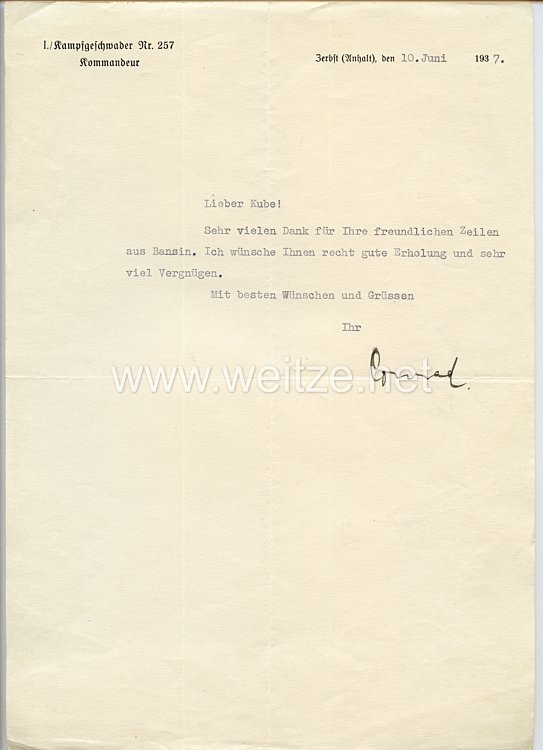
Luftwaffe - Original Signature of Knight's Cross Recipient Generalmajor Dipl.-Ing. Gerhard Conrad
Gerhard Conrad was awarded the Knight's Cross on May 24, 1940.
This historical document from 1937 represents a fascinating testimony to German Luftwaffe history in the pre-war period. It is a letter on official stationery of I./Kampfgeschwader Nr. 257, signed by Gerhard Conrad, who would later become known as Generalmajor and Knight's Cross recipient.
Kampfgeschwader 257 was a bomber unit of the newly established Luftwaffe, which officially existed from 1935 despite the provisions of the Treaty of Versailles. The location of Zerbst in Anhalt already had a long military tradition and became an important training and stationing location for the rapidly developing Luftwaffe. The numbering of Kampfgeschwader followed a systematic structure, with number 257 indicating a specific organizational integration.
Gerhard Conrad, who as a graduate engineer (Diplom-Ingenieur) had received technical training, represents the type of modern Luftwaffe officer of the 1930s. His technical qualifications were particularly valuable in the rapidly modernizing air force. In 1937, at the time of writing this letter, he served as Kommandeur (commander) of the I. Gruppe of Kampfgeschwader 257. The award of the Knight's Cross of the Iron Cross on May 24, 1940, was given for outstanding military achievements during the Western Campaign, making Conrad one of the early recipients of this prestigious decoration.
Get-well wishes to comrades were part of military camaraderie culture and demonstrate personal relationships within military units. Such letters on official stationery with printed letterhead document not only the administrative organization of the Luftwaffe but also the social structure and leadership philosophy of the time. The ink signature gives the document authenticity and personal character.
In 1937, the German Luftwaffe was in an intensive phase of expansion and training. The Spanish Civil War served as a testing ground for new tactics and aircraft types. The Kampfgeschwader were systematically established, equipped, and trained. Officers like Conrad played a central role in developing bomber formations that would later be deployed in World War II.
Original signatures of Knight's Cross recipients are highly sought after by collectors of military historical documents. Signatures from the pre-war period, such as this example from 1937, are particularly rare because they show an officer in his early career phase before he achieved military honors. The combination of official stationery, concrete date and location, and authentic signature makes such documents important sources for military history research.
The printed letterhead with the precise unit designation, the location Zerbst (Anhalt), the exact date, and the characteristic ink signature are typical features of authentic Luftwaffe documents from this period. The double folding corresponds to the usual handling of letters from this time.
Documents like this provide researchers with valuable insights into the organizational structure, command hierarchies, and personal networks within the Luftwaffe. They serve as primary sources that help reconstruct the daily life and administrative practices of military units during a crucial period of German military history.