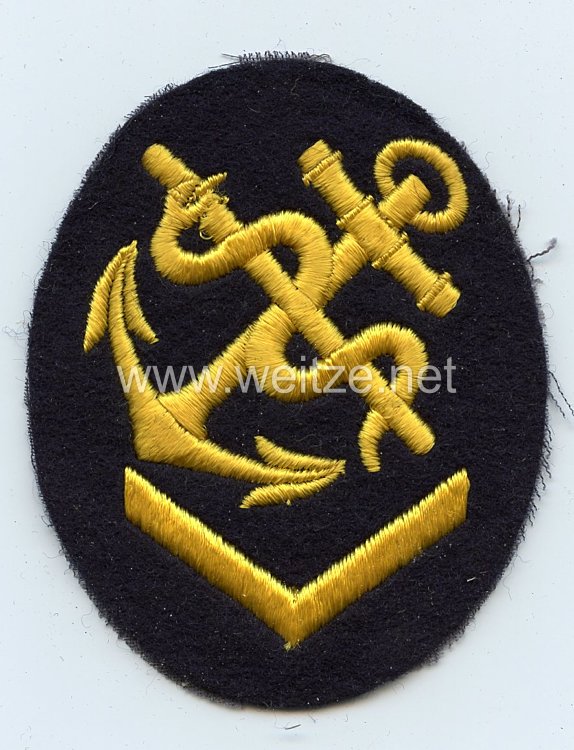
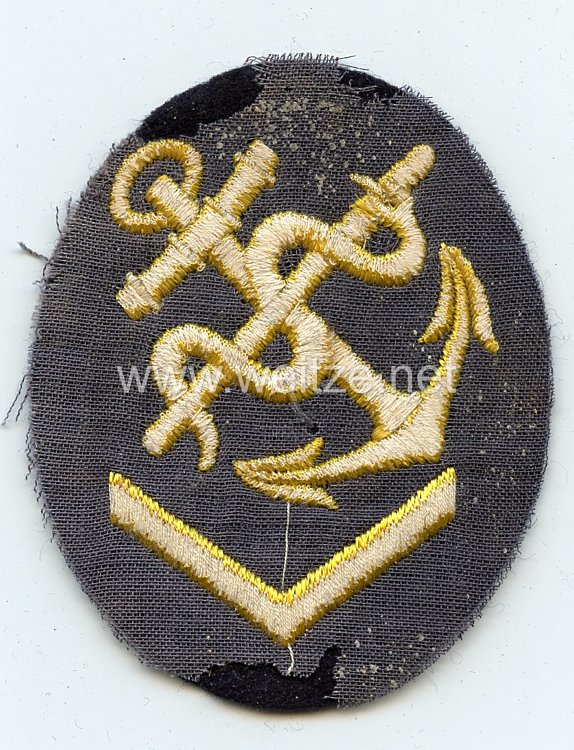
Kriegsmarine Sleeve Insignia for Sanitätsobermaat (Senior Medical Petty Officer)
The sleeve badge of a Kriegsmarine Sanitätsobermaat (Senior Medical Petty Officer) represents a significant example of military rank insignia and specialization within the German Navy during World War II. This machine-embroidered career badge was worn on the blue uniform and identified a non-commissioned officer in the medical service of the Kriegsmarine.
The Kriegsmarine, which existed as the official naval force of the German Reich from 1935 to 1945, had developed a complex system of rank insignia and specialization markings. The Sanitätsobermaat was a non-commissioned officer rank within the medical career path and corresponded hierarchically to an Obermaat (senior petty officer) in other branches. The medical career path was one of several specialized branches alongside others such as torpedo, communications, or engineering branches.
The badge itself was machine-embroidered, which was typical for mass production during the war years. Machine embroidery enabled standardized production with consistent quality and was more cost-effective than hand-embroidered variants, which were primarily reserved for officers and higher ranks. The badge was worn on the blue work jacket or blouse, which was part of the everyday shipboard uniform.
The uniform regulations of the Kriegsmarine were detailed in various dress codes. The blue blouse was part of the work and shipboard uniform and was worn during daily service aboard ship and for practical duties. In contrast, there were more formal uniform variants in dark blue or white for special occasions and shore leave.
The Medical Service of the Kriegsmarine played an essential role in fleet operations. Medical personnel were stationed on all larger ships, submarines, and in naval hospitals. Training to become a Sanitätsobermaat included both military and medical components. Personnel had to be capable of providing emergency medical care under the special conditions at sea, particularly in submarines.
Identification through the sleeve badge was of great practical importance. In the shipboard hierarchy, it had to be immediately recognizable who held which rank and specialization. This was especially vital in emergency situations. The career badge indicated membership in the medical branch through its specific design, usually featuring the characteristic Rod of Asclepius or other medical symbols.
The rank structure of the Kriegsmarine differed from that of the Army and Air Force. The Maat rank was specific to the Navy and had its roots in traditional German naval organization dating back to the Imperial Navy. The Obermaat stood between the simple Maat and the Oberbootsmann (chief boatswain) and was an experienced non-commissioned officer.
Following the Defense Act of 1935 and subsequent uniform regulations, the system of career badges was continuously developed. The various career paths were identified by different symbols worn as sleeve badges on both upper arms. This system served to clearly organize the different specialist areas within the Navy.
The production of such badges was carried out by specialized manufacturers approved by the Kriegsmarine. Quality and precise execution had to meet certain standards. However, during the course of the war, there were increasing material shortages, which were sometimes reflected in the manufacturing quality of later productions.
Today, these sleeve badges are important collector's items and historical documents. They enable historians and collectors to understand the organizational structure of the Kriegsmarine and to reconstruct the various ranks and career paths. The condition of such objects is classified according to a grading system, taking into account various factors such as state of preservation, completeness, and originality.
The study of such military-historical objects serves historical understanding and scholarly analysis of this era. They are material witnesses to a dark chapter of German history and help to document and understand the structures and daily life of the military organization of that time.