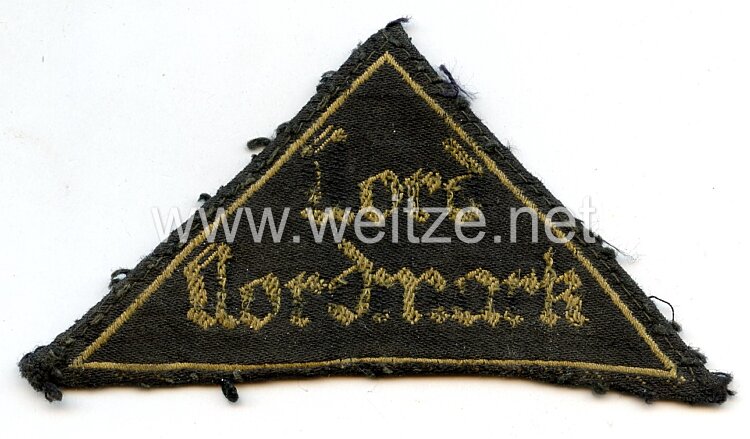
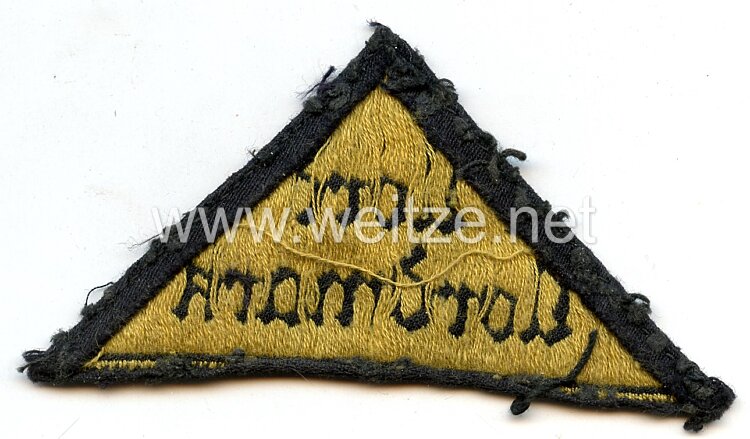
HJ District Triangle “Nord Nordmark”

BeVo woven construction. Heavily worn, condition 3.
464313
90,00

HJ District Triangle “Nord Nordmark”

The HJ Area Triangle "Nord Nordmark" represents a significant artifact of the organizational structure of the Hitler Youth during the National Socialist era. These insignia served for territorial identification and distinction of various administrative units within the nationwide youth organization.

The Hitler Youth was founded in 1926 and developed into the state youth organization of the German Reich after the Nazi seizure of power in 1933. Following the Law on the Hitler Youth of December 1, 1936, nearly all German youth between 10 and 18 years of age were incorporated. The organizational structure followed geographical principles, divided into Gebiete (areas), Obergebiete (upper areas), Banne (districts), Stämme (tribes), and smaller units.

The Gebiet Nordmark belonged to the significant administrative units of the HJ and encompassed the regions of Schleswig-Holstein and Hamburg. The name "Nordmark" referred to the historical designation for the northern border regions of the Reich. The area leadership was headquartered in Kiel and was responsible for organizing and implementing all HJ activities in this territory.

The Gebietsdreiecke (area triangles) were worn as sleeve insignia on the uniform, typically on the left upper arm. They served for quick identification of a HJ member's regional affiliation. The Bevo-woven execution described here refers to a special manufacturing technique. Bevo was the abbreviation for "Bandfabrik Ewald Vorsteher" in Wuppertal-Barmen, which had developed a special weaving technique. This method enabled the mechanical production of colored insignia with precise details and clear contours. Bevo insignia were of high quality and were produced for various organizations of the Third Reich.

The area triangle typically had a triangular shape with a base of approximately 60-70 mm and a height of about 45-50 mm. The color scheme varied by area and followed an established system. For the Gebiet Nordmark, specific colors and often maritime or Nordic symbolism were characteristic, reflecting the geographical location and cultural identity of the region.

The introduction of these insignia occurred in the late 1930s as part of the increasing uniformization and regimentation of the HJ. Through service regulations and various directives from the Reich Youth Leadership, the appearance, wearing method, and production of these insignia were precisely specified. Strict adherence to these regulations was intended to underscore the uniformity of the organization.

The described heavily worn condition of this specimen indicates intensive use. This is historically significant as it demonstrates that the insignia was actually worn in service and did not merely exist for representative purposes. Signs of wear, color fading, and fiber damage are typical of originals worn over extended periods. Many young people wore their uniforms during weekly home evenings, field exercises, athletic competitions, and during mandatory service.

After 1945, all organizations of the NS regime, including the Hitler Youth, were banned and dissolved by the Allied Control Council. Uniforms and insignia were largely destroyed or confiscated by the occupation forces. Today, such objects are historical documents preserved in museums, archives, and private collections. They serve scientific research and historical education about the National Socialist era.

Engagement with such objects requires responsible and critical handling. They are testimonies of a totalitarian system that cost millions of lives and plunged Europe into World War II. The Hitler Youth played a central role in the indoctrination of young people and their preparation for military service. The historical examination of this era remains an important societal task.

r