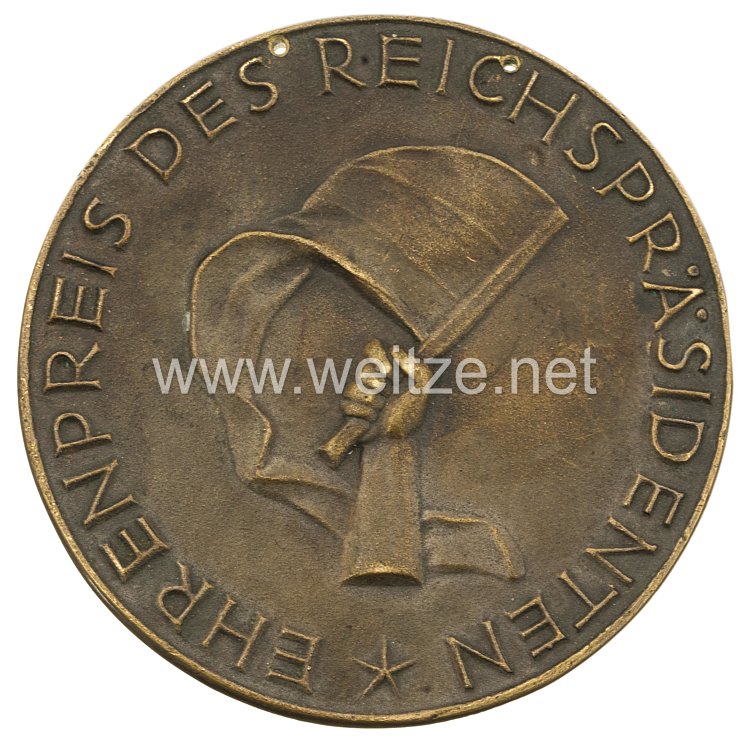
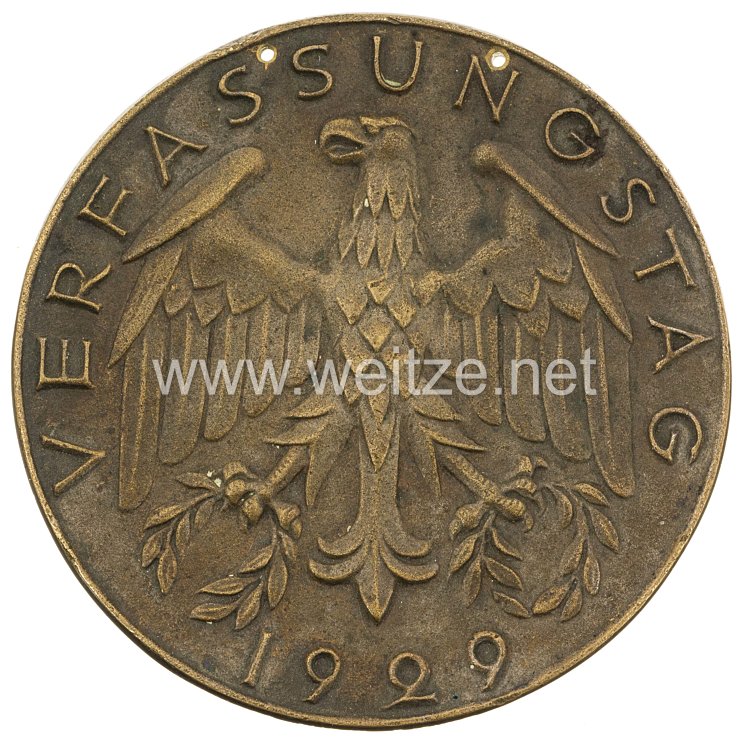
Reich President's Honor Prize 1929
The Honorary Prize of the Reich President from 1929 represents a significant testimony to German sports history during the Weimar Republic. This award was presented within the framework of official competitions and events held under the patronage of Reich President Paul von Hindenburg.
The Weimar Republic (1919-1933) utilized sporting events and honors as means to promote national cohesion and strengthen democratic consciousness. The Reich President, as head of state, awarded such honorary prizes to recognize outstanding achievements in various areas of sport, marksmanship, or other competitions. The year 1929 marks a time of relative stabilization of the Weimar Republic after the turbulent early years.
The present object with a diameter of approximately 70 mm corresponds to the typical dimensions for medals and badges of honor from this era. The two small drill holes indicate that this honorary prize was originally attached to a chain, ribbon, or other carrier, as was customary for awards of this period. Such attachment options allowed the award to be worn at official occasions or displayed as part of a trophy collection.
Honorary prizes of the Reich President were awarded in various categories. They were particularly widespread in the field of shooting sports, where numerous shooting clubs and associations competed for these prestigious awards. Such prizes were also announced in equestrian sports, athletics, and other sporting disciplines. The awards were usually made within the framework of Reich competitions or significant regional events that enjoyed national attention.
Paul von Hindenburg, who served as Reich President from 1925 to 1934, was a widely respected figure as a former Field Marshal and hero of World War I. His patronage gave such awards special weight and national significance. The honorary prizes typically bore his portrait, his monogram, or other symbols of the Reich Presidency, as well as corresponding inscriptions with the year and occasion of the award.
The craftsmanship of such honorary prizes was carried out by specialized minting facilities and medallists. German medal artistry had reached a high standard in the early 20th century, and high-quality pieces were produced during the Weimar Republic as well. The materials ranged from bronze to silver-plated or gold-plated versions to precious metals, depending on the importance of the competition and the placement.
The historical context of 1929 is noteworthy: it was the last year before the Great Depression, which began in October 1929 with Black Thursday on the New York Stock Exchange. Germany was at this time in a phase of economic recovery supported by the Dawes Plan and later the Young Plan. Sports and cultural events experienced a golden age before the political and economic situation deteriorated dramatically.
Such honorary prizes document not only sporting achievements but also the state promotion of associational life and the importance that sport held for Weimar Republic society. They reflect efforts to create a sense of community through shared activities and competitions that would bridge the deep political and social divides of the time.
From a collector's perspective, honorary prizes of the Reich President are today sought-after objects of contemporary history. They combine sports-historical with general historical aspects and are testimonies of an era that lay between the catastrophes of two world wars. The authenticity of such pieces can be assessed based on the quality of minting, the materials used, stylistic features, and historical documentation.
Research into such objects contributes to understanding everyday culture and state representation in the Weimar Republic and shows how sport and state authority were intertwined.